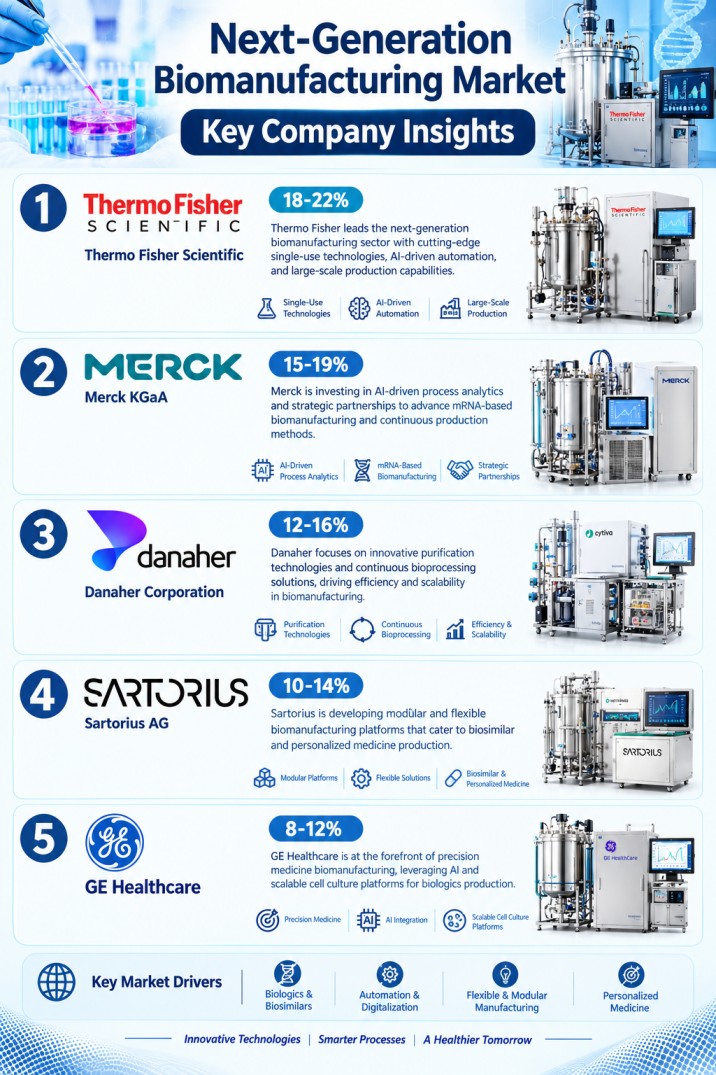
NEWARK, DE, USA – The global next-generation biomanufacturing market is projected to expand from USD 22.98 billion in 2025 to USD 44.37 billion by 2035, registering a compound annual growth rate (CAGR) of 6.8% during the forecast period, according to Future Market Insights (FMI). Advancements in bioprocessing technologies, wider adoption of single-use systems, and rising demand for biologics and cell-based therapies are supporting the market’s expansion.
Biopharmaceutical manufacturers are increasingly evaluating advanced production methods to improve manufacturing efficiency, scalability, and process flexibility. Automation, continuous bioprocessing, and modular production systems are changing how biologics are developed and manufactured. These technologies are particularly relevant as demand increases for monoclonal antibodies, vaccines, recombinant proteins, and other complex biologic products.
FMI estimates that upstream biomanufacturing workflows will account for 46.8% of the workflow segment in 2025, while monoclonal antibodies will represent 54.2% of application demand. These segments demonstrate the importance of cell culture and protein production capabilities in next-generation biomanufacturing.
Request For a Report Sample: https://www.futuremarketinsights.com/reports/sample/rep-gb-12108
Next-Generation Biomanufacturing Market: Key Takeaways
- Market size in 2025: USD 22.98 billion
- Forecast market value by 2035: USD 44.37 billion
- Market CAGR (2025–2035):8%
- Leading workflow segment: Upstream biomanufacturing, with a 46.8% share in 2025
- Leading application: Monoclonal antibodies, with a 54.2% share in 2025
- Fastest-growing profiled country: United States and South Korea, each with a projected 6.9% CAGR
- Key companies: Thermo Fisher Scientific, Merck KGaA, Danaher Corporation, Sartorius AG, Lonza Group, and Cytiva
Rising Biologics Demand Supports Market Expansion
The increasing use of biologic medicines is a major factor supporting the next-generation biomanufacturing market. Biologics are used across several therapeutic areas, including oncology, autoimmune disorders, infectious diseases, and rare conditions. Their complex manufacturing requirements are encouraging pharmaceutical companies to invest in advanced production technologies.
The expansion of monoclonal antibody therapies is particularly important. These products require controlled cell culture, purification, and quality management processes. Manufacturers are therefore adopting advanced bioreactors, process monitoring tools, and automated production systems to improve consistency and manufacturing efficiency.
Demand for vaccines, recombinant proteins, and cell-based therapies is also creating opportunities. As biopharmaceutical pipelines become more diverse, production facilities need flexible systems that can accommodate different products, batch sizes, and manufacturing requirements.
Upstream Biomanufacturing Leads Workflow Demand
By workflow type, upstream biomanufacturing is projected to account for 46.8% of the market in 2025. This stage includes activities associated with cell culture, fermentation, and the production of biological materials before downstream purification.
Upstream processes are essential to determining production yield, product quality, and overall manufacturing efficiency. Advances in cell-line development, automated bioreactors, and process optimization are helping manufacturers improve production performance.
Single-use upstream biomanufacturing is another important area of development. Disposable components and systems can reduce cleaning and sterilization requirements between production runs, offering operational flexibility for facilities handling multiple products. However, manufacturers must assess material compatibility, supply reliability, and validation requirements before adopting these systems at scale.
Downstream biomanufacturing remains equally important to the overall production process. Purification, filtration, and separation technologies help manufacturers achieve the required quality and purity of biologic products.
Monoclonal Antibodies Drive Application Demand
By application, monoclonal antibodies are expected to represent 54.2% of the market in 2025. Their broad use in oncology, immunology, and other therapeutic areas is creating sustained demand for specialized manufacturing capabilities.
Monoclonal antibody production requires carefully controlled processes to maintain product consistency and quality. Manufacturers are investing in advanced cell culture systems, purification technologies, and process analytics to support commercial-scale production.
Other applications include vaccines, recombinant proteins, hormones, and additional biologic products. Growing interest in personalized medicine, biosimilars, and advanced therapies is expected to create further opportunities for manufacturers offering adaptable production platforms.
Automation and Continuous Processing Create New Opportunities
Automation is becoming increasingly important as biopharmaceutical manufacturers seek to improve production consistency and reduce manual intervention. Digital monitoring tools, process analytical technologies, and data-driven optimization can help manufacturers monitor critical production parameters and identify deviations.
Continuous bioprocessing is another area of interest. Unlike traditional batch manufacturing, continuous approaches allow selected production stages to operate in an integrated and ongoing manner. These systems can support improved process control and more efficient facility utilization when appropriately designed and validated.
Single-use bioreactors and modular facilities are also attracting interest because they can offer flexibility in production capacity and facility configuration. These approaches may be particularly useful for contract manufacturers and companies developing multiple biologic products.
United States and South Korea Lead Country-Level Growth
FMI projects different growth rates across major markets between 2025 and 2035. The United States and South Korea are expected to record the highest growth among the countries profiled, each registering a projected CAGR of 6.9%.
- United States: Projected to grow at a CAGR of 6.9% from 2025 to 2035.
- South Korea: Projected to grow at a CAGR of 6.9% from 2025 to 2035.
- European Union: Projected to grow at a CAGR of 6.8% from 2025 to 2035.
- United Kingdom: Projected to grow at a CAGR of 6.7% from 2025 to 2035.
The United States benefits from an established biopharmaceutical research ecosystem, advanced manufacturing infrastructure, and investment in biologics production. South Korea’s biotechnology sector and government-supported innovation programs are contributing to demand for advanced production capabilities.
The European Union is projected to grow at 6.8%, supported by regulatory initiatives and investment in modern biomanufacturing practices. The United Kingdom is expected to register a 6.7% CAGR, with companies increasingly adopting sophisticated production technologies.
Across Asia-Pacific, China, India, Japan, and South Korea are investing in biopharmaceutical manufacturing capacity and research infrastructure. These developments are creating opportunities for suppliers of bioreactors, filtration systems, automation platforms, and other production technologies.
Competitive Landscape: Companies Focus on Advanced Bioprocessing Platforms
The next-generation biomanufacturing market includes equipment manufacturers, bioprocess technology suppliers, and contract manufacturing organizations. Competition is influenced by product performance, process integration, regulatory compliance, manufacturing capacity, and the ability to support different biologic production requirements.
Key companies profiled by FMI include:
- Thermo Fisher Scientific
- Merck KGaA
- Sartorius AG
- Danaher Corporation
- Meissner Filtration
- ESCO Group LLC
- Solaris Biotechnology
- Applikon Biotechnology
- GEA Group AG
- PBS Biotech Inc.
- bbi-biotech GmbH
Thermo Fisher Scientific, Merck KGaA, Danaher, and Sartorius are among the established suppliers of bioprocessing equipment, consumables, and integrated manufacturing technologies. Lonza Group, Cytiva, WuXi Biologics, Samsung Biologics, and FUJIFILM Biotechnologies are also important participants in the broader biomanufacturing ecosystem.
Companies are focusing on single-use technologies, process automation, filtration, chromatography, and modular manufacturing solutions. Suppliers that can provide integrated workflows and reliable technical support may be better positioned as biopharmaceutical manufacturers modernize their production facilities.
Access The Full Report: https://www.futuremarketinsights.com/reports/next-generation-biomanufacturing-market
Outlook: Flexible and Automated Manufacturing to Shape the Industry
The next-generation biomanufacturing market is expected to expand through 2035 as biologics demand, advanced therapies, and manufacturing modernization support investment in new production technologies.
However, high initial investment requirements, complex regulatory standards, and the need for specialized technical expertise may affect adoption. Manufacturers must also ensure process consistency, product quality, and reliable supply of critical components.
With the market projected to reach USD 44.37 billion by 2035, next-generation biomanufacturing is expected to play an increasingly important role in the global production of biologics and advanced therapies.
Frequently Asked Questions
- What is the projected size of the next-generation biomanufacturing market by 2035?
The global market is expected to reach USD 44.37 billion by 2035, increasing from USD 22.98 billion in 2025.
- What is the expected CAGR of the next-generation biomanufacturing market?
The market is projected to grow at a CAGR of 6.8% between 2025 and 2035.
- Which workflow segment leads the market?
Upstream biomanufacturing workflows are projected to account for 46.8% of the market in 2025.
- Which application holds the largest market share?
Monoclonal antibodies are expected to represent 54.2% of application demand in 2025.
- Which countries are expected to record the fastest growth?
The United States and South Korea are projected to record the highest growth among the profiled markets, each with a 6.9% CAGR between 2025 and 2035.
Related Reports:
- Endolymphatic Duct Shunts Market – https://www.futuremarketinsights.com/reports/endolymphatic-duct-shunts-market
- Magnetogenetic Deep-Brain Stimulators Market – https://www.futuremarketinsights.com/reports/magnetogenetic-deep-brain-stimulators-market
- Sonogenetic Neuromodulation Systems Market – https://www.futuremarketinsights.com/reports/sonogenetic-neuromodulation-systems-market
About Future Market Insights (FMI)
Future Market Insights (FMI) is a market intelligence and consulting organization providing research, analysis and strategic insights across industries. FMI supports business decision-makers with market forecasts, competitive assessments and industry perspectives to help evaluate emerging opportunities and changing market dynamics.
Media and Business Enquiries
Email: sales@futuremarketinsights.com
Phone: +1 347 918 3531
Website: https://www.futuremarketinsights.com/