

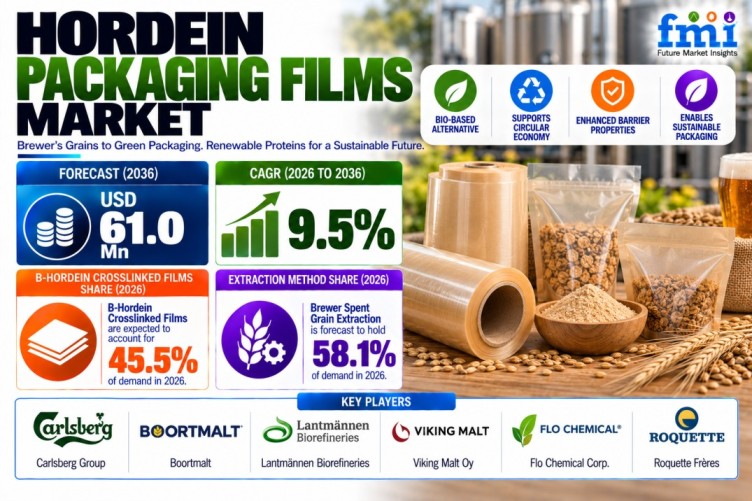
The global Hordein Packaging Films Market is projected to grow from US$24.6 million in 2026 to US$61.0 million by 2036, registering a compound annual growth rate (CAGR) of 9.5%, according to Future Market Insights (FMI). The market was valued at US$22.4 million in 2025. The forecast represents an increase of US$36.4 million in annual market value between 2026 and 2036.
Hordein is a family of barley storage proteins that can be processed into films and coatings. Interest in these materials is linked to their potential for oil-resistant food packaging, edible confectionery wraps, and single-dose seasoning sachets. Brewery and malting operations also provide potential feedstock through spent grain and barley-processing side streams, connecting packaging-material development with agricultural by-product utilization.
Hordein Packaging Films Market: Key Forecast Highlights
- Market size in 2026: US$24.6 million
- Forecast market size by 2036: US$61.0 million
- CAGR (2026–2036): 9.5%
- Market size in 2025: US$22.4 million
- Leading protein fraction grade: B-Hordein Crosslinked Films, projected at 45.5% in 2026
- Leading feedstock source: Brewer Spent Grain Extraction, estimated at 58.1% in 2026
- Leading packaging application: Edible Confectionery Wraps, projected at 38.6% in 2026
- Leading film format: Solvent-Cast Flexible Films, forecast at 49.2% in 2026
- Leading sales channel: Direct Brewery Biorefinery Offtake, anticipated at 51.5% in 2026
- Fastest-growing profiled country: China, with a projected 10.9% CAGR through 2036
>> Get Detailed Market Forecasts, Competitive Benchmarking, and Pricing Trends: https://www.futuremarketinsights.com/reports/sample/rep-gb-36087
What Is Driving the Hordein Packaging Films Market?
The market’s growth outlook reflects interest in alternative protein-based films and more productive uses of brewing and malting by-products. Brewer spent grain contains residual proteins that can be recovered and processed into higher-value ingredients. Integrating extraction operations with breweries and malting facilities may help reduce feedstock transportation requirements and support more consistent material sourcing.
FMI identifies food packaging applications including confectionery wraps, single-dose seasoning sachets, lipid-barrier meat casings, and fresh-produce coatings. These applications require different combinations of flexibility, moisture resistance, oil resistance, and processing compatibility.
Film performance is a major factor in commercial adoption. B-hordein contains sulfur-bearing amino acid residues that can form disulfide-linked protein networks during processing. Such crosslinking can improve film cohesion and resistance to water compared with some unmodified plant-protein films. Performance nevertheless depends on formulation, processing conditions, and the intended food application.
The report also identifies the potential to replace selected conventional coatings and films with barley-derived materials. However, commercial viability depends on extraction costs, film consistency, purification requirements, and food-safety considerations.
B-Hordein Films and Brewery By-Products Lead Key Segments
B-Hordein Crosslinked Films are projected to account for 45.5% of protein fraction grade demand in 2026. FMI attributes this position to the ability of sulfur-rich protein fractions to form crosslinked networks that support film strength and resistance to moisture.
Brewer Spent Grain Extraction is estimated to represent 58.1% of feedstock-source demand in 2026. This route uses a by-product generated by brewing operations, offering a potential pathway to recover value from existing industrial streams rather than relying exclusively on purpose-grown raw materials.
Solvent-Cast Flexible Films are forecast to capture 49.2% of film-format demand in 2026. The format supports the production of flexible films for applications such as small seasoning sachets. Direct Brewery Biorefinery Offtake is expected to account for 51.5% of sales-channel value, highlighting the role of direct commercial relationships between feedstock processors and packaging-material buyers.
Edible Confectionery Wraps are projected to lead packaging applications with a 38.6% share in 2026. Their adoption will depend on the ability to meet product-quality requirements, maintain consistent film properties, and comply with applicable ingredient and allergen-labeling rules.
Regional Opportunities: China Leads Growth Forecasts
FMI’s country outlook identifies several markets where brewing, malting, and food-packaging activity could support demand.
- China: Projected CAGR of 10.9% through 2036, supported by potential applications in instant-noodle seasoning and chili-oil sachets.
- Japan: 10.1%, with opportunities in instant-food packaging and specialty coatings.
- France: 9.9%, supported by malting and barley-processing infrastructure.
- Germany: 9.8%, with brewery by-product utilization and specialty food applications contributing to the outlook.
- United Kingdom: 9.4%, with potential uses in bakery and biscuit packaging.
For suppliers, these forecasts provide a starting point for prioritizing market development. Investment decisions should also consider local feedstock supply, extraction infrastructure, customer qualification requirements, and regulations governing food-contact materials.
Top Players in the Hordein Packaging Films Market
FMI identifies the following notable companies in the market:
- Anheuser-Busch InBev SA/NV (EverGrain)
- InVivo Group / Soufflet Malt
- Carlsberg Group
- Boortmalt (Axéréal Group)
- Lantmännen Biorefineries
- Viking Malt Oy
- Flo Chemical Corporation
- Roquette Frères
The competitive landscape spans brewing and malting companies with access to barley side streams, integrated agricultural processors, and specialty ingredient or coating businesses. The companies have different roles in the value chain; the list does not imply that each currently sells commercial hordein packaging films or holds a particular market-share ranking.
FMI highlights brewery and malting side-stream valorization as an important industry development. It also reports initiatives involving AB InBev’s EverGrain platform and InVivo/Soufflet Malt’s malting side-stream program. These developments illustrate the potential role of industrial partnerships in scaling up by-product processing and developing higher-value materials.
>> Access Detailed Market Insights: https://www.futuremarketinsights.com/reports/hordein-packaging-films-market
Strategic Priorities for Packaging Decision-Makers
Three priorities stand out for companies evaluating hordein-based films.
First, secure consistent feedstock. Partnerships with breweries and malting facilities can help establish reliable supplies of spent grain and other barley-processing by-products.
Second, validate technical and economic performance. Buyers should assess film strength, oil resistance, moisture sensitivity, purification requirements, and conversion costs against the performance of existing materials.
Third, address allergen requirements early. Because hordein is derived from barley, gluten-related labeling and food-safety requirements can restrict its use in certain products, particularly those marketed as gluten-free. Application selection and regulatory review are therefore essential before commercialization.
FMI’s analyst perspective emphasizes the potential cost advantage of recovering hordein from brewery by-products. The report states: “Upcycling water-insoluble B-hordein press-cake from brewery spent-grain protein plants cuts prolamin resin cost below USD 9.50 per kilogram, opening instant-noodle oil sachets and vegan confectionery glazes.” — Nandini Roy Choudhury, Principal Analyst at Future Market Insights.