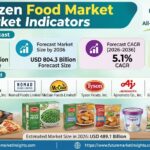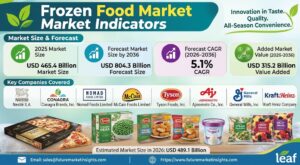


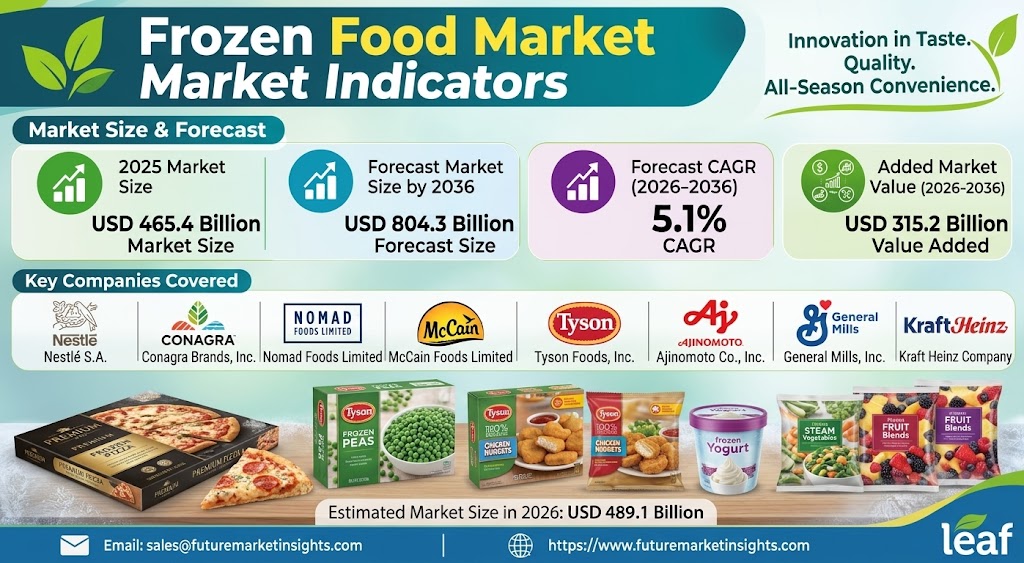
NEWARK, Del., November 3, 2026 — The global frozen food market is estimated to reach USD 489.1 billion in 2026, up from USD 465.4 billion in 2025. According to the latest market intelligence report published by Future Market Insights (FMI), the market is projected to reach USD 804.3 billion by 2036, expanding at a CAGR of 5.1% between 2026 and 2036. This represents an additional market value of USD 315.2 billion over the forecast period.
The outlook reflects growing demand for convenient meal solutions, ready-to-eat frozen products, frozen vegetables, meat and seafood, and air-fryer-friendly food formats. Changing household lifestyles, rising foodservice demand and improvements in individual quick freezing (IQF) technology are also supporting market expansion.
Get the latest market insights and forecasts: Request a Sample Report: https://www.futuremarketinsights.com/reports/sample/rep-gb-17944
Frozen Food Market Size & Growth Forecasts
- 2025 Market Size: USD 465.4 billion
- Estimated Market Size in 2026: USD 489.1 billion
- Projected Market Size by 2036: USD 804.3 billion
- CAGR, 2026 to 2036: 5.1%
- Added Market Value, 2026 to 2036: USD 315.2 billion
The short version
Frozen ready meals lead the market: Frozen ready meals are projected to account for 34.7% of the 2026 product category share, supported by growing demand for convenient pizzas, handheld entrees and prepared meals.
Mechanical IQF tunnels shape freezing technology: This segment is expected to account for 53.1% of the 2026 freezing technology category, reflecting the importance of efficient freezing systems in maintaining product quality and texture.
Retail remains the leading end-user channel: Retail household consumption is forecast to account for 58.4% of end-user demand in 2026, supported by household meal planning and convenient home cooking.
Supermarkets and hypermarkets dominate distribution: These channels are anticipated to account for 52.6% of distribution channel demand in 2026, supported by extensive freezer infrastructure and established grocery networks.
Growth Driver
Where Growth Is Strongest
Country-level forecasts highlight different growth opportunities across emerging and established markets. Brazil leads with a 6.2% CAGR, followed by Mexico at 5.9% and Canada at 4.8%. The USA is projected to grow at 4.7%, while Japan, Germany, the UK and France record CAGRs of 4.6%, 4.5%, 4.4% and 4.3%, respectively.
- Brazil – 6.2% CAGR: Expansion of cash-and-carry supermarkets, increasing household freezer adoption and domestic poultry and potato processing are supporting market growth.
- Mexico – 5.9% CAGR: Urban convenience retail expansion and cross-border IQF vegetable and prepared-meal manufacturing are creating new opportunities.
- Canada – 4.8% CAGR: Established frozen potato manufacturing, regenerative agriculture initiatives and household demand for convenient frozen products are supporting growth.
- USA – 4.7% CAGR: Demand for high-protein single-serve bowls, air-fryer-ready meals and quick-service restaurant products is driving expansion.
- Japan – 4.6% CAGR: Demand for single-portion gyoza, ramen and convenient bento components is supporting market development.
- Germany – 4.5% CAGR: Supermarket freezer modernization, private-label products and recyclable packaging adoption are shaping demand.
- UK – 4.4% CAGR: Online grocery delivery, frozen meal consumption and energy-efficient cold-chain operations are supporting growth.
- France – 4.3% CAGR: Specialist frozen food retailers, certified frozen seafood and frozen bakery products are creating opportunities.
Brazil records the highest projected CAGR among the countries covered. Mexico also offers strong expansion prospects, while Canada and the USA demonstrate steady growth opportunities. Across Europe, Germany is forecast to grow faster than the UK and France.
Who is moving: Market developments and key players
The competitive landscape is centred on product innovation, advanced freezing technologies, convenient meal formats, cold-chain efficiency and sustainable packaging.
Key market developments shaping the industry
- Convenience-led product innovation: Manufacturers are expanding frozen ready meals, pizzas, handheld entrees and single-serve meal bowls to address changing household consumption patterns.
- Advanced freezing technology: Individual quick freezing systems are gaining importance for maintaining moisture, texture and product quality across vegetables, poultry and seafood.
- High-protein product development: Food processors are introducing protein-rich frozen meals and portion-controlled products for consumers seeking convenient meal options.
- Cold-chain modernization: Automated freezing systems, temperature monitoring and energy-efficient cold-storage facilities are becoming important competitive priorities.
- Packaging innovation: Polyolefin film bags and improved flexible packaging solutions are supporting product protection, automated processing and distribution efficiency.
Key companies profiled in the report
- Nestlé S.A.
- Conagra Brands, Inc.
- Nomad Foods Limited
- McCain Foods Limited
- Tyson Foods, Inc.
- Ajinomoto Co., Inc.
- General Mills, Inc.
- Kraft Heinz Company
FMI’s competitive benchmarking assesses product category breadth, IQF and blast-freezing capabilities, retail and quick-service restaurant distribution reach, and geographic presence.
Strategic Recommendations for Industry Stakeholders
- Expand ready-meal portfolios: Develop frozen pizzas, prepared meals, handheld entrees and single-serve bowls to address demand for convenient meal solutions.
- Invest in advanced freezing technologies: Upgrade mechanical IQF tunnels and blast-freezing systems to improve product consistency, texture and processing efficiency.
- Target high-growth markets: Brazil and Mexico offer higher projected growth rates than established markets such as the USA, UK and France.
- Strengthen retail and foodservice distribution: Build partnerships with supermarkets, hypermarkets, quick-service restaurants and institutional foodservice operators.
- Improve cold-chain efficiency: Invest in temperature-controlled storage, automated monitoring and energy-efficient refrigeration systems.
- Develop sustainable packaging solutions: Explore recyclable flexible packaging and improved material structures to support evolving retail and sustainability requirements.
Explore the frozen food market outlook, country-level forecasts, segment analysis and competitive landscape: https://www.futuremarketinsights.com/reports/frozen-food-market
Where to be careful
- Cold-chain temperature fluctuations can compromise product quality, texture and food safety.
- High commercial refrigeration and cold-storage electricity costs can place pressure on manufacturer and distributor margins.
- Microbial contamination risks, including Bacillus cereus and other foodborne pathogens, require stringent hygiene and quality-control systems.
- Ice crystal formation and recrystallization during frozen storage can affect product texture and moisture retention.
- Packaging performance and moisture-barrier requirements remain important for maintaining frozen product quality throughout distribution.
- Regulatory compliance, temperature monitoring and traceability requirements can increase operational complexity.
Analyst perspective
” Grocery buyers and foodservice operators no longer treat the freezer aisle as a fallback pantry reserve. Processors that combine high-protein portion control with energy-efficient mechanical IQF lines and recyclable mono-material polyolefin films will secure primary retail shelf space through 2036.” — Nandini Roy Choudhury, Principal Consultant, Future Market Insights.
The commercial message is clear: frozen food manufacturers need to balance convenience, product innovation and operational efficiency. Investments in ready-meal development, advanced freezing technologies and reliable cold-chain infrastructure will be important areas of competition.
Related Food & Beverage Industry Reports
Vegan Protein Bars Market https://www.futuremarketinsights.com/reports/vegan-protein-bars-market
Plant-based Yogurt Market https://www.futuremarketinsights.com/reports/plant-based-yogurt-market
Nutraceutical Gummies Market https://www.futuremarketinsights.com/reports/nutraceutical-gummies-market
Probiotic Drink Market https://www.futuremarketinsights.com/reports/probiotic-drink-market
About Future Market Insights (FMI)
Future Market Insights (FMI) is the publisher of this market intelligence research. Its report provides market sizing, forecasts, country-level growth analysis, segment assessments and competitive benchmarking to support business planning and investment decisions.
Media Contact
For Press & Corporate Inquiries
Rahul Singh
AVP – Marketing and Growth Strategy
Future Market Insights, Inc.
Phone: +91 8600020075
For Sales: sales@futuremarketinsights.com
For Media: Rahul.singh@futuremarketinsights.com
Website: https://www.futuremarketinsights.com