

The global Book & Media Mailers Market is projected to grow from US$268.5 million in 2026 to US$443.6 million by 2036, registering a compound annual growth rate (CAGR) of 5.1%, according to Future Market Insights (FMI). The market was valued at US$255.2 million in 2025. The forecast represents an increase of US$175.1 million in annual market value between 2026 and 2036.
The shift from bulk book deliveries to individual e-commerce parcels is increasing demand for protective packaging designed for paperbacks, hardcovers, vinyl records, optical discs, and video games. Online booksellers and media distributors require mailers that protect corners and spines, fit parcel-size limits, and move efficiently through automated fulfillment operations.
Book & Media Mailers Market: Key Forecast Highlights
- Market size in 2026: US$268.5 million
- Forecast market size by 2036: US$443.6 million
- CAGR (2026–2036): 5.1%
- Market size in 2025: US$255.2 million
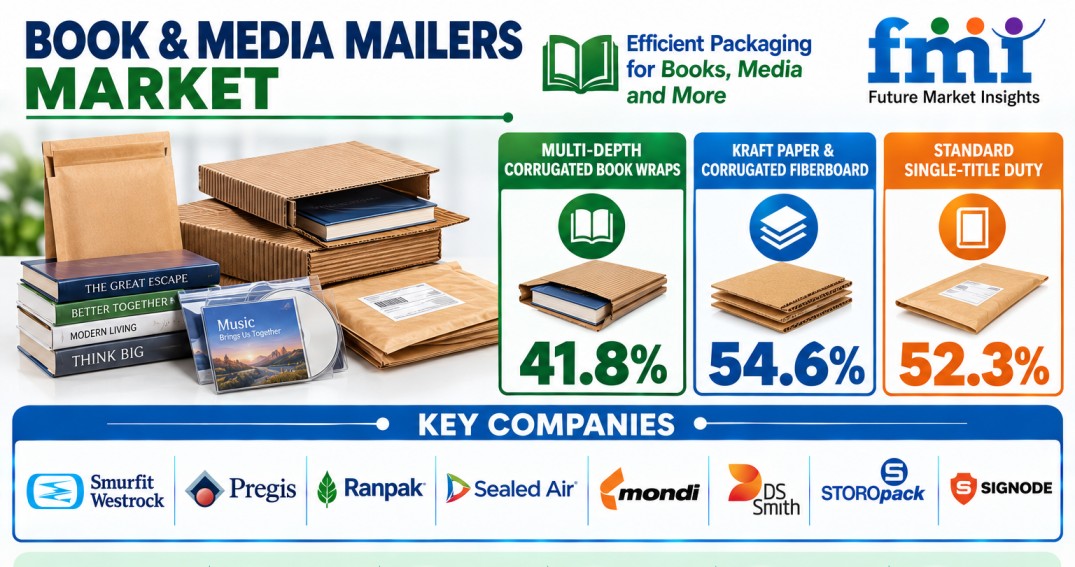
- Leading format: Multi-depth corrugated book wraps, with a projected 41.8% share in 2026
- Leading material: Kraft paper and corrugated fiberboard, with a projected 54.6% share in 2026
- Leading performance class: Standard single-title duty, projected at 52.3% in 2026
- Leading end-use segment: Online bookstores and direct-to-consumer marketplace fulfillment, projected at 48.7% in 2026
- Leading sales channel: Direct enterprise and fulfillment accounts, projected at 46.2% in 2026
>> Get Detailed Market Forecasts, Competitive Benchmarking, and Pricing Trends: https://www.futuremarketinsights.com/reports/sample/rep-gb-36000
What Is Driving the Book & Media Mailers Market?
Growth in online book and media sales is creating demand for packaging that protects products during sorting, handling, and last-mile delivery. Individual parcels can experience drops and compression that damage book corners, spines, and covers if the packaging lacks adequate structural support.
Automated fulfillment is another important growth driver. Warehouses are adopting pre-scored corrugated wraps and automated packaging equipment to reduce manual box assembly, taping, and void fill. Mailers that fold consistently, maintain their shape, and seal reliably can improve pack-station throughput and reduce packaging-related delays.
Postal pricing also influences packaging decisions. Right-sized mailers help shippers control parcel dimensions and avoid unnecessary packaging volume. For fulfillment managers, the challenge is to balance low shipping costs with adequate protection for heavier hardcovers, multi-volume editions, and collector media.
Corrugated Book Wraps and Fiber Materials Lead Key Segments
Multi-depth corrugated book wraps are projected to account for 41.8% of format-type demand in 2026. Their variable-depth scoring allows one mailer design to accommodate different book thicknesses while securing products without excessive void fill.
Kraft paper and corrugated fiberboard are expected to represent 54.6% of material demand in 2026. These materials provide structural protection and can support fiber-recovery systems where local collection and recycling infrastructure accepts the finished packaging. Recyclability still depends on coatings, adhesives, labels, and the capabilities of local paper mills.
Standard single-title duty mailers are projected to hold 52.3% of the performance-class segment in 2026, reflecting the importance of everyday single-book and single-disc orders. Online bookstores and direct-to-consumer marketplace fulfillment are forecast to account for 48.7% of end-use demand, while direct enterprise and fulfillment accounts are expected to represent 46.2% of sales-channel demand.
These trends favor suppliers that can provide standardized, machine-ready mailers while maintaining reliable protection across a range of product sizes.
Regional Opportunities: The United States Leads Growth Forecasts
FMI’s country-level forecasts identify the United States and South Korea as the fastest-growing profiled markets, with opportunities across Europe and the Middle East.
- United States: Projected CAGR of 5.8% through 2036, supported by automated parcel sorting and demand for protective book wraps.
- South Korea: 5.6%, driven by online book and physical-media fulfillment.
- United Kingdom: 5.3%, with parcel-size optimization and fiber-based packaging supporting demand.
- France: 5.0%, influenced by packaging requirements and letterbox-compatible delivery.
- Germany: 4.9%, supported by automated book fulfillment and paper-recycling considerations.
- Saudi Arabia: 4.6%, reflecting e-commerce expansion and textbook distribution.
- United Arab Emirates: 4.3%, with cross-border fulfillment and demand for moisture-resistant packaging.
- Japan: 3.9%, where compact mailbox dimensions favor low-profile protective wraps.
For manufacturers, these forecasts can guide market prioritization, distributor relationships, and capacity planning. Buyers should also assess local postal requirements, humidity exposure, recycling systems, and packaging-machine compatibility before qualifying new mailers.
Top Players in the Book & Media Mailers Market
FMI identifies the following notable companies in the market:
- Smurfit Westrock
- Pregis
- Ranpak
- Sealed Air
- Mondi plc
- DS Smith
- Storopack
- Signode
These companies participate in corrugated packaging, protective mailers, paper-based cushioning, and automated packaging systems. Their roles and product portfolios differ; the list is not a ranking by market share.
Competition increasingly depends on combining protective performance with efficient packing operations. Integrated paperboard converters can supply corrugated wraps and capacity envelopes, while protective-packaging specialists offer cushioned paper mailers and equipment designed to reduce manual handling. FMI also highlights automation investment, including Ranpak’s 2025 partnership with bookseller Thalia to install automated packaging lines and book-wrapping systems.
>> Access Detailed Market Insights: https://www.futuremarketinsights.com/reports/book-and-media-mailers-market
Strategic Priorities for Packaging Decision-Makers
Three priorities stand out for suppliers and fulfillment operators.
First, validate protection under real shipping conditions. Test corner-crush resistance, drop performance, closure integrity, and suitability for different book weights before switching mailer formats.
Second, design for automation. Consistent board thickness, accurate scoring, reliable adhesive performance, and resistance to curling can help prevent jams and maintain throughput on automated folding and sealing lines.
Third, evaluate the full packaging lifecycle. Fiber-based mailers can support recycling objectives where local infrastructure accepts them. Buyers should assess material composition, adhesives, protective performance, and end-of-life requirements together rather than relying on material labels alone.
Nandini Roy Choudhury, Principal Consultant at Future Market Insights, said: “Converting print and recorded-media shippers from mixed plastic-and-paper mailers to mono-material fiber wraps requires proven corner-crush survival at automated bagging and folding speeds. Suppliers that combine variable-depth scoring with verified curbside repulpability will secure multi-year fulfillment contracts.”