

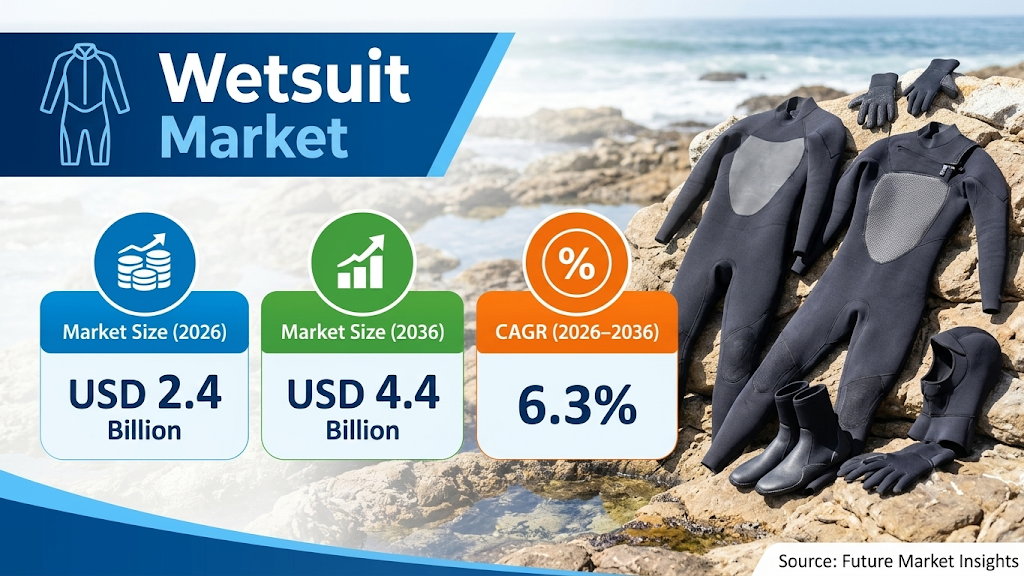
The global wetsuit market is estimated to reach USD 2.4 billion in 2026, up from USD 2.2 billion in 2025, and is projected to grow to USD 4.4 billion by 2036, expanding at a compound annual growth rate (CAGR) of 6.3% between 2026 and 2036, according to a new report by Future Market Insights (FMI).
The market is expected to generate an additional USD 2.0 billion in revenue during the forecast period, representing an expansion multiple of 1.8x. Increasing participation in surfing, paddling and other water sports, alongside the development of wave parks and growing interest in alternative rubber materials, is shaping demand.
Wetsuit Market Size and Growth Forecast
- 2025 Market Size: USD 2.2 billion
- 2026 Estimated Market Size: USD 2.4 billion
- 2036 Projected Market Value: USD 4.4 billion
- Forecast CAGR (2026–2036): 6.3%
- Incremental Revenue Opportunity: USD 2.0 billion
- Market Expansion Multiple: 1.8x
Get detailed market forecasts, competitive benchmarking, and pricing trends: https://www.futuremarketinsights.com/reports/sample/rep-gb-14119
Key Market Segments
Full Body Wetsuits Lead Product Demand
Full body wetsuits are projected to account for 55% of product sales in 2026, making them the leading product category. Their coverage and thermal protection make them suitable for surfing across different seasons and water temperatures.
Other product segments include:
- Shorty Wetsuits: 18.6% share.
- Specialty Wetsuits (Triathlon and Diving): 16.6% share.
- Two Piece Wetsuits: 9.8% share.
Water Sports Dominate Application Demand
Water sports are expected to represent 35% of application demand in 2026, supported by participation in surfing, bodyboarding, paddling and kiting.
- Diving Activities: 24.4% share.
- Swimming and Triathlon: 21.8% share.
- Recreational Activities: 18.8% share.
Individual consumers are anticipated to account for 60% of end-use demand, while commercial users are projected to hold 31.7%. Defense and rescue applications represent the remaining 8.3%.
3 mm to 5 mm Suits Lead Thickness Demand
Wetsuits measuring 3 mm to 5 mm are expected to capture 52.4% of the market in 2026. These suits provide thermal protection for surfing in cooler waters across Europe, North America and North Asia.
By material, neoprene-based wetsuits are projected to maintain an 83.6% share, while alternative materials, including natural rubber and hybrid foams, account for 16.4%.
Regional Market Outlook
South Korea is forecast to record the highest CAGR among the profiled countries, supported by growing participation in surfing and demand from first-time wetsuit buyers.
- South Korea: 6.6% CAGR (2026–2036).
- United States: 6.4% CAGR, supported by surf retail activity and board-sport participation.
- France: 6.2% CAGR, with repair programmes and premium wetsuit demand supporting the market.
- United Kingdom: 6.1% CAGR, supported by coastal surfing and inland wave parks.
- Japan: 6.0% CAGR, with replacement purchases contributing to demand.
The global wetsuit market is also covered across North America, Latin America, Western Europe, Eastern Europe, East Asia, South Asia and Pacific, and the Middle East and Africa.
Major Market Trends and Growth Drivers
Natural Rubber Foams Gain Attention
Changes in chloroprene rubber supply are encouraging wetsuit manufacturers to explore alternative foam materials. Denka suspended chloroprene rubber production at its Louisiana facility in May 2025 and announced a price increase of USD 200 or more per metric ton for Denka Chloroprene, effective May 15, 2026.
Manufacturers are increasingly introducing natural rubber blends in premium product lines while retaining conventional neoprene for more affordable suits. Rip Curl’s E-Bomb and Dawn Patrol ranges have incorporated Sheico’s Ocena foam, which contains 74% natural rubber.
Wave Parks Expand the Customer Base
Wave parks are creating additional opportunities by introducing beginners to surfing. The Wave, located near Bristol, serves over 120,000 surfers annually, with more than 30,000 beginners wearing Rip Curl wetsuits at the facility.
These venues allow first-time surfers to rent equipment before purchasing personally fitted wetsuits, creating additional demand for surf retailers.
Repair and Recycling Programmes Support Premium Sales
Repair services, trade-in programmes and alternative materials are becoming important differentiation strategies. Rip Curl operates repair services in Hossegor and offers discounts on new suits through its wetsuit collection programme. Patagonia also supports its wetsuits through the Ironclad Guarantee and free repairs.
These initiatives can encourage repeat purchases and strengthen customer relationships.
Competitive Landscape
The wetsuit market includes established surf brands, sporting goods retailers, outdoor companies and specialist manufacturers. Competition increasingly centres on product performance, thermal protection, natural rubber foam adoption, retail margins and repair services.
Key Companies Profiled Include:
- O’Neill
- Rip Curl
- Boardriders (Billabong and Quiksilver)
- Decathlon
- Patagonia
- Xcel Wetsuits
- C-Skins
- Alder
- Manera
- Vissla
- Finisterre
- Fourth Element
Rip Curl and Patagonia are among the brands combining premium product offerings with natural rubber materials and repair programmes. Decathlon serves the value-oriented segment, while specialist manufacturers compete through product design and technical performance.
Analyst Perspective
“I expect most surf shop buyers to pick a mid-range 4/3 full suit from a heritage brand over a basic entry suit, because last season’s premium suits on clearance now sell near entry prices. Natural rubber suits will draw European buyers once the price gap to neoprene narrows. Beginners at wave parks will choose the brand rented on the day.”
— Rahul Pandita, Principal Consultant, Future Market Insights
Explore More Related Studies Published by FMI Research:
About Future Market Insights (FMI)
Future Market Insights (FMI) is an ESOMAR-certified market research and consulting firm providing market intelligence, business insights and strategic analysis across industries. Headquartered in Delaware, the company serves clients through offices in the United Kingdom, the United Arab Emirates and India. Its research coverage includes food and beverage, healthcare, chemicals, technology, packaging, consumer goods and industrial sectors.
Media Contact:
Corporate Communications Team
Future Market Insights (FMI)
Email: sales@futuremarketinsights.com
Phone: +1-347-918-3531
Official Report Page: Wetsuit Market – Future Market Insights