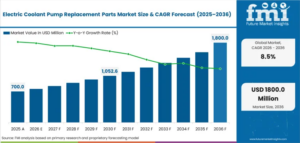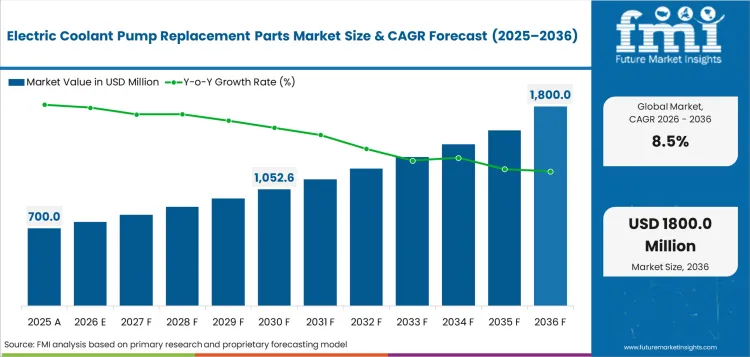
The development comes as electric and hybrid vehicles increasingly rely on dedicated coolant loops to manage batteries, power electronics, engines, and turbochargers. Future Market Insights (FMI) finds that the Electric Coolant Pump Replacement Parts Market was valued at USD 700.0 million in 2025 and is expected to reach USD 800.0 million in 2026. Demand is forecast to rise to USD 1,800.0 million by 2036, expanding at an 8.5% CAGR from 2026 to 2036.
Valeo highlighted smart coolant modules in September 2024 that support cabin heating, battery cooling, and power electronics cooling, with systems capable of integrating coolant heaters, multiway valves, and more than one pump. The development illustrates how thermal management architectures are becoming more interconnected, creating a broader replacement requirement for electric coolant pumps as electrified vehicles accumulate mileage.
Get detailed market forecasts, competitive benchmarking, and pricing trends:
https://www.futuremarketinsights.com/reports/sample/rep-gb-33188
Why are direct-fit electric coolant pumps gaining commercial importance?
For repair workshops, electric coolant pump replacement is becoming a fitment accuracy decision rather than a simple component swap. Modern thermal systems can use multiple pumps operating across separate coolant circuits, meaning the replacement part must match the vehicle’s voltage, connector, housing configuration, and intended thermal loop.
“Electric coolant pump replacement has become a fitment accuracy decision for workshops. Repair channels need pumps with the right connector and housing design for each thermal loop. Suppliers with OE cross-reference depth and lower return rates will hold stronger positions as electrified vehicles age.”
-Nikhil Kaitwade, Principal Consultant, Future Market Insights
The complexity is increasing as manufacturers integrate battery cooling and power electronics into coordinated thermal architectures. A mismatched pump can restrict coolant flow, create electrical connection issues, or result in repeat workshop visits. For independent repair channels, direct-fit replacement pumps with clear OE cross-reference data can therefore provide an advantage over generic alternatives.
Aftermarket availability is also becoming more organized. In May 2025, HELLA Aftermarket returned to thermal management with around 1,200 spare parts and announced plans to expand the range to 6,000 parts by 2027. The company identified coolant control hubs and medium pumps among products planned for later independent aftermarket introduction.
Which vehicle and pump formats are shaping demand?
Passenger cars are expected to remain the largest vehicle category, accounting for 61.0% of vehicle type demand in 2026. The broad passenger vehicle parc creates a substantial replacement pool as hybrid and electric vehicles move beyond their initial warranty periods.
Composite housing units are forecast to account for 58.0% of material demand in 2026. Molded composite housings can support weight reduction while allowing manufacturers to position electrical connectors and fluid interfaces within compact thermal-management layouts.
The 12V category is also expected to remain important, holding a projected 57.0% share in 2026. Low-voltage electric pumps are widely suited to auxiliary thermal circuits, including applications where the vehicle uses separate pumps for engine after-run cooling, battery conditioning, or other secondary coolant loops.
Auxiliary cooling pumps are forecast to represent 46.0% of pump-function demand in 2026. These pumps serve thermal circuits beyond the primary mechanical water-pump function and are increasingly relevant in hybrid and electrified vehicle architectures.
Market Snapshot
• Market value, 2025: USD 700.0 million
• Market value, 2026: USD 800.0 million
• Forecast market value, 2036: USD 1,800.0 million
• Global CAGR, 2026-2036: 8.5%
• Incremental opportunity, 2026-2036: USD 1,000.0 million
• Leading vehicle type: Passenger cars, with a 61.0% share in 2026
• Leading material: Composite housing, with a 58.0% share in 2026
• Leading pump voltage: 12V pumps, with a 57.0% share in 2026
• Leading replacement channel: Independent aftermarket, with a 52.0% share in 2026
• Leading pump function: Auxiliary cooling, with a 46.0% share in 2026
• Fastest-growing profiled country: China, at a 9.8% CAGR through 2036
What is driving near-term demand?
Electric and hybrid vehicle growth is expanding the future replacement pool for coolant pumps. The International Energy Agency reported that electric car sales reached 21.0 million units in 2025. As these vehicles accumulate mileage, more battery and power-electronics cooling components will enter regular service and replacement cycles.
The replacement opportunity is not limited to battery cooling. Hybrid vehicles can require auxiliary coolant pumps to maintain thermal control after engine shutdown, while turbocharged applications can use electric pumps for continued coolant circulation. As thermal circuits multiply, workshops need replacement parts that correspond precisely to each application.
Service quality is becoming another important factor. In January 2025, BMW placed certain 2012 to 2018 vehicles under coolant pump connector inspection. In April 2025, Isuzu reported eight propulsion-loss cases associated with coolant-derived deposits that seized EV cooling pumps. These developments highlight the importance of electrical connector condition, coolant cleanliness, and pump-specific service procedures during replacement.
Pump suppliers therefore have an opportunity to differentiate through complete service-ready solutions. Pump kits that include appropriate connector components, fitment information, and approved coolant guidance can help workshops reduce repeat repairs and installation errors.
Why is the aftermarket becoming more important?
Independent repair channels are expected to account for 52.0% of replacement demand in 2026. As the installed base of electrified vehicles ages, vehicle owners are increasingly likely to encounter thermal-system repairs outside the original dealership network.
This creates a requirement for aftermarket suppliers to provide broader catalog coverage and accurate vehicle application data. A pump that physically fits but uses the wrong connector, voltage, flow specification, or housing interface can create additional diagnostic and labor costs.
HELLA Aftermarket’s expansion into thermal management illustrates how suppliers are responding to this opportunity. The planned expansion from around 1,200 spare parts in 2025 toward 6,000 parts by 2027 indicates that thermal-management aftermarket coverage is becoming a larger product category.
For distributors, repair workshops, and fleet service operators, catalog depth can become a competitive differentiator as the number of electrified vehicle configurations increases.
How are China and India shaping the replacement opportunity?
China is expected to expand at a 9.8% CAGR through 2036, while India is projected to grow at a 9.5% CAGR. Both markets are developing larger electric and hybrid vehicle populations, creating future demand for thermal-system replacement parts.
China’s large electric vehicle manufacturing and installed base support opportunities for replacement pump suppliers with extensive application coverage. India’s expanding electrified vehicle market provides another growth avenue as more vehicles enter the service population.
The United States remains commercially important because of its established independent repair network and growing hybrid vehicle penetration. Suppliers that combine OE fitment data with thermal durability testing can strengthen their position across high-volume service channels.