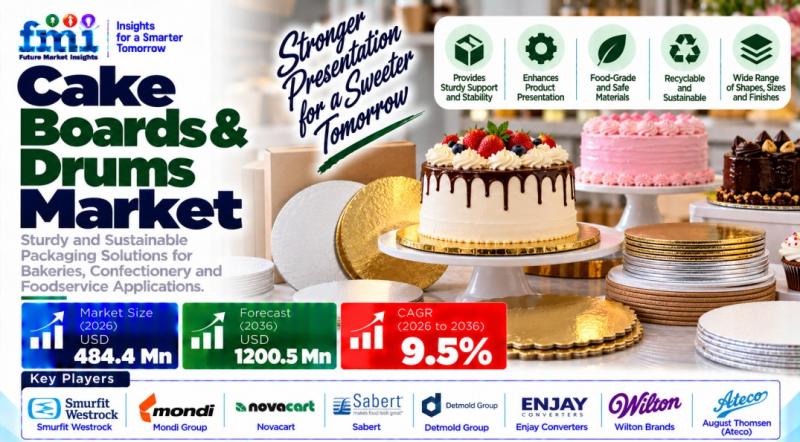
The global Cake Boards & Drums Market is projected to increase from US$484.4 million in 2026 to US$1.20 billion by 2036, registering a compound annual growth rate (CAGR) of 9.5% over the forecast period, according to Future Market Insights (FMI). The market was valued at US$442.4 million in 2025. The forecast represents an increase of US$716.1 million in market value between 2026 and 2036.
Cake boards and drums provide structural support for decorated cakes, tiered wedding cakes, pastries, and other bakery products. As bakeries expand online ordering, delivery, and customized cake offerings, buyers increasingly require bases that resist bending, grease penetration, and moisture-related warping while maintaining presentation quality.
Cake Boards & Drums Market: Key Forecast Highlights
- Market size in 2026: US$484.4 million
- Forecast market size by 2036: US$1,200.5 million
- CAGR (2026–2036): 9.5%
- Market size in 2025: US$442.4 million
- Leading product type: Standard laminated cake boards (3 mm to 4 mm), with a projected 44.2% share in 2026
- Leading material: Corrugated and solid paperboard, with a projected 54.6% share in 2026
- Leading bakery application: Celebration and specialty cakes, with an estimated 48.5% share in 2026
- Fastest-growing profiled country: Saudi Arabia, with a projected 11.4% CAGR through 2036
>> Get Detailed Market Forecasts, Competitive Benchmarking, and Pricing Trends: https://www.futuremarketinsights.com/reports/sample/rep-gb-35993
What Is Driving the Cake Boards & Drums Market?
Growth in celebration cakes, customized bakery products, hotel catering, and online cake delivery is increasing demand for reliable cake-support products. A warped or unstable base can damage icing, shift cake layers, and compromise presentation during transport. This makes board stiffness, dimensional accuracy, and moisture resistance important purchasing criteria for commercial bakeries.
Industrial bakeries and centralized commissaries also require standardized boards that work with automated production and packing lines. Consistent thickness and precise die-cutting can reduce misfeeds, improve handling, and support efficient palletized procurement.
Food-contact compliance and recyclability are additional market drivers. FMI highlights growing interest in grease-resistant paperboard and aqueous dispersion coatings as converters seek alternatives to certain plastic-film laminations and fluorochemical-based barriers. Manufacturers must balance grease resistance and structural performance with food-contact safety, recyclability, and cost.
Standard Boards and Paperboard Lead Key Segments
Standard laminated cake boards measuring 3 mm to 4 mm are projected to account for 44.2% of product-type demand in 2026. Their position reflects demand for everyday single-tier cakes supplied through supermarket bakery counters and commercial cake-production facilities.
Corrugated and solid paperboard are expected to hold 54.6% of the material segment in 2026. These substrates offer structural support while providing a fiber-based option for bakery packaging. Celebration and specialty cakes are forecast to represent 48.5% of bakery-application demand, reflecting the need for individual load-bearing bases beneath decorated products.
By function, primary cake base and decorating support is projected to account for 51.4% of demand in 2026. Industrial and commissary bakeries are expected to represent 41.6% of end-use demand, supported by bulk purchasing and standardized production requirements.
Regional Opportunities: Saudi Arabia Leads Growth Forecasts
FMI’s country outlook identifies strong projected growth across the Middle East, East Asia, and established Western markets.
- Saudi Arabia: 11.4% CAGR, supported by hotel, hospitality, banquet, and premium patisserie expansion.
- United Arab Emirates: 10.8%, reflecting new food establishments and demand for bakery delivery.
- South Korea: 10.1%, supported by specialty cafés and premium cake consumption.
- United States: 9.7%, with supermarket bakery operations and food-contact material changes shaping demand.
- United Kingdom: 9.2%, where recyclability assessments and custom cake requirements influence substrate selection.
- Germany: 8.8%, supported by industrial bakery automation and packaging compliance priorities.
- France: 8.4%, reflecting established patisserie networks and specialty dessert demand.
- Japan: 7.9%, where food-contact compliance and premium bakery presentation are important considerations.
For manufacturers, these forecasts can help guide distributor development, capacity planning, and customer acquisition. Investment decisions should also consider local competition, logistics, regulatory requirements, and the product specifications preferred by bakery customers.
Top Players in the Cake Boards & Drums Market
FMI identifies the following notable companies in the market:
- Smurfit Westrock
- Mondi Group
- Novacart
- Sabert
- Detmold Group
- Enjay Converters
- Wilton Brands
- August Thomsen (Ateco)
Competition spans specialist cake-board and decorating suppliers, paperboard converters, and broader foodservice packaging manufacturers. These companies serve different parts of the supply chain, from laminated cake circles and heavy-duty drums to fiber-based packaging and bakery presentation products. The report does not establish a ranked market-share order for the companies listed.
FMI also highlights developments relevant to the competitive landscape, including Mondi Group’s acquisition of Schumacher Packaging’s Western European corrugated and solid-board converting operations in April 2025, expanding its packaging footprint. Such developments underscore the importance of production capacity, regional supply, and the ability to serve large commercial customers.
>> Access Detailed Market Insights: https://www.futuremarketinsights.com/reports/cake-boards-and-drums-market
Strategic Priorities for Bakery Packaging Decision-Makers
Three actions can help suppliers and buyers respond to the market outlook.
First, qualify boards for real delivery conditions. Evaluate load-bearing strength, edge stability, grease resistance, and performance under chilled or humid conditions to minimize damage to finished cakes.
Second, assess recyclable barrier technologies. Aqueous dispersion coatings and fiber-based substrates may offer alternatives to some composite laminations, but manufacturers should validate food-contact compliance and performance before changing established specifications.
Third, tailor products to customer segments. Industrial commissaries may prioritize consistent dimensions, automated handling, and pallet availability. Artisan patisseries, hotels, and wedding-cake specialists may place greater emphasis on presentation, heavier drums, and customized sizes.
Nandini Roy Choudhury, Principal Consultant at Future Market Insights, said: “Commercial bakery buyers evaluate cake boards and drums as structural load-bearing components rather than disposable outer wraps because a single warped base ruins a high-margin decorated cake. Converters that replace plastic-film laminations with recyclable dispersion-coated corrugated and compressed fiberboard will capture multi-year supermarket and patisserie supply contracts.”