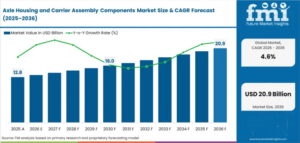


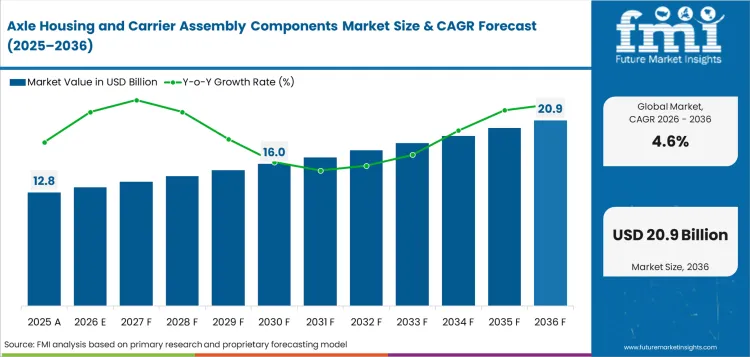
The development comes as axle suppliers move beyond basic cast component production toward more controlled structural driveline manufacturing. Future Market Insights (FMI) finds that the Axle Housing and Carrier Assembly Components Market stood at USD 12.8 billion in 2025 and is expected to reach USD 13.4 billion by the end of 2026. With demand projected to expand at a 4.6% CAGR from 2026 to 2036, the market is forecast to reach USD 20.9 billion by 2036.
Cummins announced a USD 55 million rear axle investment in October 2024 to add 50,000 units of annual production capacity in North America, including carrier assembly and carrier casting machining. The investment highlights a broader shift in commercial vehicle axle sourcing: manufacturers are placing greater emphasis on casting consistency, carrier machining depth, bearing alignment, and structural durability as axle loads and driveline requirements increase.
Get detailed market forecasts, competitive benchmarking, and pricing trends:
https://www.futuremarketinsights.com/reports/sample/rep-gb-33187
Why are precision carrier assemblies gaining commercial importance?
For axle manufacturers, carrier machining is becoming more than a downstream production step: it directly affects bearing alignment, gear mesh, noise performance, and warranty exposure. The Cummins investment, which combines additional rear axle capacity with carrier assembly and carrier casting machining, points to the value of controlling casting and machining operations within a coordinated production system.
Higher axle loads are reinforcing this requirement. Light trucks and commercial vehicles increasingly operate with higher payload and towing specifications, placing greater structural demands on housings and carrier cases. Suppliers able to maintain dimensional accuracy while controlling casting yield and machining rejection can offer stronger value to OEM programs.
The market is also developing alongside changes in commercial vehicle drivetrain architecture. Electric axle programs are bringing motor, gear, and housing interfaces closer together, increasing the need for compact structural designs that maintain stiffness and dimensional stability.
What components and materials are shaping demand?
Differential housings are projected to remain the leading component type, accounting for 35.0% of component type demand in 2026. These structures provide the primary enclosure for differential gear sets and support the alignment and protection requirements of rear axle systems.
Ductile iron is expected to hold a 46.0% share of material demand in 2026. Its combination of strength, durability, and practical machining economics makes it suitable for housings exposed to road shock and driveline loads.
Light trucks are forecast to account for 38.0% of vehicle type demand in 2026. Rising towing requirements and payload ratings increase the importance of stronger housings and carrier structures across these platforms.
ICE axles continue to represent the main drivetrain demand base, with a projected 58.0% share in 2026. Commercial vehicles continue to depend on established mechanical axle layouts across long operating and service cycles, while hybrid and electric axle programs add new requirements for compact housing and carrier designs.
What does the analyst see as the key commercial issue?
“Axle housing and carrier assembly components now require precision beyond basic cast parts. OEM programs need bore accuracy with dependable foundry quality. Higher axle torque and material discipline raise pressure, while casting yield and machining depth reduce rework.”
Nikhil Kaitwade, Principal Consultant for the Automotive domain, Future Market Insights
Market Snapshot
• Market value, 2026: USD 13.4 billion
• Forecast market value, 2036: USD 20.9 billion
• Global CAGR, 2026-2036: 4.6%
• Incremental opportunity: USD 7.5 billion
• Leading component type: Differential housings, with a 35.0% share in 2026
• Leading material type: Ductile iron, with a 46.0% share in 2026
• Leading vehicle type: Light trucks, with a 38.0% share in 2026
• Leading drivetrain type: ICE axles, with a 58.0% share in 2026
• Leading sales channel: OEM fitment, with a 72.0% share in 2026
• Fastest-growing profiled country: China, at a 5.4% CAGR through 2036
What is driving near-term demand?
Commercial vehicle production remains a major demand foundation for axle housings and carrier assemblies. In March 2025, ACEA reported that North America recorded 4 million commercial vehicle sales in 2024, representing a 30% market share. World bus production reached 362,005 units in 2024, marking a 10.3% increase from 2023.
These production volumes support continuing requirements for axle components across OEM and service channels. High-mileage commercial vehicles also generate replacement demand as damaged covers, carrier assemblies, and other axle housing components are replaced during overhaul cycles.
Carrier quality is becoming increasingly important in the aftermarket as well. Dana extended the Spicer service carrier warranty in December 2024 to three years with unlimited mileage for service carriers purchased from June 1, 2024. The longer warranty period provides fleets and distributors with an additional reason to consider branded carrier assemblies where durability, fitment, and service support are important purchasing factors.
Electric axle development is creating another source of demand. ZF announced in April 2025 a nomination to supply several thousand AxTrax 2 electric axle units in India. The axle delivers 210 kW of continuous power, highlighting the move toward compact and integrated commercial vehicle electric drivetrains.
These platforms require housing and carrier interfaces capable of accommodating closely packaged motors and gear systems. As electric commercial vehicle production expands, suppliers with established casting and machining capabilities can adapt these processes to new axle architectures.
Material economics are also influencing purchasing decisions. FRED reported an iron and steel Producer Price Index of 353.916 in April 2026, compared with 323.978 in December 2025. Higher metal input costs increase the financial impact of casting scrap, rejection, and inefficient material utilization.
For suppliers, this makes casting yield and machining efficiency increasingly important. Buyers are likely to assess not only component pricing but also material utilization, rejection rates, machining capability, and manufacturing consistency when evaluating axle housing and carrier assembly suppliers.
Which regions are creating the strongest opportunities?
China is expected to expand at a 5.4% CAGR through 2036, while India is projected to grow at a 5.2% CAGR. Both markets benefit from established automotive manufacturing ecosystems and growing commercial vehicle production.
China’s substantial vehicle production base supports demand for locally sourced axle components, while India’s utility vehicle and commercial vehicle manufacturing activity is creating opportunities for housing and carrier suppliers.
Countries with large light truck and commercial vehicle assembly bases are particularly relevant because axle component demand follows both vehicle production and fleet utilization. Local casting and machining capacity can also help suppliers respond to OEM localization requirements and reduce supply-chain complexity.
What is changing axle component sourcing?
Axle housing and carrier assembly component procurement is increasingly being influenced by landed cost, material exposure, and manufacturing depth. In June 2025, the USA Department of Commerce stated that 25% tariffs on imported automobile parts had taken effect on May 3, 2025, with an offset process available for automobile manufacturers producing vehicles in the United States.
Steel and aluminum costs add another consideration. The White House stated in June 2025 that tariffs on steel increased from 25% to 50% effective June 4, 2025, with the same increase applying to aluminum and derivative articles.
For axle component buyers, these changes make it increasingly important to separate casting, machining, logistics, metal content, and duty costs when comparing supplier quotations. Suppliers with stronger domestic or localized production capabilities may gain an advantage where tariff exposure changes the total landed cost of imported components.