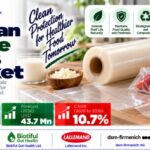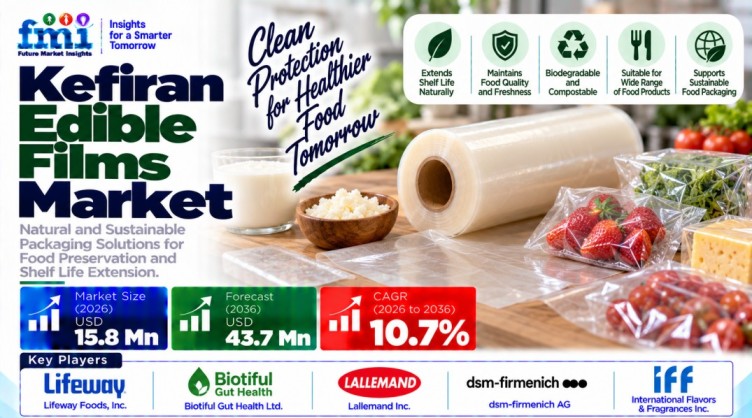
The global Kefiran Edible Films Market is projected to increase from US$15.8 million in 2026 to US$43.7 million by 2036, registering a compound annual growth rate (CAGR) of 10.7% over the forecast period, according to Future Market Insights (FMI). The market was valued at US$14.2 million in 2025. The forecast represents an increase of US$27.9 million in annual market value between 2026 and 2036.
Kefiran, a microbial exopolysaccharide associated with kefir fermentation, is attracting attention as a material for edible films and active food packaging. Dairy processors and packaging converters are evaluating its potential for cheese wraps, deli products, and selected nutraceutical applications where packaging performance, product quality, and shelf-life management are important.
Kefiran Edible Films Market: Key Forecast Highlights
- Market size in 2026: US$15.8 million
- Forecast market size by 2036: US$43.7 million
- CAGR (2026–2036): 10.7%
- Market size in 2025: US$14.2 million
- Leading fermentation culture: Lactobacillus kefiranofaciens pure-culture fermentation, projected to account for 62.5% of the segment in 2026
- Leading plasticizer and crosslinking system: Glycerol/sorbitol plasticized flexible films, estimated at 54.0% in 2026
- Leading functional packaging role: Probiotic-carrying active dairy and cheese wraps, projected at 49.2% in 2026
- Fastest-growing profiled country: Türkiye, with a projected 12.2% CAGR through 2036
>> Get Detailed Market Forecasts, Competitive Benchmarking, and Pricing Trends: https://www.futuremarketinsights.com/reports/sample/rep-gb-35992
What Is Driving the Kefiran Edible Films Market?
Demand for improved refrigerated food packaging is a key growth driver. Cheese and deli products can be vulnerable to surface spoilage during storage, creating opportunities for packaging materials designed to help maintain product quality and reduce waste. FMI identifies active dairy and cheese wraps as a leading application for kefiran edible films.
The material is also being explored for its potential to combine film-forming properties with active ingredients or probiotic cultures. Research cited in the FMI report includes a May 2026 soft-cheese storage trial in which probiotic dairy edible films carrying Lactobacillus acidophilus LA5 improved film elongation and maintained cell viability under refrigerated conditions. These findings support continued research into active packaging, although commercial performance must be validated for each formulation and application.
Interest in alternative packaging materials is another demand driver. Dairy processors and retailers are evaluating ways to reduce reliance on conventional plastic wraps that are difficult to recycle. Edible films may offer an alternative for selected cheese and deli products, provided they meet the necessary food safety, barrier, mechanical, and processing requirements.
Pure-Culture Fermentation and Flexible Films Lead Key Segments
FMI projects that Lactobacillus kefiranofaciens pure-culture fermentation will account for 62.5% of the microbial fermentation culture segment in 2026. The report attributes this position to more consistent fermentation and polysaccharide properties compared with traditional mixed kefir-grain systems.
Glycerol/sorbitol plasticized flexible films are estimated to represent 54.0% of the plasticizer and crosslinking system segment in 2026. Plasticizers help improve flexibility, which is important when films must withstand handling, converting, and wrapping operations.
Probiotic-carrying active dairy and cheese wraps are projected to account for 49.2% of functional packaging demand in 2026. Retail cheese and deli packs weighing 100–500 grams are expected to represent 54.6% of the packaged portion-weight segment.
Direct flexible packaging converter contracts are forecast to capture 76.4% of sales-channel revenue in 2026. This reflects the importance of technical collaboration between material suppliers and converters, particularly when film viscosity, web tension, coating conditions, and line performance must be qualified for production.
Regional Opportunities: Türkiye and Poland Lead Growth Forecasts
FMI’s country forecasts identify several markets with strong projected growth through 2036.
- Türkiye: 12.2% CAGR, supported by kefir-whey valorization and packaging applications for brined white cheese.
- Poland: 12.0% CAGR, with dairy by-product utilization and alternative deli-wrap materials among the growth factors.
- Brazil: 11.5% CAGR, reflecting opportunities in artisanal cheese preservation and edible coatings.
- United States: 10.4% CAGR, supported by commercial fermentation capabilities and specialty cheese packaging opportunities.
- Germany: 10.1% CAGR, with packaging compliance priorities and demand for industrially processable materials shaping the outlook.
These forecasts offer potential expansion priorities for producers and investors. However, companies should assess local feedstock availability, processing costs, food-contact requirements, customer qualification timelines, and access to packaging converters before committing to capacity expansion.
Top Players in the Kefiran Edible Films Market
FMI identifies the following notable companies in the market:
- Novonesis (Chr. Hansen Starter Platforms)
- International Flavors & Fragrances Inc. (Danisco Cultures)
- Lifeway Foods, Inc.
- Biotiful Gut Health Ltd.
- Lallemand Inc.
- dsm-firmenich AG
The competitive landscape spans microbial starter-culture suppliers, fermentation and biosolutions businesses, and kefir producers with experience in commercial dairy processing. These companies participate in related culture, fermentation, probiotic, or dairy supply categories. Their inclusion does not imply that every company currently sells a commercial kefiran edible-film product, nor does FMI present them as a ranked list by market share.
Commercial differentiation is likely to depend on reliable fermentation yields, consistent polymer properties, purification efficiency, and compatibility with converting equipment. For prospective suppliers, collaboration with dairy processors and packaging converters can help bridge the gap between laboratory formulations and commercial rollstock applications.
>> Access Detailed Market Insights: https://www.futuremarketinsights.com/reports/kefiran-edible-films-market
Strategic Priorities for Packaging and Ingredient Companies
Three priorities emerge from the market outlook.
First, improve fermentation consistency. Pure-culture processes and reproducible polymer characteristics can help address variations in viscosity and tensile performance that complicate continuous film production.
Second, validate packaging performance at production scale. Moisture absorption, film elasticity, heat sealing, optical clarity, and performance during chilled storage should be tested under actual operating conditions. FMI identifies moisture absorption above 75% relative humidity as a constraint for uncrosslinked films, particularly in humid supply chains.
Third, build converter partnerships early. Packaging suppliers should work with converters and dairy customers to assess line compatibility, product safety, shelf-life requirements, and cost per packaged unit before moving into full-scale production.
Nandini Roy Choudhury, Principal Consultant at Future Market Insights, states: “Commercial transition of kefiran edible films from laboratory solvent casting to continuous roll-to-roll web lines requires decoupling exopolysaccharide biosynthesis from slow artisanal kefir grain propagation. Culture suppliers that pair high-yield Lactobacillus kefiranofaciens fermentation with hydrophobic nanocellulose crosslinking will capture multi-year converter contracts across Europe and North America.”