

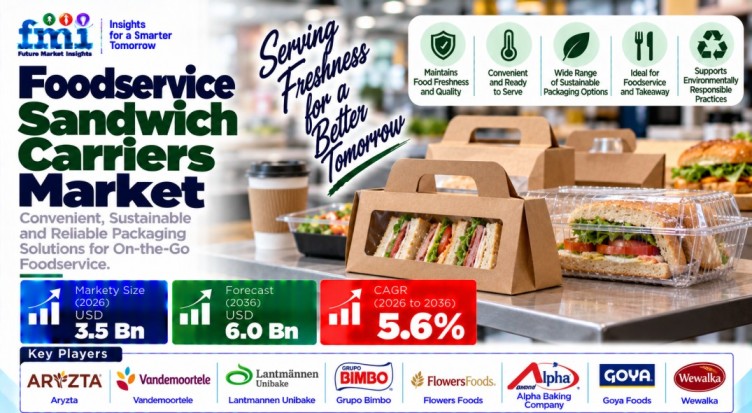
The global Foodservice Sandwich Carriers Market is projected to grow from US$3.5 billion in 2026 to US$6.0 billion by 2036, registering a compound annual growth rate (CAGR) of 5.6% over the forecast period, according to Future Market Insights (FMI). The market was valued at US$3.3 billion in 2025, and the forecast points to an additional US$2.5 billion in market value between 2026 and 2036.
Growth is supported by the continuing importance of takeaway meals, drive-thru service, third-party delivery, and centralized foodservice procurement. Restaurant chains and institutional kitchens increasingly require bakery products that deliver consistent dimensions, reliable preparation performance, and efficient inventory management across multiple locations.
Foodservice Sandwich Carriers Market: Key Forecast Highlights
- Market size in 2026: US$3.5 billion
- Forecast market size by 2036: US$6.0 billion
- Market CAGR (2026–2036): 5.6%
- Market size in 2025: US$3.3 billion
- Leading product type: Burger buns and sandwich rolls, with a projected 42.8% share in 2026
- Leading format: Par-baked and thaw-and-serve products, with a projected 38.6% share in 2026
- Fastest-growing profiled country: United Arab Emirates, with a projected 6.5% CAGR through 2036
These estimates cover wholesale commercial revenue from separately sold, unfilled edible sandwich carriers supplied to foodservice operators, preparation counters, and caterers. The scope includes burger buns, sandwich rolls, tortillas, flatbread wraps, sub rolls, sliced loaves, and other bakery products used to assemble sandwiches. It excludes finished pre-filled sandwiches and downstream restaurant meal receipts.
>> Get Detailed Market Forecasts, Competitive Benchmarking, and Pricing Trends: https://www.futuremarketinsights.com/reports/sample/rep-gb-35977
What Is Driving Growth in the Foodservice Sandwich Carriers Market?
The expansion of off-premises dining is increasing the need for reliable commercial bakery supply. Sandwiches prepared for takeaway and delivery must maintain their texture and structural integrity during handling and transit. This creates opportunities for suppliers offering consistent crumb structure, suitable bread formats, and products engineered for high-volume foodservice operations.
Operational efficiency is another important growth driver. Multi-location restaurant operators face pressure to manage labor costs, food waste, and preparation times. Pre-sliced buns, frozen bakery products, and par-baked formats can help standardize preparation while allowing kitchen teams to finish products according to demand.
Centralized procurement also supports market growth. Foodservice distributors and quick-service restaurant (QSR) contracts favor suppliers that can meet volume requirements, maintain product specifications, and coordinate deliveries across multiple outlets.
Burger Buns, Par-Baked Products, and Bulk Formats Lead Key Segments
FMI identifies burger buns and sandwich rolls as the leading product type, accounting for a projected 42.8% share in 2026. Standardized bun formats support repeatable assembly processes across burger and chicken sandwich menus, making them important for high-volume restaurant operations.
Within the claim and nature segment, conventional commercial products are forecast to account for 56.2% in 2026. Their projected position reflects the importance of cost control and consistent product performance in institutional kitchens and high-volume foodservice settings.
Par-baked and thaw-and-serve products are expected to represent 38.6% of the format segment in 2026. These products offer operators greater flexibility to prepare smaller batches and adjust output to fluctuating customer traffic, helping manage inventory and reduce avoidable waste.
Bulk foodservice cases and trays are projected to hold 51.4% of the packaging format segment in 2026. Bulk supply formats support efficient storage, handling, and replenishment at commercial kitchens. Meanwhile, foodservice distributors and QSR contracts are expected to account for 44.6% of the sales channel segment, reflecting the importance of contracted purchasing and coordinated distribution.
Regional Opportunities: UAE and Saudi Arabia Lead Growth Projections
FMI’s country forecasts identify the Middle East and selected established foodservice markets as important opportunities for suppliers.
- United Arab Emirates: Projected CAGR of 6.5% from 2026 to 2036, supported by hospitality activity, restaurant expansion, and foodservice demand.
- Saudi Arabia: Projected CAGR of 6.2%, reflecting opportunities associated with expanding QSR and hospitality channels.
- United States: Projected CAGR of 5.8%, supported by established drive-thru operations and large-scale commercial bakery procurement.
- South Korea: Projected CAGR of 5.5%, with demand shaped by mobile food delivery and takeaway consumption.
- United Kingdom: Projected CAGR of 5.2%, reflecting food-to-go and sandwich-counter demand.
- France: Projected CAGR of 4.9%.
- Japan: Projected CAGR of 4.6%.
- Germany: Projected CAGR of 4.2%.
For suppliers evaluating expansion, these forecasts offer a starting point for prioritizing regional distribution, customer acquisition, and production planning. Actual market-entry decisions should also consider local customer specifications, logistics costs, food safety requirements, and the competitive environment.
Top Players in the Foodservice Sandwich Carriers Market
According to FMI, notable companies profiled in the Foodservice Sandwich Carriers Market include:
- ARYZTA
- Vandemoortele
- Lantmännen Unibake
- Grupo Bimbo
- Flowers Foods
- Alpha Baking Company
- Goya Foods
- Wewalka
Competition spans multinational frozen bakery and par-baked specialists, commercial bun manufacturers, and suppliers of unfilled dough and bakery products. Companies compete through product portfolio breadth, consistent quality, foodservice distribution capabilities, and the ability to meet the operational requirements of restaurant chains and institutional buyers.
FMI also highlights recent industry developments, including ARYZTA’s January 2026 commitment to invest EUR 40 million in a dedicated bun bakery in Portugal. Such investment illustrates how bakery suppliers are positioning production capacity to serve foodservice demand.
>> Access Detailed Market Insights: https://www.futuremarketinsights.com/reports/foodservice-sandwich-carriers-market
Strategic Implications for Foodservice Suppliers and Buyers
The forecast suggests three priorities for decision-makers.
First, align product development with kitchen requirements. Consistent bun dimensions, reliable slicing, and suitability for high-throughput preparation can strengthen a supplier’s appeal to large restaurant accounts.
Second, improve demand and inventory planning. Frozen and par-baked offerings can help customers adjust production to changing footfall and reduce dependence on fixed daily fresh-bread volumes.
Third, evaluate regional opportunities selectively. The UAE and Saudi Arabia show the highest country-level growth rates in FMI’s forecast, while the United States offers a sizeable established foodservice market. Suppliers should weigh projected growth against route-to-market access, customer concentration, and local operating costs.
Commenting on purchasing priorities, Nandini Roy Choudhury, Principal Consultant at Future Market Insights, said: “Foodservice buyers judge a sandwich carrier by how well its crumb structure holds hot proteins and high-moisture sauces after twenty minutes in a delivery bag. Industrial bakers that combine tight slice-thickness tolerances with zero-shrink thaw-and-serve logistics win multi-year QSR supply contracts.”
MEDIA CONTACT
Contact Person: Media Relations Team
Designation: Corporate Communications
Email: sales@futuremarketinsights.com
Phone: +1-347-918-3531
Website: https://www.futuremarketinsights.com/
ABOUT FUTURE MARKET INSIGHTS
Future Market Insights, Inc. (FMI) is an ESOMAR-certified market research and consulting firm headquartered in Delaware, USA, with offices in the United Kingdom, the United Arab Emirates, and India. FMI delivers syndicated and custom research across food and beverage, healthcare, chemicals, technology, packaging, consumer goods, and industrial sectors. Its research helps organizations assess market opportunities, understand industry developments, and make informed strategic decisions.