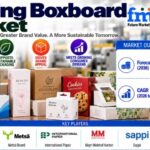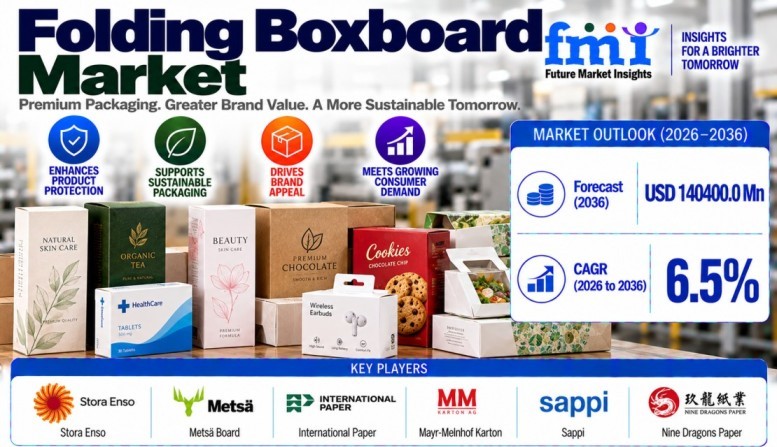
According to the latest market intelligence report published by Future Market Insights (FMI), the global folding boxboard market is projected to increase from USD 70.33 billion in 2025 to USD 74.90 billion in 2026 and reach USD 140.40 billion by 2036, registering a compound annual growth rate (CAGR) of 6.5% from 2026 to 2036. Demand for recyclable retail packaging, the transition away from plastic trays and multilayer laminates, and growing requirements for high-quality printed cartons are supporting market expansion.
Market Size & Growth Forecasts
- 2025 Baseline Value: USD 70.33 billion.
- 2026 Estimated Market Size: USD 74.90 billion.
- 2036 Projected Value: USD 140.40 billion.
- Growth Rate: 6.5% CAGR from 2026 to 2036.
- Incremental Growth Opportunity: USD 65.50 billion in additional revenue between 2026 and 2036.
FMI’s outlook reflects rising demand for paperboard packaging that combines structural strength, printability, and compatibility with recycling systems. Food, healthcare, personal care, and fast-moving consumer goods (FMCG) manufacturers are evaluating folding boxboard for cartons and other formats that need to protect products while maintaining shelf appeal.
>> Get detailed market forecasts, competitive benchmarking, and pricing trends: https://www.futuremarketinsights.com/reports/sample/rep-gb-5151
Key Market Segments
By Material and Structure
- Pulp-Based Materials: Expected to account for 70.0% of material demand in 2026, supported by high brightness, carton stiffness, print quality, and suitability for food-contact packaging.
- Single-Layer Structures: Projected to represent 30.0% of structure demand in 2026, serving cost-sensitive applications where straightforward converting and economical production are priorities.
- Multi-Layer Structures: Offer opportunities to combine stiffness, surface quality, and functional performance for demanding packaging applications.
By Application and End User
- Food and Beverages: Expected to account for 50.0% of application demand in 2026, supported by recurring carton volumes, takeaway packaging, and the shift from plastic to fiber-based formats.
- FMCG Manufacturers: Represent a leading end-user group, requiring consistent print quality, reliable carton converting, and dependable supply for branded retail products.
- Healthcare and Personal Care: Create demand for packaging that combines presentation, product protection, and appropriate material performance.
By Country and Region
- China: Forecast to grow at an 8.3% CAGR through 2036, supported by bleached board capacity and substitution of plastic packaging.
- Indonesia: Expected to register a 7.2% CAGR, with integrated fiber resources and regional export opportunities supporting growth.
- India: Projected to expand at a 7.1% CAGR, driven by branded FMCG products and organized retail.
- Brazil: Forecast to grow at a 6.5% CAGR, supported by integrated eucalyptus fiber production and export economics.
- United States: Expected to record a 6.0% CAGR, with domestic supply reliability and recovering packaging demand supporting the outlook.
Major Market Trends and Drivers
- Plastic-to-Paper Substitution: Retailers and consumer brands are evaluating fiber-based cartons as packaging rules and recyclability expectations influence material choices.
- Barrier-Coating Innovation: Grease- and moisture-resistant coatings are expanding folding boxboard applications, particularly in foodservice and food packaging. Suppliers must demonstrate that barrier performance does not prevent effective fiber recovery.
- Lightweighting and Production Efficiency: Mills are developing boards that maintain stiffness, print quality, scoring accuracy, and high-speed converting performance while reducing material use.
The European Union’s Packaging and Packaging Waste Regulation entered into force in February 2025 and began applying from August 2026. These requirements are increasing attention to packaging design, recyclability, and material efficiency. However, energy costs, fiber-price volatility, and investment in coating and drying equipment continue to pressure manufacturers, particularly smaller mills.
>> Access detailed market insights: https://www.futuremarketinsights.com/reports/folding-boxboard-market
Competitive Landscape
Competition is shaped by fiber access, coating technology, product consistency, and relationships with converters and brand owners. Integrated producers can benefit from more secure fiber sourcing, while specialist cartonboard suppliers compete through print quality, stiffness, barrier performance, and reliable delivery.
Recent developments include Stora Enso’s January 2026 introduction of Performa Lumi, a lightweight GC1 folding boxboard for premium packaging, and Metsä Board’s September 2025 presentation of its renewed Classic FBB with curtain coating for improved print results. Metsä Board also began installing upgrades for its Simpele board-machine modernization in August 2025.
Key Companies Profiled Include: Stora Enso, Metsä Board, International Paper, Mayr-Melnhof Karton, Sappi, Nine Dragons Paper, Klabin, ITC Limited, Oji Holdings, and Nippon Paper Industries.
Analyst Perspective / Insight
“Folding boxboard purchasing is shifting from simple grammage comparisons toward stiffness, coating performance, and recovery-system compatibility. Mills that combine fiber security with stable converting performance will protect premium contracts.”
— Nandini Roy Choudhury, Principal Consultant, Future Market Insights