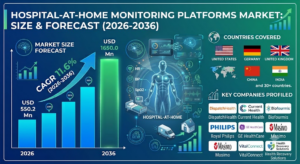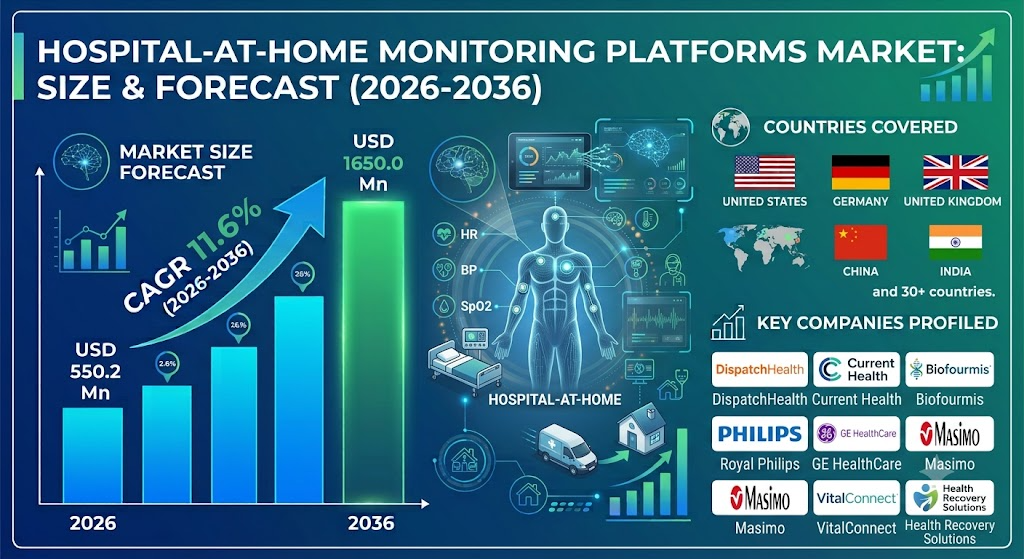
The global hospital-at-home monitoring platforms market is projected to grow from USD 550.2 million in 2026 to USD 1.65 billion by 2036, registering an 11.6% CAGR, according to Future Market Insights (FMI). The forecast reflects growing interest in delivering hospital-level care in patients’ homes while maintaining clinical oversight, documented interventions, and reliable escalation pathways.
The operating model requires more than remote collection of vital signs. Healthcare providers need systems that bring patient readings, clinical alerts, home-service scheduling, and intervention records into coordinated workflows. In March 2026, the Centers for Medicare & Medicaid Services released nearly five years of Acute Hospital Care at Home program data, providing health systems with a broader evidence base for evaluating patient selection, utilization, and clinical outcomes.
👉 Get Detailed Market Forecasts, Competitive Benchmarking, and Pricing Trends:
https://www.futuremarketinsights.com/reports/sample/rep-gb-34127
Where Growth Is Fastest
- India: The market is forecast to grow at a 7% CAGR through 2036. Established telemedicine use and expanding digital-health infrastructure provide a foundation for connecting remote observations with clinical review and home-care coordination.
- China: Demand is projected to increase at a 5% CAGR. FMI cites the expansion of home-based healthcare capacity and the need to coordinate patient data and clinical escalation across distributed care settings.
- United States: The market is expected to expand at a 3% CAGR. Experience with the federal Acute Hospital Care at Home program is supporting the development of operational workflows and platform evaluation criteria.
- Germany: Sales are forecast to rise at a 2% CAGR, supported by demand for validated remote monitoring, interoperable clinical records, and clearly documented clinical responsibility.
- United Kingdom: The market is projected to grow at an 0% CAGR. Virtual ward programs and NHS operational guidance are increasing attention to patient monitoring, service coordination, and escalation records.
- Japan: The market is expected to advance at a 9% CAGR, with ageing-care requirements supporting interest in dependable home observation and coordinated clinical response.
What Leads the Market
- Software: This product category is projected to account for 0% of market share in 2026. Centralized alert management, shared patient records, and coordinated home-care workflows support its leading position.
- Monitoring applications: Monitoring is forecast to represent 0% of application demand in 2026. Continuous observation and documented clinical interventions are central to maintaining oversight during acute home-care episodes.
- Hospital care settings: Hospitals are expected to account for 0% of care-setting demand in 2026. Hospital governance preserves responsibility for admission criteria, clinical decisions, and escalation even when care takes place at home.
- Payers: This end-user category is projected to hold 0% of demand in 2026. Payers assess utilization, readmission exposure, and documented intervention histories when evaluating the economics of hospital-at-home programs.
The Hurdle
Fragmented evidence requirements and incompatible interfaces remain key barriers. Platforms may require repeated integration and validation work before deployment across additional hospital networks. This can increase implementation costs and delay procurement decisions.
Clinical accountability is another consideration. Continuous monitoring provides limited value if alerts are poorly configured, clinicians cannot review them promptly, or responsibility for arranging an in-person response is unclear. Buyers therefore need to evaluate alert quality, system interoperability, cybersecurity documentation, and service coverage alongside platform functionality.
Industry Investment and Recent Developments
- January 2025: Biofourmis was selected by AdventHealth to support a new acute care-at-home program in Central Florida, combining continuous monitoring and remote clinical support with home-based care.
- June 2025: DispatchHealth completed its merger with Medically Home, bringing complex home-care delivery and clinical command-center capabilities together under DispatchHealth.
- March 2026: Health Recovery Solutions acquired Rimidi to expand remote-care programs, adding electronic health record integration and ambulatory disease-management capabilities.
FMI identifies DispatchHealth, Current Health, Biofourmis, Royal Philips, GE HealthCare, Masimo, VitalConnect, and Health Recovery Solutions as key participants.
The competitive field combines care-delivery platforms with monitoring technology suppliers. Companies compete on device integration, clinical workflow compatibility, command-center support, implementation expertise, and their ability to preserve clear responsibility for escalation across home-based episodes.
Analyst View
Anurag Sharma, Principal Analyst for Healthcare at Future Market Insights, said:
“Hospital-at-home monitoring platforms represent a structural change in how health systems allocate clinical attention and care responsibility. Platform value is gained from coordinating medication workflows and in-person response under one accountable care model. Executive evaluation must confirm that clinical judgment is protected across every handoff and that escalation preserves service continuity.
Suppliers proving dependable coordination among physicians and logistics partners are better placed for recurring enterprise adoption. Long-term leadership belongs to providers converting home-based acute care from isolated programs into repeatable clinical infrastructure influenced by measurable outcomes and disciplined governance.”
What This Means for Healthcare Providers and Technology Suppliers
- Prioritize integration before expanding deployments. Interoperable records and clearly assigned escalation responsibilities can reduce repeated implementation work and improve continuity between hospital and home.
- Measure operational performance, not just monitoring volume. Buyers should assess alert handling, clinician workload, intervention records, and the reliability of in-person response arrangements.
- Prepare for different national adoption conditions. India and China have the highest forecast growth rates in FMI’s country comparison, while Germany, the UK, and Japan offer distinct opportunities shaped by clinical governance and healthcare delivery structures.
Access Full report: https://www.futuremarketinsights.com/reports/hospital-at-home-monitoring-platforms-market
Report Scope
The Hospital-at-Home Monitoring Platforms Market report covers software, wearables, diagnostic kits, consumables, and device accessories. Care settings include hospitals, home care, ambulatory centers, retail clinics, and decentralized trial sites.
Application categories include monitoring, diagnosis, workflow automation, therapy support, and infection control. End users include hospitals, payers, diagnostic laboratories, medical technology firms, and patients. Geographic coverage spans North America, Latin America, Western Europe, Eastern Europe, East Asia, South Asia and the Pacific, and the Middle East and Africa. The forecast period runs from 2026 to 2036.
About Future Market Insights
Future Market Insights, Inc. (FMI) is an ESOMAR-certified market research and consulting firm headquartered in Delaware, USA, with offices in the United Kingdom, the United Arab Emirates and India. FMI delivers syndicated and custom research across food and beverage, healthcare, chemicals, technology, packaging, consumer goods and industrial sectors.
Media Contact
Future Market Insights, Inc.
Email: sales@futuremarketinsights.com
Phone: +1-347-918-3531