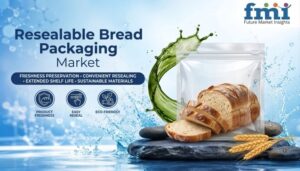
The global resealable bread packaging market is projected to increase from USD 672.8 million in 2026 to USD 1,777.1 million by 2036, registering a compound annual growth rate (CAGR) of 10.2%, according to Future Market Insights (FMI). The market is forecast to add USD 1,104.3 million over the period, as bakery brands evaluate packaging that supports repeated opening while preserving product freshness and maintaining production-line performance.
Packaging decisions are increasingly shaped by material documentation and the compatibility of bags, closures and barrier layers. In the European Union, Regulation (EU) 2025/40 on packaging and packaging waste, dated January 22, 2025, establishes packaging requirements that include recyclability criteria. For bread-packaging suppliers, the practical question is whether the complete package, including attached closures and other components, can meet the intended recovery requirements.
Get detailed market forecasts, competitive benchmarking, and pricing trends:
https://www.futuremarketinsights.com/reports/sample/rep-gb-35402
Where growth is fastest
FMI’s country forecasts show the strongest projected growth in the UAE and Saudi Arabia, followed by the USA and South Korea. The rates below cover 2026 to 2036.
- United Arab Emirates: 11.5% CAGR. The country’s single-use packaging framework includes exemptions for certain fresh-bread formats. The Emirates News Agency reported on December 16, 2025, that the second phase of the nationwide ban on specified single-use consumer plastic products and bags would begin in January 2026, with fresh-bread wraps among the stated exemptions.
- Saudi Arabia: 11.2% CAGR. The Saudi Food and Drug Authority reported on January 26, 2026, that the country had 624 licensed food factories and 5,344 licensed food warehouses during 2025. Packaging suppliers serving these operations need clear conformity documentation and closures suited to the requirements of their intended applications.
- USA: 10.9% CAGR. The Bureau of Labor Statistics reported approximately 272,700 jobs in bread and bakery product manufacturing in May 2026. For large bakery operations, repeatable bag feeding, closure performance and limited production disruption are relevant considerations when evaluating packaging changes.
- South Korea: 10.5% CAGR. The Ministry of Food and Drug Safety issued Notice No. 2026-24 on March 27, 2026, amending its Standards and Specifications for Utensils, Containers and Packages. The report identifies detailed material specifications and current technical documentation as important considerations for packaging qualification.
- Germany: 10.2% CAGR. The German Environment Agency and Central Agency Packaging Register reported on January 27, 2026, that approximately 5.5 million tonnes of dual-system packaging had been recycled during 2024. The report points to established recovery routes and the need to assess how attached closures and windows affect sorting and recycling.
- United Kingdom: 9.9% CAGR. Department for Environment, Food & Rural Affairs statistics published July 23, 2025, reported recycling rates of 51.0% for plastic packaging and 74.3% for paper and cardboard under the cited 2024 methodology. These differences make it important for suppliers to document the intended recovery route of the complete package.
These country growth rates are forecasts, not rankings of current market revenue or bakery production capacity. Local regulations, recovery systems and documentation requirements can influence the time and cost needed to qualify a packaging format.
What leads the market
FMI’s segment forecasts identify established formats and paper-based materials as important parts of the market. The following shares are projected for 2026:
- Standard formats: 42.0% of the product-type segment. Familiar bag dimensions can reduce conversion risk when bakeries use installed packaging equipment and established closure stations.
- Paper and board: 40.0% of the material segment. Printability and established fiber-recovery routes support the material category, although bread-specific moisture performance still requires testing.
- Bread and rolls: 37.0% of the bakery-application segment. Repeated opening makes closure usability and post-opening protection important parts of package evaluation.
- Primary packaging: 48.0% of the function segment. The primary pack combines the consumer-facing closure with the contact surface, label and moisture barrier, making component compatibility central to qualification.
- Industrial bakeries: 42.0% of the end-use segment. High-volume production allows operators to assess closure reliability, line interruptions, coding accuracy and changeover time over repeated runs.
The figures describe different segment categories and should not be added together.
The hurdle: maintaining freshness without disrupting production
The main restraint is the difficulty of balancing convenient reclosure with material compliance and consistent line performance. A closure can perform well during household use but still be unsuitable if it introduces feeding problems, slows a closing station or complicates recycling documentation.
Material changes also require more than a general recyclability claim. Paper structures need bread-specific moisture trials, while plastic formats need appropriate records for recycled content and tax treatment where relevant. Attached windows, coatings and closures can change the recovery route of the overall package.
FMI identifies an opportunity for suppliers that integrate the substrate and reclosure system during the initial design stage. Evaluating closure force, moisture control, printing, machine compatibility and recovery performance within one qualification programme can help bakery customers assess a proposed format before committing to routine production.
Recent developments
Three dated developments cited in the report illustrate how suppliers are addressing bakery packaging and adjacent food-packaging requirements:
- May 19, 2026: Sabert announced plans to showcase new packaging innovations at IDDBA 2026, targeting bakery and related food operators.
- February 10, 2026: Vegware introduced laminated kraft bloomer bags with NatureFlex windows for fresh rolls and pastries.
- May 29, 2025: ProAmpac announced bakery-focused packaging solutions for IDDBA 2025, including fiber formats for retail food operations.
These announcements concern individual companies’ products and activities; they do not establish market-wide adoption or prove that every format is suitable for every bakery line.
The companies profiled in FMI’s resealable bread packaging market report are Amcor, Mondi Group, Sealed Air, Smurfit Westrock, Novolex, Kwik Lok, ProAmpac, Sabert, Detmold Group and Vegware. Their offerings span flexible and fiber packaging, bakery closures, food protection and compostable packaging formats.
Analyst perspective
Nandini Roy Choudhury, Principal Consultant at Future Market Insights, said:
“Bakery buyers fund reclosure only after the package protects loaf quality without introducing an unstable machine step. Commercially durable formats document freshness and material recovery while maintaining repeatable line output in one qualification program.”
What this means for packaging manufacturers and industries
- Test the complete package on the intended production line. Evaluate bag feeding, closure consistency, printing, coding and changeover time alongside performance after repeated consumer opening. A material or closure that performs well in isolation may behave differently when integrated into a high-speed packaging system.
- Build compliance evidence into material selection. Maintain current specifications for the bag, closure, coatings, windows and recycled content. Confirm how the complete format is classified under the regulations relevant to each destination market before making claims about recyclability or tax treatment.
- Compare fiber and plastic alternatives through application-specific trials. For paper-based formats, test moisture protection and loaf softness over the expected consumption period. For plastic or mixed-material formats, check closure compatibility, documentation requirements and the intended recovery route. Use trial results to compare operating performance and total conversion requirements before scaling production.
About the report
Future Market Insights’ Resealable Bread Packaging Market report examines market revenue and growth forecasts from 2026 to 2036. Coverage includes product type, material, bakery application, function, end use, regions, country-level growth and key companies.
Report URL: https://www.futuremarketinsights.com/reports/resealable-bread-packaging-market
Related Reports Links:
https://www.openpr.com/news/4659286/luxury-rigid-box-market-to-reach-usd-15-84-billion-by-2036-china
https://www.openpr.com/news/4659292/fibre-film-market-to-reach-usd-955-4-million-by-2036-south-korea
https://www.openpr.com/news/4659331/packaging-testing-services-market-to-reach-usd-2-1-billion
FMI Custom Research: Strategic Intelligence for Confident Decision-Making
In today’s rapidly evolving business environment, leadership teams need more than market data—they need clear, actionable intelligence tailored to their strategic objectives. FMI’s Custom Research solutions are designed around the specific business questions organizations need answered, enabling executives to evaluate growth opportunities, validate investments, assess competitive dynamics, and reduce uncertainty before making critical decisions. By combining deep industry expertise, primary research, and proprietary market intelligence, FMI delivers insights that help organizations move from assumptions to evidence-based strategies with greater speed and confidence.
Business Impact
FMI helps organizations transform market complexity into strategic clarity, enabling leadership teams to identify growth opportunities faster, optimize resource allocation, strengthen competitive positioning, and make high-stakes business decisions with confidence.
To explore how FMI Custom Research can support your strategic priorities, please connect with our team at – sales@futuremarketinsights.com
About Future Market Insights (FMI)
Future Market Insights, Inc. (FMI) is an ESOMAR-certified, ISO 9001:2015 market research and consulting organization, trusted by Fortune 500 clients and global enterprises. With operations in the U.S., UK, India, and Dubai, FMI provides data-backed insights and strategic intelligence across 30+ industries and 1200 markets worldwide.
Contact Us:
Future Market Insights Inc.
Christiana Corporate, 200 Continental Drive,
Suite 401, Newark, Delaware – 19713, USA
T: +1-347-918-3531
For Sales Enquiries: sales@futuremarketinsights.com
Website: https://www.futuremarketinsights.com
LinkedIn| Twitter| Blogs | YouTube