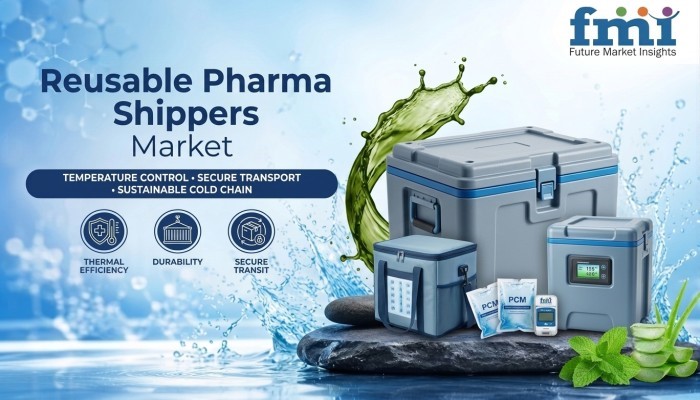
The global reusable pharma shippers market is projected to grow from USD 591.1 million in 2026 to USD 1,276.1 million by 2036, registering a compound annual growth rate (CAGR) of 8.0%, according to Future Market Insights (FMI). The market is expected to add USD 685.0 million over the forecast period. Growth depends not only on the ability of reusable containers to maintain required shipping conditions, but also on whether operators can recover, inspect and redeploy them efficiently across repeat pharmaceutical distribution routes.
The economics of reuse are increasingly tied to transport-network design. On April 29, 2026, the Saudi Food and Drug Authority (SFDA) and Saudia Cargo announced an initiative offering pharmaceutical shippers air-freight price reductions of up to 50%. The initiative also referenced cold-chain capabilities and temperature control for medicine shipments. Lower freight costs can improve the economics of recurring distribution lanes, although reusable assets still need reliable return arrangements to generate repeated use.
Get detailed market forecasts, competitive benchmarking, and pricing trends:
https://www.futuremarketinsights.com/reports/sample/rep-gb-35413
Where growth is fastest
FMI’s country forecasts show the strongest projected growth in the UAE, Saudi Arabia and South Korea. The following CAGRs cover 2026 to 2036, with the country-specific factors identified in the report.
- United Arab Emirates: 9.6% CAGR. The UAE’s position as an air-cargo hub supports demand for reusable shipping assets that can circulate between major gateways. In January 2026, the Ministry of Health and Prevention transferred medicine-related regulatory services, including good-practice compliance functions, to the Emirates Drug Establishment.
- Saudi Arabia: 9.3% CAGR. Pharmaceutical distribution across long routes and repeated air-cargo handoffs makes documented transport conditions and recovery planning important. The SFDA’s updated Good Storage and Distribution Practices guidance, published in 2025, addresses responsibilities for pharmaceutical storage and transport.
- South Korea: 9.0% CAGR. The country’s export-oriented biopharmaceutical sector places emphasis on documented storage performance and compliant transport procedures. The Ministry of Food and Drug Safety issued its 2025 basic plan for manufacturing and distribution management under the Biopharmaceutical and Herbal Medicine Bureau on January 2, 2025.
- United States: 8.7% CAGR. Extensive parcel and healthcare distribution networks can support recovery and redeployment when service locations and return procedures are coordinated. The Centers for Disease Control and Prevention updated its Vaccine Storage and Handling Toolkit on July 1, 2026, including guidance on cold-chain transport and temperature monitoring for immunization products.
- Germany: 8.4% CAGR. Documented transport conditions and repeat-route qualification are important in pharmaceutical distribution. In September 2025, the Federal Ministry of Health discussed proposed pharmacy reforms requiring suitable transport providers and documented conditions for cold-chain medicines shipped to patients.
- United Kingdom: 8.1% CAGR. Crown Commercial Service framework RM6354 started in February 2026. Its pharmaceutical lot includes refrigerated storage and temperature-controlled onward vehicles, making controlled handling a defined procurement consideration.
These figures are forecasts rather than current market-share rankings. The commercial case for reuse varies by route, shipment frequency, freight cost and the availability of recovery services.
What leads the market
FMI’s 2026 segment estimates show that parcel formats and standard-duty systems lead several key categories. The report identifies the following shares:
- Parcel shippers: 36.0% of the product-type segment. These systems suit frequent, smaller consignments where predictable return cycles can help keep assets in productive circulation.
- Paper-based systems: 35.0% of the material segment. Fiber components can reduce disposable protective content when used alongside qualified reusable thermal elements. Engineers still need to assess moisture resistance and repeated-handling performance.
- Standard-duty systems: 37.0% of the performance-class segment. These formats suit predictable routes where the required protection duration can be met without specifying heavier-duty equipment.
- E-commerce and parcel: 36.0% of the end-use segment. Frequent smaller orders can create opportunities for repeated use when recipient return instructions and collection arrangements are practical.
- Direct accounts: 41.0% of the sales-channel segment. Direct relationships can help coordinate qualification records, fleet availability and service requirements after the initial shipment.
The shares describe separate segment categories and should not be added together. Each reflects a different aspect of purchasing and system design.
The hurdle: getting the shipper back
The principal restraint is weak asset recovery. A reusable container can meet thermal requirements and still deliver poor economics if it remains at a destination for too long, is lost or must travel an expensive empty return leg.
That problem becomes more pronounced when shipments go to dispersed destinations with no dependable collection process. Inspection, conditioning and refurbishment also need to be planned between shipments so that a returned asset can re-enter service without compromising the documented qualification process.
FMI identifies managed return networks as an opportunity for suppliers. Collection, inspection and redeployment can be organized as part of a service agreement rather than left entirely to the pharmaceutical shipper or receiving site. The value depends on actual route density and return performance, not simply on the durability of the container.
Recent developments
Three dated company announcements cited in the report illustrate investment in reusable systems and the services that support them.
- September 1, 2026: CSafe announced the launch of its reusable Silverskin RE PMC thermal cover, with a refurbishment model for multi-pallet pharmaceutical air freight.
- March 12, 2026: Peli BioThermal announced a partnership with Polar Group to expand sales and leasing support for reusable cold-chain solutions in Brazil.
- October 22, 2025: ThermoSafe announced that Etihad Cargo had approved its Pegasus ULD for pharmaceutical uplift across the carrier’s international network.
These developments concern individual companies and do not, by themselves, establish market-wide adoption.
FMI profiles the following companies in the reusable pharma shippers market: Peli BioThermal, ThermoSafe, Cold Chain Technologies, CSafe, Envirotainer, SkyCell, va-Q-tec Thermal Solutions GmbH, Sofrigam, Intelsius and EMBALL’ISO. Their offerings span reusable parcel and pallet systems, air-cargo container networks, passive thermal packaging and associated return or refurbishment services.
Analyst perspective
Nandini Roy Choudhury, Principal Consultant at Future Market Insights, said:
“Reusable shippers earn their place when lane qualification and recovery planning are designed together before purchase. Pharmaceutical teams should compare thermal protection with realistic asset-turn frequency because a durable shipper only saves cost while it keeps circulating.”
What this means for packaging manufacturers and industries
- Evaluate reuse at the route level. Before committing to a reusable system, map shipment frequency, delivery locations, expected turnaround time and responsibility for collection. Model empty repositioning and refurbishment costs alongside the purchase or lease price.
- Keep thermal qualification and return operations connected. Document the required shipping conditions and the inspection steps an asset must complete before reuse. Align return procedures with the quality records needed for each shipment so that recovery does not become an undocumented step.
- Compare systems on total operating requirements. Assess parcel and pallet formats against actual payloads, transit duration, monitoring needs and available service coverage. Where destinations are difficult to recover from, compare a managed-return arrangement with alternatives rather than assuming reuse will always cost less.
About the report
Future Market Insights’ Reusable Pharma Shippers Market report examines the market from 2026 to 2036, covering product type, material, performance class, end use, sales channel, regional outlook, country-level growth and key companies.
Report URL: https://www.futuremarketinsights.com/reports/reusable-pharma-shippers-market
Related Reports Links:
https://www.openpr.com/news/4659199/corrugated-fiberboard-market-to-reach-usd-211-9-billion-by-2036
https://www.openpr.com/news/4659200/barrier-coatings-for-packaging-market-to-reach-usd-36-7-billion
https://www.openpr.com/news/4659201/foamed-polypropylene-films-market-to-reach-usd-18-61-billion
FMI Custom Research: Strategic Intelligence for Confident Decision-Making
In today’s rapidly evolving business environment, leadership teams need more than market data—they need clear, actionable intelligence tailored to their strategic objectives. FMI’s Custom Research solutions are designed around the specific business questions organizations need answered, enabling executives to evaluate growth opportunities, validate investments, assess competitive dynamics, and reduce uncertainty before making critical decisions. By combining deep industry expertise, primary research, and proprietary market intelligence, FMI delivers insights that help organizations move from assumptions to evidence-based strategies with greater speed and confidence.
Business Impact
FMI helps organizations transform market complexity into strategic clarity, enabling leadership teams to identify growth opportunities faster, optimize resource allocation, strengthen competitive positioning, and make high-stakes business decisions with confidence.
To explore how FMI Custom Research can support your strategic priorities, please connect with our team at – sales@futuremarketinsights.com
About Future Market Insights (FMI)
Future Market Insights, Inc. (FMI) is an ESOMAR-certified, ISO 9001:2015 market research and consulting organization, trusted by Fortune 500 clients and global enterprises. With operations in the U.S., UK, India, and Dubai, FMI provides data-backed insights and strategic intelligence across 30+ industries and 1200 markets worldwide.
Contact Us:
Future Market Insights Inc.
Christiana Corporate, 200 Continental Drive,
Suite 401, Newark, Delaware – 19713, USA
T: +1-347-918-3531
For Sales Enquiries: sales@futuremarketinsights.com
Website: https://www.futuremarketinsights.com
LinkedIn| Twitter| Blogs | YouTube