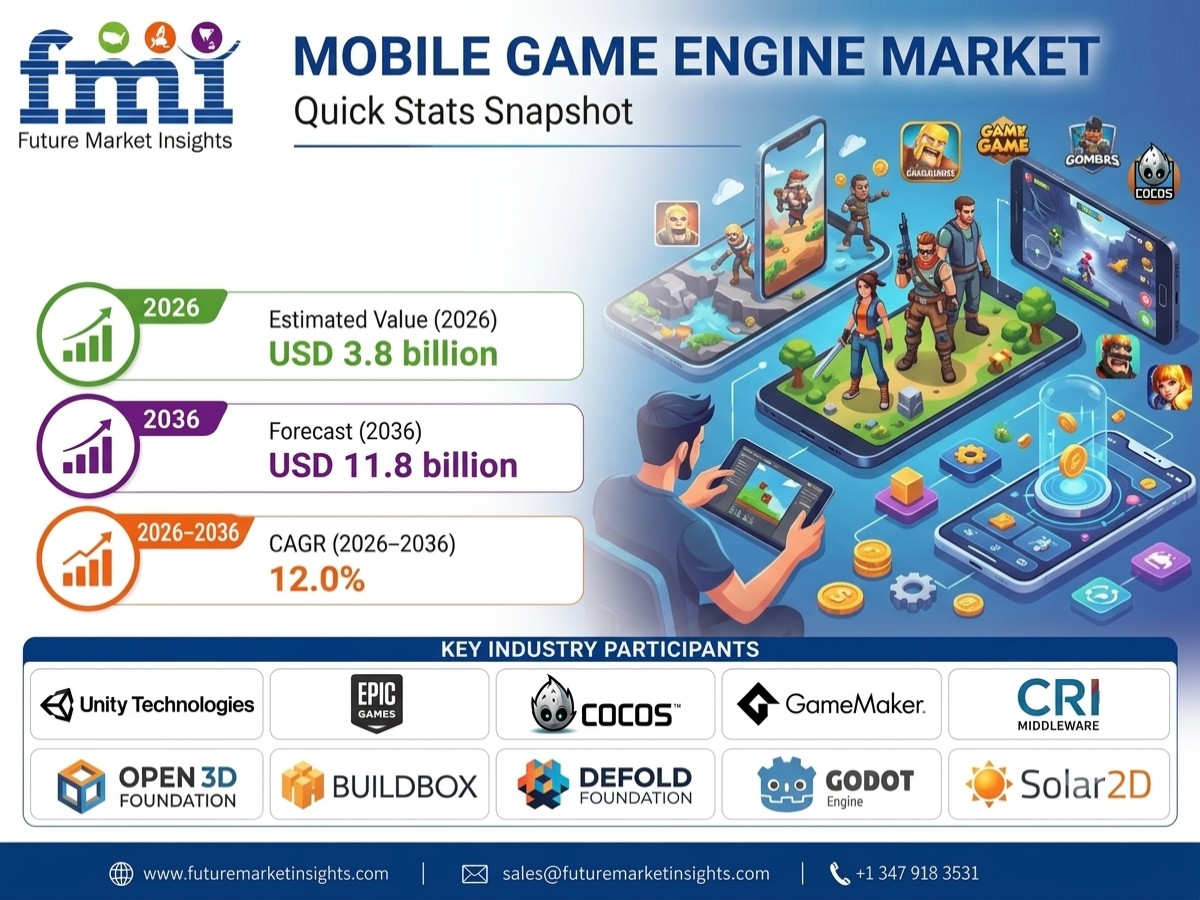
NEWARK, Del., October 13, 2026. The global mobile game engine market is projected to grow from USD 3.8 billion in 2026 to USD 11.8 billion by 2036, registering a compound annual growth rate (CAGR) of 12.0%, according to Future Market Insights (FMI). The market is expected to add USD 8.0 billion over the forecast period as game studios seek software that can manage development, testing and deployment across mobile platforms.
Engine selection is becoming a long-term production decision. Developers must balance graphics performance, build stability, licensing costs and support for operating-system changes. These requirements are particularly relevant to studios releasing frequent updates or maintaining games across a wide range of Android devices.
Platform compatibility is shaping engine decisions
Operating-system requirements can affect production schedules and the cost of maintaining a mobile game. On May 8, 2025, the Android Developers Blog published Prepare your apps for Google Play’s 16 KB page size compatibility requirement. The notice addressed 16 KB page-size support for new applications and updates targeting Android 15 from November 2025.
For engine providers, continued Android support is an important part of the product offering. Developers need dependable build tools, compatibility testing and clear migration guidance before updating an established project. A change that requires extensive testing or code adjustments can delay releases, particularly for smaller teams with limited engineering resources.
Cross-platform production adds another consideration. Shared development workflows can reduce duplicated work across operating systems, but teams still need to test performance and compatibility on their target devices. The value of an engine therefore depends not only on its editor or rendering features, but also on how reliably it supports the full release cycle.
Explore the Report Before You Buy — Download the Sample Now!
https://www.futuremarketinsights.com/reports/sample/rep-gb-34411
Where growth is fastest
FMI projects different growth rates across the countries covered in its analysis. South Korea leads the comparison, while the United Kingdom and Germany provide European market perspectives.
- South Korea — 14.1% CAGR: The country leads the profiled markets. Developers and engine providers must account for local release requirements while maintaining efficient mobile build workflows.
- United Kingdom — 12.9% CAGR: A growing development ecosystem creates opportunities for commercial and open-source tools. Predictable licensing and accessible technical support remain important for smaller studios.
- United States — 11.7% CAGR: A substantial game-development and publishing ecosystem supports demand for engines that can maintain performance and compatibility across mobile titles.
- Japan — 11.0% CAGR: Established game-development capabilities and international publishing activity support interest in dependable production tools and clear technical documentation.
- Brazil — 10.4% CAGR: Development activity creates opportunities for affordable tools, lightweight Android performance and accessible training.
- Germany — 10.0% CAGR: A broad base of game companies supports demand for engine licensing and specialized middleware. Lifecycle support and documented compatibility remain important selection criteria.
- Canada — 8.7% CAGR: International publishing connections and a domestic development sector support demand across independent studios and larger publishers.
These figures are country-level forecasts for 2026–2036. They indicate expected market growth rather than guaranteed revenue or returns for individual engine providers.
What leads the market
FMI’s 2026 estimates show that 2D engines, mobile gaming, development studios, direct licensing and Android are the leading categories in their respective segments.
- 2D game engines — 34.0% of product-type demand: These engines support sprite-based production and shorter development cycles for casual and puzzle games. Their more focused workflows can help smaller teams manage production complexity.
- Mobile gaming — 41.0% of application demand: Frequent content updates and publishing across mobile devices support demand for dependable build and testing processes.
- Game development studios — 38.0% of end-user demand: Studios use shared production pipelines to coordinate programming, art, testing and release schedules across projects.
- Direct licensing — 37.0% of distribution-channel demand: Direct agreements give development organizations a way to negotiate software access, support arrangements and license terms.
- Android — 39.0% of platform demand: The variety of Android devices and operating-system configurations increases the need for profiling tools and maintained build pipelines.
The shares refer to separate categories and should not be added together. They show where demand is concentrated, but the best engine for an individual project depends on its technical requirements, staffing and release plans.
The hurdle: licensing costs and migration risk
The main challenge is maintaining production continuity while controlling costs. Engine fees and changes to commercial policies can complicate budgets for projects that remain in development for several years. Switching engines may also require code changes, asset adjustments, staff training and repeated testing.
Device limitations add to the workload. A game that performs well on a high-end phone may require further optimization for devices with less memory or processing capacity. Developers must account for these differences before approving a release.
FMI identifies predictable pricing, lightweight runtimes and clear documentation as opportunities for engine providers. Open-source options can also appeal to teams seeking source-code access, although studios still need to assess maintenance requirements, community support and the availability of specialist tools.
Recent developments
Recent engine releases illustrate how providers are addressing mobile development workflows, Android support and device performance.
- March 2025: Godot Engine released Godot 4.4, featuring embedded game windows and improvements intended to reduce stutter. The release supports quicker testing workflows for development teams.
- April 2025: Unity Technologies released Unity 6000.1.0f1 with Android SDK 36 support, addressing compatibility needs for Android development.
- June 2025: Epic Games released Unreal Engine 5.6, highlighting a 60-frames-per-second target for modern mobile devices under controlled device optimization.
These releases reflect product development across the engine sector. They do not, by themselves, establish comparative market share or guarantee performance for every mobile game.
FMI profiles ten companies in its report: Unity Technologies, Epic Games, Cocos, GameMaker, CRI Middleware, Open 3D Foundation, Buildbox, Defold Foundation, Godot Engine and Solar2D.
The competitive field includes broad production platforms, tools focused on smaller development teams and open-source engines. Providers differentiate themselves through mobile build stability, cross-platform coverage, documentation and support for platform updates.
Analyst perspective
“Mobile game engine selection begins with technical proof instead of editor familiarity. Development teams examine build stability and licensing exposure across a complete release cycle. Sustained adoption follows engines supporting platform changes without costly production disruption.”
— Sudip saha, Principal Analyst at Future Market Insights
What this means for game studios and developers
For studios choosing or renewing an engine, the decision should account for the entire production cycle rather than the initial ease of building a prototype.
- Test the engine on target devices. Define the minimum hardware specifications, operating-system versions and performance targets before comparing providers. Include lower-end devices in testing and verify that updates can be built and deployed consistently.
- Review licensing over the expected project life. Compare subscription fees, renewal terms, team-seat costs and any restrictions that could affect future releases. For multi-year projects, establish how policy changes or engine upgrades would affect the budget.
- Measure migration and support requirements. Before replacing an established engine, estimate the work needed to move code and assets, retrain developers and repeat quality checks. Ask providers to document their Android support plans, release schedules and technical assistance arrangements.
These steps help teams assess the practical cost of adoption and reduce the risk of avoidable delays during development, testing and deployment.
Report coverage
Future Market Insights’ Mobile Game Engine Market report examines market size and forecasts through 2036, product types, applications, end users, distribution channels, platforms, country growth rates, competitive activity, adoption drivers, restraints and opportunities.
Read the full report:
https://www.futuremarketinsights.com/reports/mobile-game-engine-market
Explore More Related Reports –
Direct Burial Cables Market – https://www.futuremarketinsights.com/reports/direct-burial-cables-market
Homomorphic Encryption Market – https://www.futuremarketinsights.com/reports/homomorphic-encryption-market
Noise Monitoring Devices Market – https://www.futuremarketinsights.com/reports/noise-monitoring-devices-market
Solar-Powered Asset Tracking Market – https://www.futuremarketinsights.com/reports/solar-powered-asset-tracking-market
About Future Market Insights
Future Market Insights, Inc. (FMI) is an ESOMAR-certified market research and consulting firm headquartered in Delaware, USA, with offices in the United Kingdom, the United Arab Emirates and India. FMI delivers syndicated and custom research across food and beverage, healthcare, chemicals, technology, packaging, consumer goods and industrial sectors.
Media contact
Future Market Insights, Inc.
Email: sales@futuremarketinsights.com
Phone: +1-347-918-3531