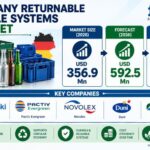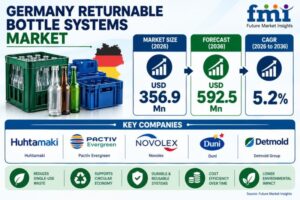


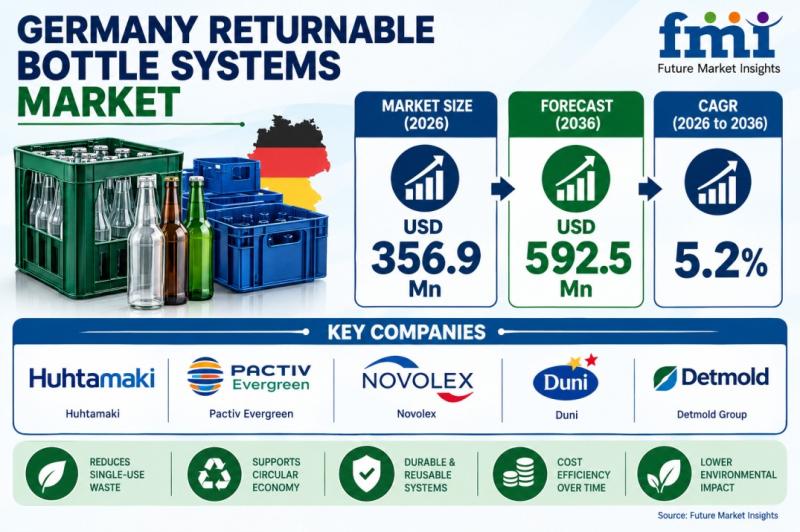
The Germany Returnable Bottle Systems Market is valued at USD 356.9 million in 2026 and is projected to reach USD 592.5 million by 2036, expanding at a 5.2% CAGR. The figures point to a market where the commercial case for returnable systems increasingly depends on how efficiently packaging can be collected, washed, redistributed and returned to service.
Why is Germany’s reuse gap important for returnable bottle systems?
Germany already has established consumer and retail familiarity with returnable beverage packaging, but the latest government data shows that reuse remains well below the statutory benchmark. The Umweltbundesamt reported on July 8, 2026, that 34.5% of beverages consumed in Germany in 2024 were filled in reusable packaging, compared with the legal target of 70%.
That gap creates a practical growth question for suppliers and operators: can return loops achieve enough completed cycles to justify collection, washing, replacement and redistribution costs?
FMI estimates that the market will add USD 235.6 million between 2026 and 2036. Standard formats are expected to account for 40.0% of the format-type segment in 2026, while broadline foodservice distributors are projected to hold 40.0% of the sales-channel category. These shares indicate that scale, interchangeability and established distribution routes remain important to system economics.
The market also includes companies with different strengths across foodservice packaging, paperboard conversion, reusable programs and broader packaging portfolios. Huhtamaki, Pactiv Evergreen, Novolex, Duni, Detmold Group, Berry Global, Genpak, Dart Container, Graphic Packaging and Sabert are among the companies profiled by FMI.
👉 Get Detailed Market Forecasts, Competitive Benchmarking, and Pricing Trends: https://www.futuremarketinsights.com/reports/sample/rep-gb-35224
What will determine whether returnable systems scale?
Returnable packaging does not create value simply by replacing a single-use item. The economics depend on how many times a unit completes the return loop before replacement, how far it travels for collection and reconditioning, and whether participating locations have sufficient volume to keep washing and redistribution infrastructure utilized.
This is particularly relevant as European packaging policy places greater emphasis on reuse. Germany’s Umweltbundesamt notes that the EU Packaging and Packaging Waste Regulation establishes requirements for reusable packaging and sets future reuse targets, including requirements affecting transport packaging and beverage packaging.
The market is therefore moving toward a more operational definition of reuse: a system must not only be reusable by design, but must achieve enough circulation to make the return network commercially workable.
Analyst Perspective
“Returnable systems should be judged on completed cycles rather than unit price alone. Commercial value depends on return frequency because collection and washing cost must stay below the avoided single-use spend.”
— Nandini Roy Choudhury, Principal Consultant, Future Market Insights
Market Snapshot
- 2026 market value: USD 356.9 million
- 2036 forecast value: USD 592.5 million
- 2026–2036 CAGR: 5.2%
- Incremental opportunity: USD 235.6 million
- Leading format type: Standard formats — 40.0% share in 2026
- Leading material: Paperboard — 32.0% share in 2026
- Leading format size: Standard meal — 39.0% share in 2026
- Leading sales channel: Broadline foodservice distributors — 40.0% share in 2026
Where are the strongest commercial opportunities?
Dense collection networks are likely to remain important because shorter return distances allow more completed cycles without excessive logistics costs. QSR chains are forecast to account for 27.0% of the end-use segment in 2026, supported by standardized operating routines and repeated purchasing across multiple locations.
Institutional catering, events and other concentrated consumption environments can also provide favorable conditions for reuse because hand-back points are easier to establish and utilization can be measured more consistently.
Paperboard is projected to hold 32.0% of the material segment in 2026. Its position reflects existing converting capacity and broad foodservice use, although barrier performance, sealing requirements and durability remain qualification factors where reusable or recovery-oriented structures are considered.