

Paper-based chocolate wrappers are moving beyond sustainability-led trials as brands face simultaneous requirements for recyclability, food-contact compliance, grease protection and high-speed converting.
The EU regulation’s phased implementation increases the commercial importance of packaging recyclability, while the European Commission’s 19% packaging-waste projection adds pressure to redesign structures before regulatory deadlines become operational constraints. The regulation also requires all packaging to be recyclable from 2030.
For chocolate, however, replacing plastic is technically more complicated than changing the substrate. Grease migration, oxygen and moisture protection, seal integrity, shelf life and machine speed all have to remain within acceptable limits.
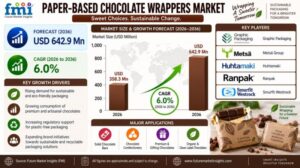
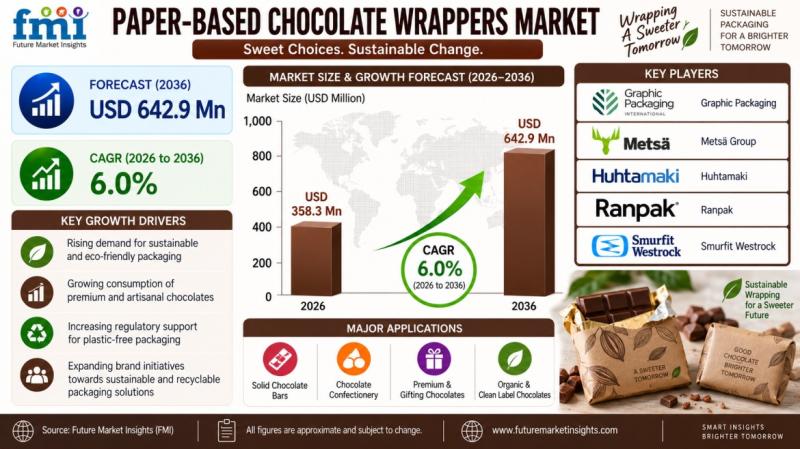
FMI estimates that the market will add USD 283.9 million in value between 2026 and 2036. Cold-seal paper wraps are projected to account for 40.0% of the product-type segment in 2026, while virgin kraft & SBS is expected to hold 33.0% of the material category.
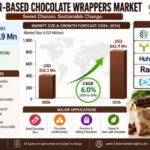
The Paper-Based Chocolate Wrappers Market is valued at USD 359.0 million in 2026 and is projected to reach USD 642.9 million by 2036, expanding at a 6.0% CAGR.
👉 Get Detailed Market Forecasts, Competitive Benchmarking, and Pricing Trends: https://www.futuremarketinsights.com/reports/sample/rep-gb-35231
What is proving that paper wrappers can run at commercial speed?
A March 2025 pilot by UPM Specialty Papers and Orkla Suomi provides a practical example. The companies introduced a six-month paper-wrapper pilot for Panda Milk chocolate in Finland using UPM Asendo Pro barrier paper. The structure used a cold-seal lacquer and was designed to run on Orkla Suomi’s existing flow-pack machinery, while also undergoing shelf-life testing.
That development matters because wrapper substitution becomes commercially meaningful only when a new structure can work with established equipment rather than requiring a completely new packaging line.
The qualification burden is also changing in the United States. On January 3, 2025, the U.S. Food and Drug Administration determined that 35 food-contact notifications involving PFAS-related grease-proofing substances for paper and paperboard were no longer effective.
Together, these developments point to a common requirement across markets: paper-based chocolate wrappers need technical documentation that covers both food-contact chemistry and production performance.
Analyst Perspective
“Paper-based chocolate wrappers earn approval only after grease barrier, shelf-life and seal behavior hold on the brand’s actual flow-wrap line. A lower-plastic structure has little commercial value if it slows packing speed or shifts failure risk into distribution.”
— Nandini Roy Choudhury, Principal Consultant, Future Market Insights
Access detailed market insights: https://www.futuremarketinsights.com/reports/brochure/rep-gb-35231
Where is the commercial opportunity emerging?
The strongest opportunities are concentrated where paper can replace plastic without disrupting the existing packaging workflow.
Direct brand contracts are projected to account for 48.0% of the sales channel in 2026. This reflects the technical nature of wrapper qualification: brands, converters and material suppliers need to coordinate barrier targets, sealing conditions, artwork, food-contact requirements and production-line performance.
Standard retail formats are expected to represent 40.0% of the format-size category. Repeated branded production runs give manufacturers more opportunities to validate web handling, print registration, seal consistency and shelf-life performance at scale.
Virgin kraft & SBS is forecast to hold 33.0% of the material segment. Its position reflects the importance of predictable coating response, printing quality and web behavior when barrier layers are added.
Mondi’s August 2025 expansion of FunctionalBarrier Paper Ultimate illustrates the direction of material development. The company described the paper as providing oxygen, water-vapor and grease protection while expanding production following a €16 million investment in technology at its Solec, Poland plant.
Competitive Landscape
The market includes Graphic Packaging, Metsä Group, Huhtamaki, Ranpak, Smurfit Westrock, Mondi Group, Stora Enso, MM Group (Mayr-Melnhof Karton AG), International Paper and Sonoco.
The competitive field spans flexible barrier-paper suppliers, food and consumer packaging converters, board manufacturers and adjacent fiber-packaging companies. The differentiator is increasingly the ability to demonstrate barrier performance and recyclability without sacrificing commercial runability.