

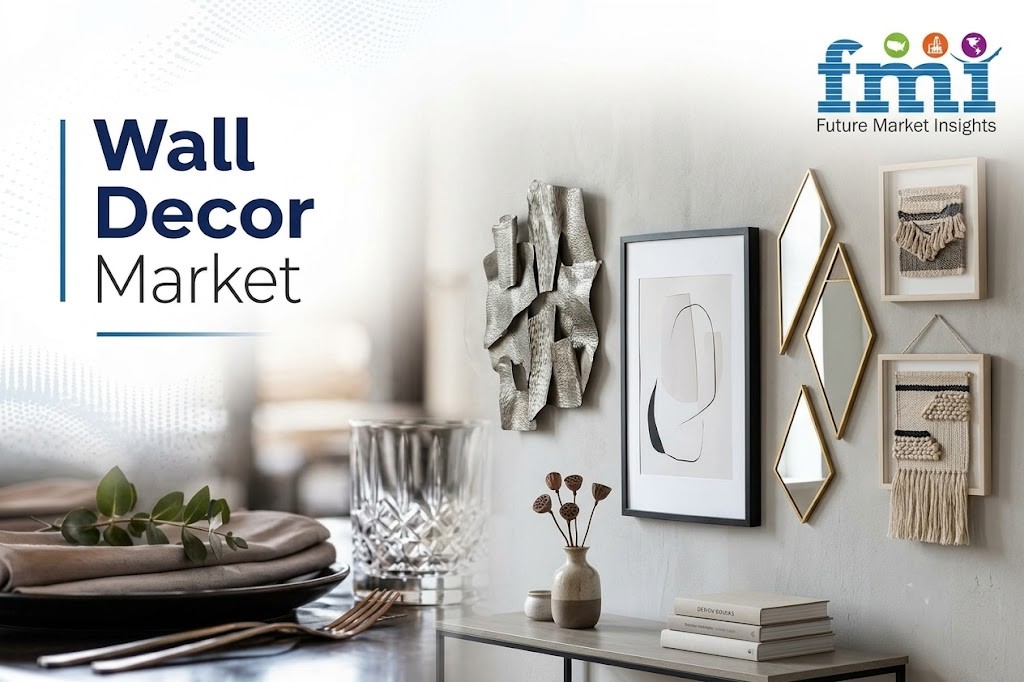
The global wall decor market is estimated at USD 73.67 billion in 2026 and is projected to reach USD 89.03 billion by 2036, expanding at a 4.5% CAGR from 2026 to 2036, according to Future Market Insights (FMI). Market growth is supported by rising home renovation activity, interior personalization, urban housing expansion, and lifestyle-driven spending.
The report identifies interior personalization as an important demand driver, with consumers increasingly using wall decor to express identity and refresh living spaces without undertaking major structural changes. Social media-driven design trends, rental housing, and the growing use of removable and lightweight products are also supporting demand.
The report page does not identify a specific dated regulation, event, or external organization as the source of the growth driver; therefore, no such attribution is added here.
Global Segment Leaders
- Wall Art — ~38% share: Wall art leads the product type segment as framed prints, canvas art, posters, and decorative panels offer flexible installation, broad price accessibility, and frequent design replacement.
- Offline Retail Channels — ~55% share: Physical stores retain the largest sales channel share because consumers value checking product size, texture, finish, and color accuracy before purchase.
- Wood — leading material category: Wood-based decor is identified among the materials attracting buyers seeking durable finishes and familiar home styling appeal. The report page does not provide a specific percentage share for the material category.
- Residential — end-use category: Residential spaces represent a core demand area as homeowners and renters increasingly use wall decor for personalization and room refreshes. The report page does not provide a specific percentage share for this category.
Get detailed market forecasts, competitive benchmarking, and pricing trends: https://www.futuremarketinsights.com/reports/sample/rep-gb-7925
Country-Level Performance
- China — 6.4% CAGR: Urban expansion and rising spending on home aesthetics are driving demand for modern, minimalist, customizable wall decor. E-commerce platforms are expanding product access across cities.
- United States — 5.2% CAGR: Strong interest in home personalization, DIY styling, and frequent interior upgrades supports demand for framed prints, canvas art, wall accents, and peel-and-stick wallpapers.
- United Kingdom — 5.0% CAGR: Customization is supporting growth, with consumers choosing bespoke framed art, tailored wallpaper designs, and made-to-order decor through online platforms.
- Germany — 4.8% CAGR: Demand is shaped by preferences for durable, well-crafted products, natural materials, eco-friendly wallpapers, and long-lasting wall panels.
- France — 4.6% CAGR: Appreciation for artistic detail and refined aesthetics supports demand for designer wall art, hand-painted pieces, and decorative tapestries.
Regional Context
Fast-growing markets: China leads the profiled country markets at a 6.4% CAGR, supported by urban expansion, higher spending on home aesthetics, e-commerce access, and demand for modern and customizable products among younger homeowners. The broader Asia Pacific region is expected to post the strongest regional expansion, supported by rising urban populations, higher disposable incomes, and growing interest in home aesthetics among younger consumers.
Stable and mature markets: The United States records a 5.2% CAGR, supported by DIY home styling, online marketplaces, home improvement retail, and frequent interior upgrades. The United Kingdom follows at 5.0%, while Germany at 4.8% and France at 4.6% reflect demand shaped by customization, product durability, sustainability, artistic detail, and established home improvement and retail practices. North America and Europe remain mature demand centers with stable replacement and upgrade cycles.
The full report covers North America, Latin America, Europe, South Asia, East Asia, Oceania, and the Middle East and Africa, with the scope covering the United States, Canada, United Kingdom, Germany, France, Italy, China, India, Japan, Australia, GCC countries, and other key markets.
Competitive Landscape
The wall decor market includes global brands, home improvement retailers, digital-first platforms, independent designers, and regional manufacturers. Key companies profiled in the report are IKEA, Home Depot, Lowe’s, Wayfair, and Williams-Sonoma group brands, alongside regional wall decor manufacturers.
The competitive environment is shaped by broad product portfolios, omnichannel reach, digital discovery, personalization, and faster design cycles. The report highlights Wayfair, Etsy-based sellers, Minted, Society6, and Redbubble as important e-commerce-driven participants offering customized prints, artist-designed wall art, and made-to-order decor. Mid-sized and niche brands compete through craftsmanship, material quality, limited-edition collections, and curated aesthetics.
The supplied report page does not provide a dated Key Developments section with specific company announcements. Accordingly, no recent company development or month/year event has been added.
Analyst Opinion
Rahul Pandita of FMI’s Consumer Product practice says, “Wall decor suppliers are anticipated to gain from easier installation formats and sharper design refresh cycles. Brands with strong online discovery and dependable store execution are likely to build better buyer recall across home interiors.”
Market Outlook and Opportunities
Wall decor demand is moving from occasional decorative purchases toward more regular room-refresh spending across residential spaces. Wall art and removable coverings offer relatively accessible ways to update interiors without structural modifications, while online catalogs, customization options, and visual room previews can improve product discovery and buyer confidence.
Consumer preferences are shifting toward easy-to-install, customizable, and visually distinctive products. Peel-and-stick wallpapers, removable decals, and modular wall art are gaining relevance among renters and younger buyers seeking flexibility. Minimalist themes, nature-inspired visuals, and abstract designs are also influencing product selection.
At the same time, market participants face cost and operational pressures. Raw material prices for wood, metal, glass, and specialty finishes can affect margins, while large or fragile products create transportation and damage risks. Price sensitivity remains relevant, particularly in emerging markets. Efficient sourcing, streamlined production, inventory management, and design differentiation will remain important to scalability through 2036.
Explore More Related Studies Published by FMI Research:
https://www.openpr.com/news/4647024/portable-car-vacuum-market-to-reach-usd-33-5-billion-by-2036
https://www.openpr.com/news/4647046/washing-machine-cleaner-market-to-reach-usd-2-2-billion-by-2036
Business Impact
FMI helps organizations transform market complexity into strategic clarity, enabling leadership teams to identify growth opportunities faster, optimize resource allocation, strengthen competitive positioning, and make high-stakes business decisions with confidence.
To explore how FMI Custom Research can support your strategic priorities, please connect with our team at – sales@futuremarketinsights.com
About Future Market Insights (FMI)
Future Market Insights, Inc. (FMI) is an ESOMAR-certified, ISO 9001:2015 market research and consulting organization, trusted by Fortune 500 clients and global enterprises. With operations in the U.S., UK, India, and Dubai, FMI provides data-backed insights and strategic intelligence across 30+ industries and 1200 markets worldwide.