

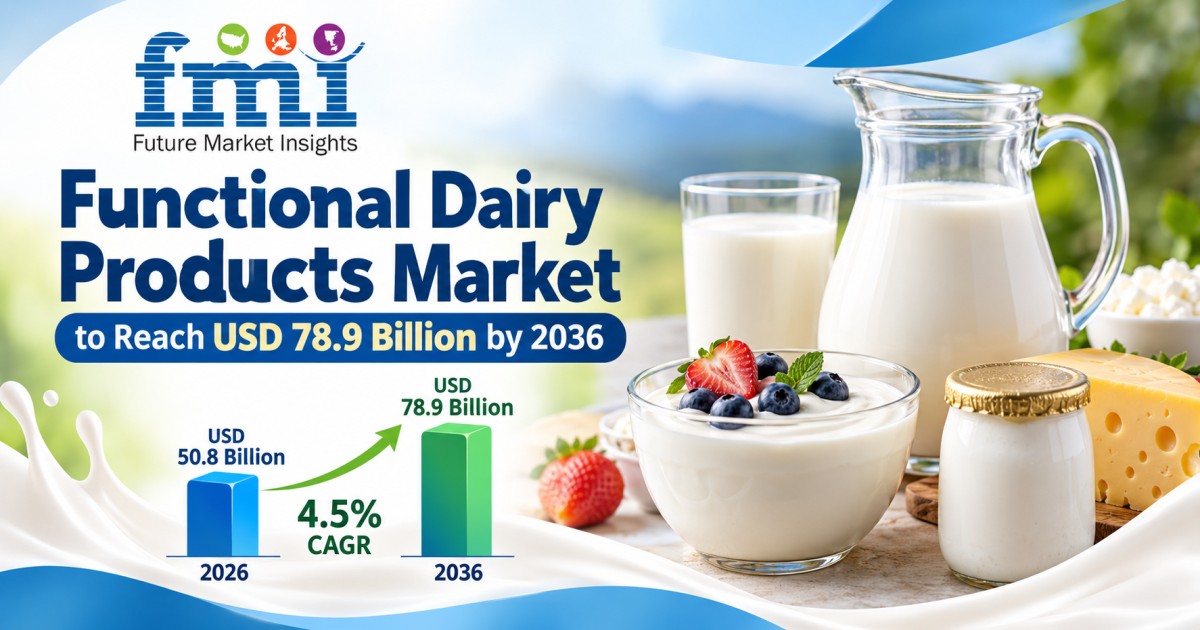
The global functional dairy products market is forecast to increase from USD 50.8 billion in 2026 to USD 78.9 billion by 2036, expanding at a 4.5% CAGR during the 2026–2036 forecast period, according to Future Market Insights. Functional dairy products are increasingly moving beyond basic nutrition as consumers seek probiotic, high-protein, fortified, and other health-focused dairy formats. Yogurt and milk are expected to remain the leading product types, while retail/household use continues to represent the dominant end-use segment as functional dairy becomes part of everyday nutrition.
Get detailed market forecasts, competitive benchmarking, and pricing trends:
https://www.futuremarketinsights.com/reports/sample/rep-gb-15571
Regional Segment Leaders
As this is a global functional dairy products market report, the segment analysis reflects product preferences, end-use patterns, and distribution dynamics across key consumer and commercial markets.
- Yogurt and Milk — Leading Product Type segment: High household consumption, probiotic innovation, fortified formulations, and familiarity with dairy-based nutrition support their leading position.
- Retail / Household — Leading End-use segment: Functional dairy is increasingly incorporated into everyday diets as consumers seek convenient products offering gut health, protein, immunity, bone health, and other nutritional benefits.
- Probiotic Yogurt — Key Functional Format: Growing awareness of gut health and fermented foods continues to support probiotic-enriched yogurt demand.
- High-Protein Dairy — Emerging Growth Area: Protein-enriched dairy beverages, snacks, and other formats are gaining attention among fitness consumers, aging populations, and GLP-1 medication users.
- E-commerce and Modern Retail — Important Distribution Routes: Supermarkets, hypermarkets, convenience stores, and online retailers are improving access to functional dairy products and expanding product discovery.
Country-Level Performance
The report profiles country-specific growth trajectories across five key markets, showing a spread of 0.5 percentage points in CAGR.
- South Korea | CAGR 4.3% (2026–2036) | Key drivers: Growing interest in gut health and nutritional enrichment, expanding e-commerce and convenience-store distribution, and partnerships between dairy manufacturers and biotechnology companies support market expansion.
- United States | CAGR 4.2% (2026–2036) | Key drivers: Strong demand for high-protein and probiotic dairy, established retail distribution, lactose-free and plant-based innovation, and growing interest in functional foods support market growth.
- European Union | CAGR 4.1% (2026–2036) | Key drivers: Germany, France, and the Netherlands contribute to demand through fortified dairy consumption, lactose-intolerance trends, probiotic adoption, advanced processing technologies, and established cold-chain infrastructure.
- United Kingdom | CAGR 3.9% (2026–2036) | Key drivers: Rising digestive-health awareness, probiotic-enriched dairy, vitamin- and mineral-fortified products, and strong established dairy brands support gradual expansion.
- Japan | CAGR 3.8% (2026–2036) | Key drivers: An aging population, demand for digestive-health products, probiotic dairy drinks, fortified milk, and functional fermented dairy innovation create opportunities for continued growth.
Regional Context
The global functional dairy products market is shifting from basic dairy consumption toward health-led nutrition platforms. Consumers are increasingly looking for products that combine familiar dairy formats with specific functional benefits such as gut health, immunity, protein enrichment, bone health, skin health, and weight management.
Yogurt and milk remain central to the category because they already occupy established positions in everyday diets. Probiotic yogurt is particularly well positioned as consumers become more aware of the relationship between digestive health and nutrition. Fortified milk also continues to benefit from demand for calcium, vitamin D, omega-3 fatty acids, and other nutritional components.
High-protein dairy represents another important opportunity. The expansion of fitness-oriented nutrition and demand among GLP-1 medication users are encouraging manufacturers to develop nutrient-dense, convenient formats designed to support protein intake and muscle maintenance.
Medical nutrition is also broadening the market’s addressable applications, particularly as dairy-based products become integrated into post-discharge and homecare nutrition routines.
Competitive Landscape
The competitive landscape features large multinational dairy companies, established functional-dairy specialists, and companies investing in medical nutrition and next-generation functional formats.
- Global Dairy and Functional Nutrition Leaders: Danone S.A. and Nestlé S.A. maintain strong positions through broad dairy portfolios, functional nutrition capabilities, and global distribution.
- Probiotic Specialists: Yakult Honsha focuses on fermented and probiotic dairy products supported by strain expertise and established consumer recognition.
- Premium and Innovation-Focused Dairy Companies: Arla Foods continues developing high-protein and specialized dairy concepts for emerging consumer needs.
- Regional Functional Dairy Innovators: Meiji and other Asian dairy companies are extending functional dairy into areas such as skin health, hydration, and other targeted wellness applications.
Based on the report’s estimated company-share analysis, Danone holds approximately 20–24% of the market, followed by Nestlé at 15–19%, Yakult Honsha at 12–16%, and Arla Foods at 10–14%, with other companies collectively accounting for approximately 30–40%.
Notable developments include Arla Foods Ingredients’ January 2026 showcase of five high-protein concepts, including Milky Spark aimed at GLP-1 medication users; Danone’s November 2025 Renew strategy update emphasizing medical nutrition and gut health; and Meiji’s January 2026 launch of W Skin Care functional drinking yogurt in Japan.
Get the Complete Story-Read More About Our Latest Report:
https://www.futuremarketinsights.com/reports/functional-dairy-products-market
Analyst Perspective
“The functional dairy products market is moving toward clinically supported health formats and protein-enriched daily nutrition. Brands with strong probiotic research and credible wellness claims are likely to gain advantage as consumers look for dairy products with clear health benefits.” — Nandini Roy Choudhury, Principal Consultant, Food and Beverage, Future Market Insights
Explore More Research Reports by FMI
Probiotic Yogurt Market:
https://www.futuremarketinsights.com/reports/probiotic-yogurt-market
Functional Foods Market:
https://www.futuremarketinsights.com/reports/functional-foods-market
Fortified Dairy Products Market:
https://www.futuremarketinsights.com/reports/fortified-dairy-products-market
Dairy Ingredients Market:
https://www.futuremarketinsights.com/reports/dairy-ingredients-market
About Future Market Insights (FMI)
Future Market Insights, Inc. (FMI) is an ESOMAR-certified, ISO 9001:2015 market research and consulting organization, trusted by Fortune 500 clients and global enterprises. With operations in the U.S., UK, India, and Dubai, FMI provides data-backed insights and strategic intelligence across 30+ industries and 1200 markets worldwide.
Contact Us:
Future Market Insights Inc.
Christiana Corporate, 200 Continental Drive,
Suite 401, Newark, Delaware – 19713, USA
T: +1-347-918-3531
Why FMI: https://www.futuremarketinsights.com/why-fmi
For Sales Enquiries: sales@futuremarketinsights.com
Website: https://www.futuremarketinsights.com