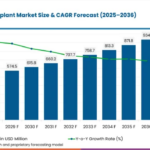


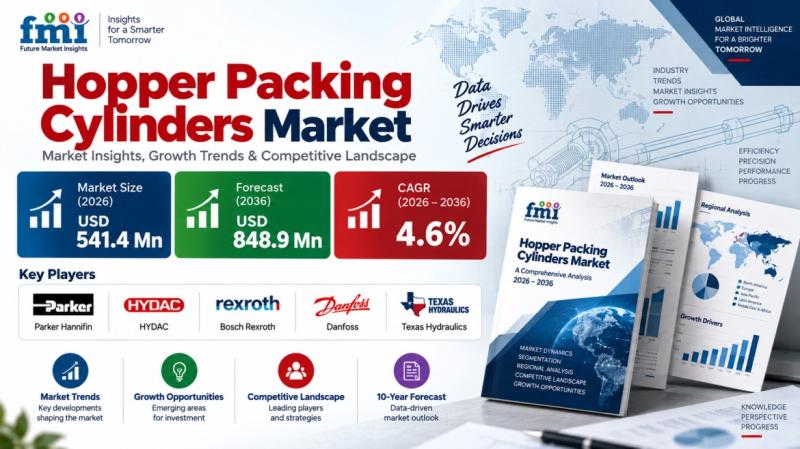
The global Hopper Packing Cylinders Market is projected to reach USD 848.9 million by 2036, up from USD 541.4 million in 2026, registering a 4.6% CAGR from 2026 to 2036, according to Future Market Insights (FMI).
The market was valued at USD 517.6 million in 2025. Demand is closely connected to refuse-equipment production, fleet maintenance, and replacement requirements. Hydraulic cylinders used in hopper packing systems operate through repeated cycles of extension and retraction to pack, eject, and contain refuse.
A cylinder failure can affect the availability of a refuse truck or compactor. As a result, buyers need to evaluate replacement components based on more than purchase price. Bore, stroke, mounting geometry, pressure, seals, rod specifications, and compatibility with the existing hydraulic circuit all influence the selection process.
👉 Get Detailed Market Forecasts, Competitive Benchmarking, and Pricing Trends: https://www.futuremarketinsights.com/reports/sample/rep-gb-35282
Double-Acting Cylinders Account for 36.0% of Demand
Double-acting packing cylinders are estimated to account for 36.0% of cylinder demand in 2026.
Their ability to provide powered movement in both directions suits repeated packing cycles. Positive hydraulic retraction can improve cycle predictability when packing mechanisms need controlled movement under changing loads.
Single-acting, telescopic, heavy-duty, and custom hydraulic cylinders continue to serve applications where machine geometry, stroke, or operating requirements call for different configurations.
For replacement buyers, the original machine specification remains important because a cylinder that shares a nominal bore may still differ in stroke, mounting, ports, seals, or rod configuration.
Rear-Loader Refuse Trucks Represent 33.0% of Equipment Demand
Rear-loader refuse trucks are projected to account for 33.0% of equipment demand in 2026.
The hopper and packing mechanism operate directly at the collection interface. Waste enters the hopper throughout a collection route, while the packing system repeatedly moves material into the vehicle body.
This creates a direct connection between hydraulic-cylinder condition and route productivity. Leakage, drift, slow movement, or mechanical damage can increase maintenance requirements and affect planned collection activity.
Rear-loader platforms also provide a continuing replacement opportunity because cylinder geometry is generally linked to a particular refuse-body design.
The 4–6 Inch Bore Category Leads
The 4–6 inch bore category is expected to represent 39.0% of bore-size demand in 2026.
Bore size influences available force at a given system pressure, while also affecting oil volume, installation dimensions, and hydraulic flow requirements.
A larger bore can increase available force but may require more fluid per stroke and additional installation space. A smaller bore can reduce package size but may not provide sufficient force for demanding loads.
The 4–6 inch range represents a practical engineering zone for many packing mechanisms where force, space, and hydraulic-flow requirements need to be balanced.
Final cylinder selection still depends on stroke, rod diameter, mounting, pressure, speed, and structural load paths.
Compactor OEMs Lead the Sales Channel
Compactor OEMs are forecast to account for 38.0% of buyer demand in 2026.
OEMs typically specify the cylinder as part of the complete compactor or refuse-body system. Bore, stroke, rod, mounts, ports, pressure, speed, and seals are evaluated against the machine’s hydraulic circuit and mechanical structure.
Once a configuration has been validated, the approved specification can continue to influence replacement purchasing throughout the equipment’s operating life.
Hydraulic cylinder suppliers, aftermarket service providers, and municipal fleet repair teams become increasingly important as equipment enters service and requires replacement or rebuilding.
Packing Blade Actuation Accounts for 43.0% of Applications
Packing blade actuation is expected to represent 43.0% of applications in 2026.
The packing blade performs the core mechanical function of moving loose refuse from the hopper into the vehicle body. The cylinder must repeatedly generate force while handling changing resistance, contamination, load reversals, and mechanical stress.
This operating environment places demands on rods, seals, mounts, and related components. Cylinder leakage or drift can reduce packing effectiveness and affect route timing.
Hopper compression, ejection support, and tailgate or auxiliary actuation remain additional application areas.
Fleet Uptime Supports Replacement Demand
The recurring nature of collection and compaction creates an ongoing requirement for replacement cylinders.
Waste-system investment provides broader context for continued refuse-equipment activity. However, cylinder purchases are tied more directly to equipment build schedules, repair requirements, and validated replacement configurations.
This distinction is important for suppliers. National waste-infrastructure investment does not automatically translate into cylinder sales. The actual purchase depends on the equipment operating in the fleet, its maintenance requirements, and the delivery schedule for replacement components.
Harsh Operating Conditions Create Technical Challenges
Hopper packing cylinders operate in environments that can expose components to contamination, moisture, temperature changes, variable loads, side-load, and operator-driven shocks.
These conditions can contribute to leakage, drift, corrosion, or mechanical damage over time.
As a result, replacement selection based solely on nominal pressure or bore can create compatibility issues. Buyers need to consider the complete application and machine interface.
The market also presents an opportunity for remanufacturing, local stocking, and design-for-service. Maintaining validated machine interfaces while addressing worn rods, seals, coatings, and other failure points can help reduce equipment downtime.
👉 Access detailed market insights: https://www.futuremarketinsights.com/reports/brochure/rep-gb-35282
Regional Market Outlook
FMI’s analysis covers Australia, the USA, Japan, Canada, Mexico, Brazil, and Germany.
Australia is projected to record a 5.8% CAGR between 2026 and 2036. Mexico follows at 5.5%, while Brazil is forecast at 5.1% and Canada at 4.8%. The USA is projected at 4.4%, Germany at 4.1%, and Japan at 3.7%.
Regional operating conditions vary. Australia and Canada have dispersed collection networks where service reach can influence equipment availability. Japan and Germany operate established municipal systems where replacement fit and service life are important. Mexico and Brazil present varying infrastructure and procurement conditions.
Competitive Landscape
The market includes integrated hydraulic engineering companies, refuse and mobile-cylinder specialists, and custom OEM and aftermarket manufacturing networks.
Notable companies profiled by FMI include Parker Hannifin, HYDAC, Bosch Rexroth, Danfoss, Texas Hydraulics, Custom Hoists, Prince Manufacturing, Bailey Hydraulics, Wipro Hydraulics, and Ligon Hydraulic Cylinder Group.
Competitive factors include cylinder range, custom machine integration, repair and supply support, geographic reach, and the ability to meet application-specific specifications.
Report Scope
The FMI study covers the Hopper Packing Cylinders Market by cylinder type, compactor type, bore size, sales channel, and application.
The forecast period runs from 2026 to 2036, with quantitative estimates presented in USD million and CAGR percentages.
The market definition includes hydraulic cylinders specifically sold for hopper packing, packing blade actuation, hopper compression, ejection support, and tailgate or auxiliary actuation within the defined refuse-truck, compactor, and transfer-station universe.
The study excludes complete refuse trucks, complete compactors or transfer units, pumps, valves, hoses, controls, unrelated general-purpose cylinders, and standalone repair labor where no cylinder product is sold.
FMI applies a hybrid bottom-up and top-down sizing approach that reconciles OEM program exposure, replacement demand, application mix, cylinder configuration, and regional operating conditions.