

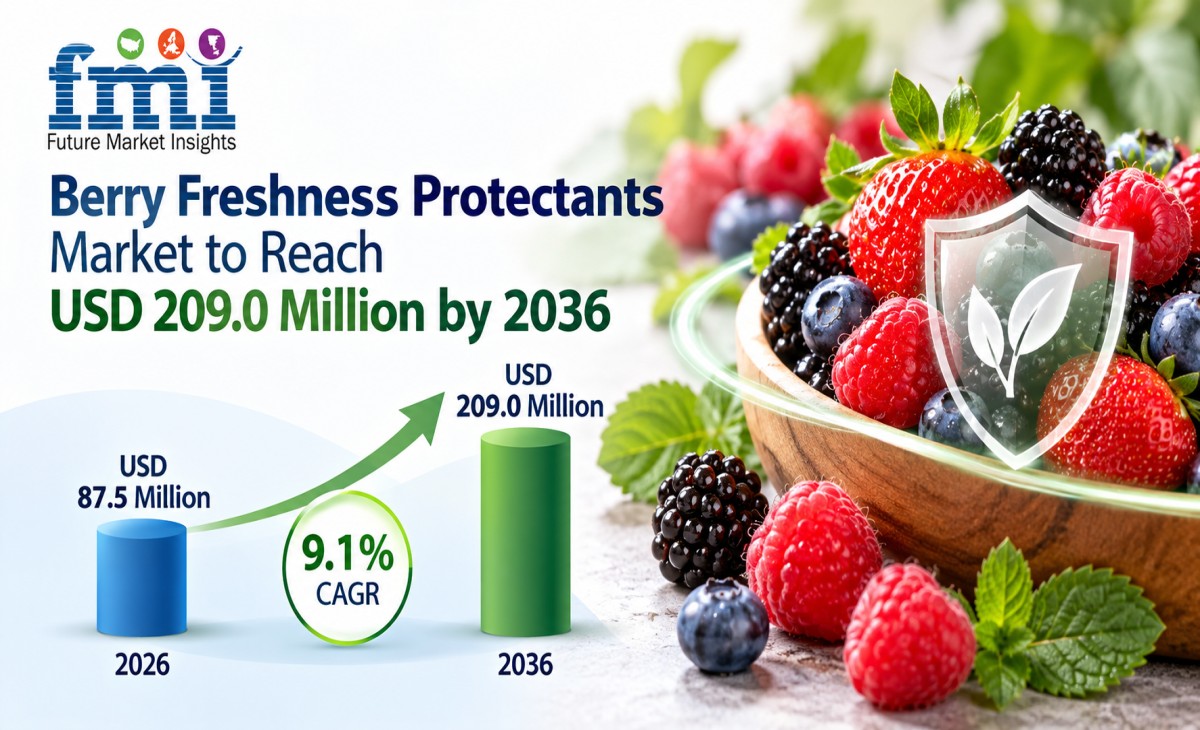
The global Berry Freshness Protectants Market is projected to reach USD 209.0 million by 2036, up from approximately USD 87.5 million in 2026, expanding at a 9.1% CAGR during the forecast period, according to the latest analysis by Future Market Insights (FMI).
Get Detailed Market Forecasts, Competitive Benchmarking, and Pricing Trends:
https://www.futuremarketinsights.com/reports/sample/rep-gb-34979
Edible Coatings Continue to Anchor Product Type Demand
Edible coatings are estimated to account for 47.8% of product type revenue in 2026, making them the leading product category. The category benefits from direct application to fruit surfaces before storage or distribution. Coatings can help manage moisture exchange and reduce deterioration while allowing packers to work within existing postharvest handling systems.
Pome & Stone Fruit Leads Commodity Demand
Pome & stone fruit is projected to account for 44.9% of commodity demand in 2026, representing the leading commodity category. Centralized storage and staged release programs create opportunities for repeated treatment protocols and quality measurements. Apples and stone fruits can remain in controlled storage for extended periods, allowing operators to evaluate decay, moisture loss and quality retention across multiple storage lots.
Packhouse Applications Dominate Demand
Packhouse applications are forecast to account for 50.2% of application point revenue in 2026.
Packhouses bring washing, grading, treatment and packing activities together within a controlled operating sequence. This makes them an important point for applying freshness technologies before fruit enters storage or transportation.
Treatment systems that fit existing lines without significantly affecting throughput can provide an operational advantage. Packhouse operators can also compare treatment outcomes using lot-level quality records, helping technical teams assess decay reduction, appearance and saleable yield.
Biological-Microbial Technologies Create New Opportunities
Biological-microbial technologies are forecast to represent 41.1% of technology-base demand in 2026.
Biological approaches are gaining attention as fresh-produce companies seek alternatives and complements to conventional postharvest treatments. These technologies can target postharvest fungal losses while supporting programs focused on reduced chemical dependence.
Longer Distribution Routes Drive Freshness Protection Spending
Longer storage and shipping windows increase the commercial value of freshness protectants.
Berry and fresh-produce losses can accumulate rapidly when decay, water loss or firmness deterioration begins during refrigerated storage. Protecting more fruit through the complete distribution route can improve saleable yield and reduce rejected loads.
Crop Response and Appearance Requirements Can Restrain Adoption
Crop-specific response remains an important restraint for the market.
A treatment that reduces decay or moisture loss can still face qualification challenges if it changes fruit appearance, surface bloom or other characteristics used by consumers and retailers to judge freshness.
Blueberry surface bloom, for example, can influence consumer preference. Consequently, packers increasingly need performance evidence covering both technical preservation and visible quality before adopting a treatment on a commercial scale.
Low-Touch Protection Formats Expand Commercial Opportunities
Low-touch protection technologies are creating opportunities for suppliers that can extend freshness without requiring major changes to existing infrastructure.
Protective barriers, coatings and packaging-based treatments can potentially be integrated into established packing and distribution systems. Such approaches allow packers to add a layer of freshness protection without constructing separate treatment facilities.
USA Leads Growth Among Highlighted Countries
Among the highlighted country markets, the USA is projected to record an 8.8% CAGR through 2036, followed by Germany at 8.5%, South Korea at 8.2%, the United Kingdom at 7.9% and Japan at 7.1%.
The USA benefits from extensive domestic distribution routes and significant fresh-produce operations where arrival quality can directly affect retailer acceptance.
Competitive Landscape
The Berry Freshness Protectants Market includes integrated postharvest solution providers, coating specialists, active-packaging companies and biological protection developers.
Key companies profiled by FMI include AgroFresh Solutions, Inc., Apeel Sciences, Hazel Technologies, Inc., DECCO (UPL), Citrosol, Biotalys, Fresh Inset S.A. and Verdant Technologies.
Competitive positioning is influenced by treatment breadth, packhouse integration, crop-specific qualification, regulatory approvals, application support, geographic coverage and the ability to demonstrate consistent quality outcomes.
Key Industry Developments
The market continues to see regulatory approvals, manufacturing expansion, technology development and commercial partnerships.
In December 2025, Fresh Inset S.A. received unconditional US EPA registration for Vidre+ Low Concentration as a postharvest freshness treatment for packaged produce.
In September 2025, DECCO (UPL) announced a new plant in Valencia, Spain, expanding its global postharvest production network.
In March 2025, Hazel Technologies, Inc. announced a BreatheWay pallet-bag format designed to maintain broccoli quality during shipment without traditional ice.
In May 2025, Biotalys and AgroFresh announced a collaboration focused on biological fungicides for postharvest fresh produce.
Analyst Perspective
“Berry freshness programs earn repeat orders after packers show better saleable yield without dulling natural bloom or slowing throughput. The most defensible programs pair crop-specific decay control with arrival-quality records that remain credible after the full storage or export route.” — Nandini Roy Choudhury, Principal Consultant, Future Market Insights
Exclusive Discounts on Full Report
Berry Freshness Protectants Market – https://www.futuremarketinsights.com/reports/berry-freshness-protectants-market
Report Scope
The FMI study covers the Berry Freshness Protectants Market by product type, commodity, application point, technology base, sales channel and region. Product types include edible coatings, active sachets & liners, wash & drench treatments, storage-room treatments and others. Commodity categories include pome & stone fruit, citrus, berries & grapes, tropical fruit, vegetables and others. Application points include packhouse, storage facility, transit & retail and others. Technology bases include biological-microbial, plant-extract-based, mineral & wax-based and others. Sales channels include packhouse suppliers, post-harvest service providers, direct sales and others. The research covers North America, Latin America, Europe, East Asia, South Asia and Pacific, and the Middle East and Africa.
Key Executive Benefits
- Decision-Ready Insights
- Reduced Strategic Risk
- Market Entry Confidence
- Competitive Advantage
- Faster Growth Decisions
- Primary Market Validation
To explore how FMI Custom Research can support your strategic priorities, connect with our team at sales@futuremarketinsights.com.
About Future Market Insights (FMI)
Future Market Insights, Inc. is an ESOMAR-certified, ISO 9001:2015 market research and consulting organization trusted by Fortune 500 companies. With a global presence across the U.S., UK, India and Dubai, FMI delivers data-driven insights across 30+ industries and 1,200 markets worldwide.
Contact Us:
Future Market Insights Inc.
Christiana Corporate, 200 Continental Drive,
Suite 401, Newark, Delaware – 19713, USA
T: +1-347-918-3531
Why FMI: https://www.futuremarketinsights.com/why-fmi
For Sales Enquiries: sales@futuremarketinsights.com
Website: https://www.futuremarketinsights.com