

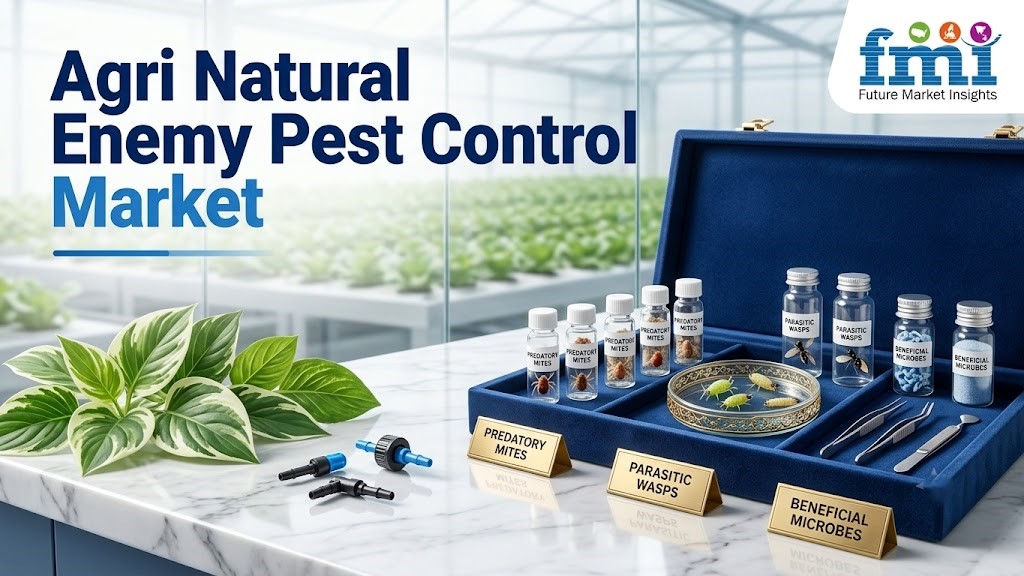
The global agri natural enemy pest control market was valued at USD 19.2 billion in 2025 and is projected to reach USD 35.7 billion by 2036, expanding at a 5.8% CAGR from 2026 to 2036. Demand is being supported by tighter restrictions on synthetic pesticide use, growth in organic farming and integrated pest management (IPM), and rising requirements for pesticide residue-free agricultural production. FMI cites the European Commission’s 2025 Farm to Fork Strategy: Pesticide Reduction Progress Report and notes that the strategy targets a 50% reduction in chemical pesticide use by 2030, strengthening demand for biological alternatives.
Global Segment Leaders
- Product Type — Predatory insects: 34.0% share in 2026. Ladybirds, lacewings, and predatory beetles are widely deployed across greenhouse and field crops for aphid, whitefly, and mite suppression.
- Application — Field crops: 42.0% share in 2026. Large-scale cereal, oilseed, and vegetable production is driving biological pest-control adoption in field crops.
- End User — Agriculture & farming: 58.0% share in 2026. Farmer-level procurement through agricultural supply stores and specialist distributors supports the segment’s leading position.
- Sales Channel — Agricultural supply stores: 36.0% share in 2026. Organized agricultural input markets continue to support farmer procurement through established supply-store networks.
Get detailed market forecasts, competitive benchmarking, and pricing trends: https://www.futuremarketinsights.com/reports/sample/rep-gb-10643
Country-Level Performance
- South Korea — 8.1% CAGR: Government sustainable agriculture programs, expanding protected cultivation, and rising biological pest-control adoption in high-value horticulture.
- India — 7.5% CAGR: Government-subsidized IPM programs, organic farming expansion, and growing awareness of chemical pesticide health risks.
- Germany — 6.9% CAGR: European pesticide-reduction targets and established biological-control infrastructure support demand.
- USA — 6.8% CAGR*: Growing IPM adoption, organic production expansion, and demand for biological control in high-value fruit and vegetable production.
- UK — 6.5% CAGR: European pesticide-reduction requirements and established biological-control adoption support market development.
- European Union — 6.2% CAGR: Farm to Fork pesticide-reduction targets, established biological-control infrastructure, and mature farmer adoption support growth.
- Japan — 5.4% CAGR: Established biological-control expertise, protected cultivation, government support for sustainable agriculture, and demand for residue-free pest management.
Regional Context
Fast-growing markets: South Korea is projected to expand at 8.1% CAGR, supported by government sustainable agriculture programs, protected cultivation, and biological pest-control use in high-value horticulture. India follows at 7.5%, with government IPM programs, organic farming expansion, and greater awareness of pesticide health risks supporting adoption.
Mature and slower-growing markets: The European Union is projected to grow at 6.2%, supported by Farm to Fork pesticide-reduction targets, established rearing and distribution infrastructure, and mature farmer adoption. The USA is cited at 5.8% in its detailed country analysis, while Japan is expected to grow at 5.4%, reflecting established IPM and biological-control practices.
The full report covers North America, Latin America, Europe, East Asia, South Asia and Pacific, and the Middle East & Africa, with 25+ countries covered in addition to the specifically highlighted country markets.
Competitive Landscape
Key companies profiled include Koppert Biological Systems, Biobest Group, BASF SE, Certis Biologicals, Bioline Agrosciences, Beneficial Insectary, Andermatt Biocontrol, AgBiome, Marrone Bio Innovations, Bug Agentes Biologicos, and InVivo Group. The report identifies Koppert Biological Systems through its beneficial-organism portfolio, rearing facilities, distribution network, and biological crop-protection advisory services, while Biobest Group competes through its organism portfolio and global distribution reach. BASF SE combines biological control with its broader crop-protection platform, while Certis Biologicals focuses on biological crop-protection products.
The report identifies two key developments in 2025. Koppert Biological Systems expanded its field-crop biological-control program with a large-scale predatory-insect release system designed for integration with precision-agriculture monitoring platforms. Biobest Group opened a new rearing facility in South Korea to serve growing demand in Asian protected-cultivation markets. The report page does not specify the month for either development.
Explore More Related Studies Published by FMI Research:
Business Impact
FMI helps organizations transform market complexity into strategic clarity, enabling leadership teams to identify growth opportunities faster, optimize resource allocation, strengthen competitive positioning, and make high-stakes business decisions with confidence.
To explore how FMI Custom Research can support your strategic priorities, please connect with our team at – sales@futuremarketinsights.com
About Future Market Insights (FMI)
Future Market Insights, Inc. (FMI) is an ESOMAR-certified, ISO 9001:2015 market research and consulting organization, trusted by Fortune 500 clients and global enterprises. With operations in the U.S., UK, India, and Dubai, FMI provides data-backed insights and strategic intelligence across 30+ industries and 1200 markets worldwide.