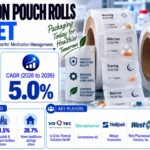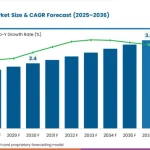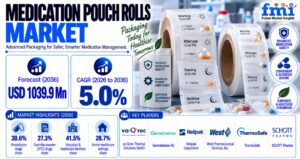


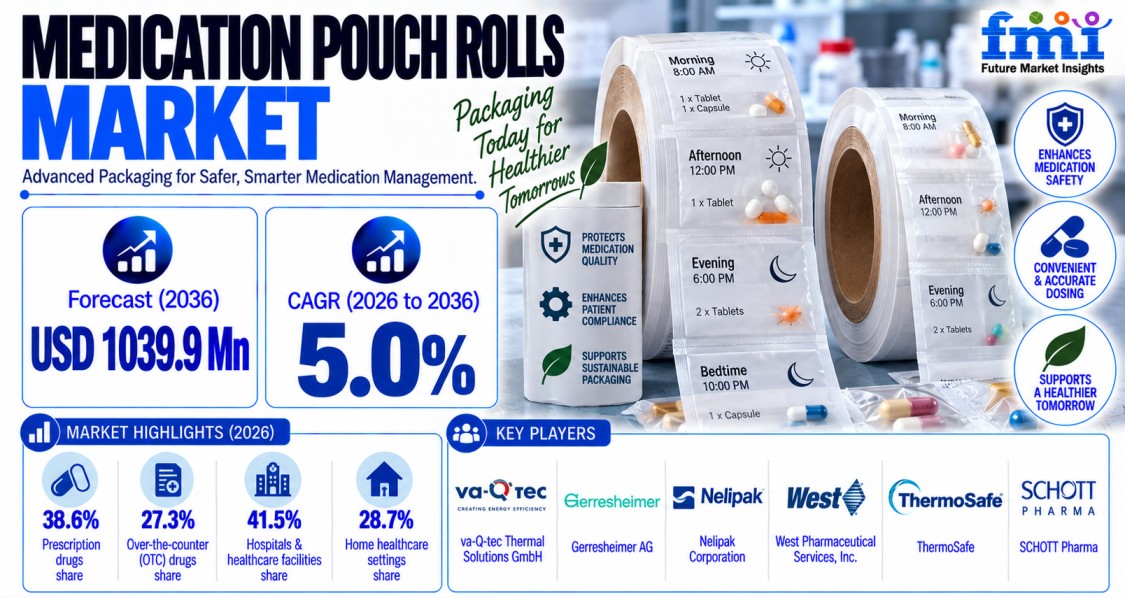
The global Medication Pouch Rolls Market is projected to reach USD 1,039.9 million by 2036, up from USD 638.4 million in 2026, expanding at a 5.0% CAGR, according to Future Market Insights.
The market registered USD 638.4 million in 2026, with demand supported by pharmacies and healthcare providers using automated dispensing lines to prepare patient-specific medication pouches.
Medication pouch rolls are consumable materials used when qualified dispensing systems form unit-dose or multi-dose pouches. As automated medication preparation expands, pharmacies repeatedly purchase fresh roll stock for scheduled dispensing workflows.
Swisslog Healthcare launched the i-Rolly pouch rolling add-on in June 2025 to organize finished AutoPack pouch strings and reduce manual handling after packing. Such developments illustrate the broader focus on improving workflow efficiency around automated medication pouching.
👉 Get Detailed Market Forecasts, Competitive Benchmarking, and Pricing Trends: https://www.futuremarketinsights.com/reports/sample/rep-gb-35363
Multi-Dose Strip Rolls Lead Product Type Demand
Multi-dose strip rolls are estimated to account for 40.0% of the product type segment in 2026.
The format supports scheduled dispensing by placing several medicines into a continuous pouch sequence. This makes it relevant to adherence packaging programs where pharmacies prepare medication according to a patient’s dosing schedule.
Repeat dispensing is important to the consumables market because every qualified packing cycle requires fresh pouch web.
JFCRx introduced TruPak Spark in October 2025 as a compact adherence pouch packaging system designed for scalable multi-dose production across routine pharmacy workflows.
Polymer Systems Remain the Leading Material
Polymer systems are anticipated to represent 39.0% of the material segment in 2026.
Flexible polymer films can be engineered for roll-fed processing, sealing and printed medication information. Their performance must remain consistent with the installed pouching equipment and the protection requirements of the medicines being repackaged.
Amcor launched AmSecure thermoformed trays and rollstock in October 2025 using qualified APET materials for current medical and pharmaceutical applications.
Child-Resistant Formats Address Controlled Access
Child-resistant formats are projected to account for 29.0% of compliance features in 2026.
The challenge is to restrict unintended access while preserving the tear behavior and sealing performance required by automated pouching lines.
For pharmacies and packaging suppliers, compliance features therefore need to work alongside machine performance rather than being treated as a separate packaging consideration.
Retail Pharmacy Remains a Major End-Use Segment
Retail pharmacy is projected to account for 30.0% of end use in 2026.
Pharmacies provide the point where medication review can transition into repeated pouch production for eligible prescriptions. However, automated equipment only creates a strong consumables opportunity when enough prescriptions qualify for pouch-based dispensing.
NCPA reported in October 2025 that independent pharmacies represented nearly 36% of USA retail pharmacies, with many also serving long-term care patients.
Direct Pharma Contracts Support Repeat Purchasing
Direct pharma contracts are expected to hold 47.0% of the sales channel in 2026.
In regulated pharmaceutical packaging, material specifications, certificates and change-control procedures can influence purchasing decisions. Direct technical coordination allows suppliers and customers to address sealing, barrier and machine compatibility before a new roll specification enters routine production.
Nelipak expanded Asia-Pacific customer support in April 2025 through direct and partner channels for flexible healthcare packaging that includes coated rollstock.
Stability and Requalification Remain Important Constraints
Medication pouch rolls must meet more than basic sealing requirements.
When medicines move from manufacturer packaging into dose-level pouches, stability and storage conditions can change. Pharmacies therefore need medicine-specific evidence before approving materials for routine pouching.
This creates a barrier to rapid material substitution. A lower-cost roll may not provide a commercial advantage if changing the material requires additional validation, line testing or causes production downtime.
Higher-barrier printable webs present an opportunity for suppliers seeking to extend pouching applications to more demanding medicines.
Country Markets Show Concentrated Growth
Among the countries profiled, USA is projected to record a 6.7% CAGR through 2036, followed by South Korea at 6.4% and Germany at 6.1%.
France is forecast at 5.8%, the UK at 5.5%, and Japan at 5.2%.
The USA combines prescription volume with pharmacy automation capacity, while South Korea’s pharmaceutical packaging environment supports disciplined unit presentation.
Germany’s growing digital prescription infrastructure can reduce intake work before automated dose preparation. France’s hospital workflows place emphasis on traceability and packaging waste, while UK practice uses compliance aids selectively. Japan is developing controlled outsourcing pathways for standardized one-dose preparation.
>> Access detailed market insights: https://www.futuremarketinsights.com/reports/brochure/rep-gb-35363
Analyst Perspective
“Medication pouch rolls earn repeat revenue after pharmacies approve the medicine and web construction for the installed dispensing line. Commercial value comes from stable sealing and credible drug protection because a cheaper roll loses its advantage after downtime or requalification.”
— Nandini Roy Choudhury, Principal Consultant, Future Market Insights
Competitive Landscape
The market includes companies involved in flexible healthcare packaging, pharmaceutical containment, adherence solutions and related packaging technologies.
Key companies profiled include va-Q-tec Thermal Solutions GmbH, Gerresheimer AG, Nelipak Corporation, West Pharmaceutical Services, Inc., ThermoSafe, SCHOTT Pharma, SGD Pharma, Amcor plc, Berry Global (integrated into Amcor plc since April 2025), and Aptar Pharma.
Competition is influenced by flexible roll-stock capability, barrier and stability engineering, compliance support, traceability and geographic service coverage.
Recent developments include West Pharmaceutical Services expanding its Dublin facility in March 2026, Aptar Pharma acquiring Sommaplast in December 2025, and Gerresheimer AG introducing Gx InMonit in March 2026 to support adherence in autoinjector-based home therapies.
Report Scope
The Medication Pouch Rolls Market report is segmented by product type, material, compliance feature, end use, sales channel and region.
Product types include multi-dose strip rolls, unit-dose rolls, child-resistant rolls and printed compliance rolls. Materials include polymer systems, glass, aluminium & foil, and fiber-based structures.
Compliance features covered include child-resistant, tamper-evident, serialization-ready and cold-chain-assured formats. End-use categories include retail pharmacy, hospital & clinical, clinical trials, and OTC & D2C health.
Sales channels include direct pharma contracts, specialty distributors and online B2B.
The report covers North America, Latin America, Western Europe, Eastern Europe, East Asia, South Asia and Pacific, and the Middle East and Africa.