

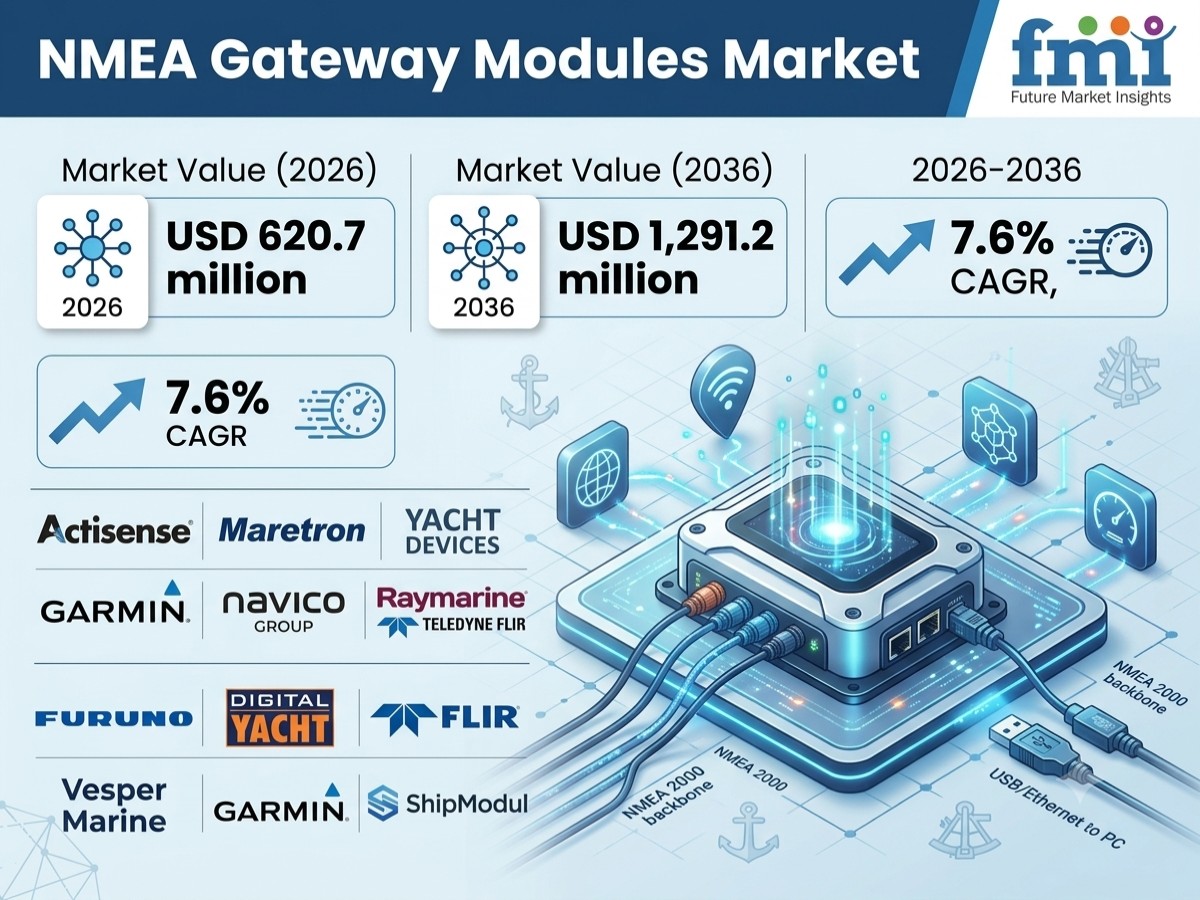
The NMEA Gateway Modules Market is projected to reach USD 1,291.2 million by 2036, rising from USD 620.7 million in 2026 at a 7.6% CAGR from 2026 to 2036, according to Future Market Insights (FMI). The market was valued at USD 576.9 million in 2025.
Demand is being supported by marine electronics owners retaining serviceable NMEA 0183 instruments while adding newer NMEA 2000, CAN, Ethernet, Wi-Fi, and Bluetooth-enabled endpoints. Retrofit projects are creating continued demand for gateway modules that translate protocols and allow mixed-generation vessel networks to operate together.
Get detailed market forecasts, competitive benchmarking, and pricing trends:
https://www.futuremarketinsights.com/reports/sample/rep-gb-35396
Why Are NMEA Gateway Modules Gaining Ground?
NMEA gateway modules are becoming increasingly relevant as boat owners upgrade displays, sensors, navigation systems, and engine interfaces without replacing every functioning instrument onboard. This creates a need for reliable protocol conversion between legacy serial systems and newer CAN-based networks.
Retrofit demand is particularly visible in recreational boating, where electronics are often replaced in stages. Gateway modules allow installers to preserve usable equipment while introducing new multifunction displays and connected devices.
FMI analysis also highlights commissioning quality as an important consideration. Connector compatibility alone does not guarantee correct message mapping or electrical isolation. Installers therefore require clear conversion documentation, reliable diagnostics, and predictable network behavior before vessel handover.
Key Market Highlights
- 2026 market value: USD 620.7 million
• 2036 market value: USD 1,291.2 million
• 2026–2036 CAGR: 7.6%
• NMEA 0183 to NMEA 2000 gateways share in 2026: 26.0%
• Wired connectivity share in 2026: 34.0%
• Recreational boats share in 2026: 34.0%
• Marine electronics dealers share in 2026: 38.0%
• Netherlands CAGR: 8.3%
What Is Driving Growth in the NMEA Gateway Modules Market?
The continued use of legacy marine electronics is a major demand driver. Owners often replace a display or sensor while retaining instruments that remain functional. Protocol converters allow these devices to communicate with newer network architectures without requiring complete system replacement.
Remote diagnostics are creating another opportunity. Gateway interfaces that provide network maps, live data views, and log downloads can help technicians identify message or configuration issues before additional hardware is replaced. This can reduce unnecessary service visits, particularly for vessels operating far from specialist marine electronics providers.
NMEA 0183 to NMEA 2000 gateways are forecast to account for 26.0% share in 2026, reflecting persistent retrofit requirements between serial and CAN-based networks. Wired connectivity is expected to hold 34.0% share, supported by fixed data paths that installers can validate during commissioning.
Recreational Boats Remain a Key Application Area
Recreational boats are projected to account for 34.0% share in 2026 within the vessel type category. Phased electronics upgrades support demand as owners replace displays and sensors on different schedules while retaining serviceable onboard equipment.
Engine data conversion is another important application, with a projected 26.0% share in 2026. Gateways can translate propulsion data so engine information appears alongside navigation and other vessel information on networked displays.
Marine electronics dealers are forecast to lead the sales channel category with 38.0% share in 2026. Their role in compatibility assessment, installation, network testing, and commissioning makes dealer-led projects important for gateway suppliers.
Netherlands and Norway Show Strong Growth
Regional growth varies across major markets. The Netherlands is projected to record an 8.3% CAGR, followed by Norway at 7.9%, Australia at 7.2%, the USA at 7.0%, France at 6.8%, Germany at 6.7%, and Japan at 5.8%.
The Netherlands benefits from an established recreational boating base and recurring electronics retrofit activity. Norway’s coastal operating environment increases the value of dependable commissioning and fault visibility. Australia offers opportunities for remote diagnostics because service visits can be costly for vessels operating far from metropolitan centers.
The USA combines a broad recreational aftermarket with diverse engine and electronics generations. Japan follows a more compatibility-focused integration path where regulated communication equipment requires documented interoperability.
What Challenges Could Slow Market Growth?
Commissioning risk remains a significant restraint. Incorrect message mapping, electrical isolation problems, unsupported data, and inadequate network configuration can increase installation time and service costs.
Cybersecurity and controlled diagnostic access are also becoming important as gateways connect vessel networks with wireless and remote interfaces. Suppliers that combine protocol conversion with authenticated diagnostics and clear data-routing controls can address emerging service requirements.
Analyst Perspective
Sudip Saha, Principal Consultant at Future Market Insights, said:
“Gateway economics are settled during commissioning because repeated troubleshooting can erase hardware savings. Suppliers earn repeat business when installers verify message coverage and electrical isolation before vessel handover.”
Competitive Landscape
The market includes Actisense, Maretron, Yacht Devices, Garmin, Navico Group, Raymarine / Teledyne FLIR, Furuno, Digital Yacht, Vesper Marine / Garmin, and ShipModul.
Competition centers on protocol coverage, network diagnostics, wireless routing, installation support, and compatibility with different generations of marine electronics. Protocol-conversion specialists compete through dedicated interfaces and installer-focused tools, while larger marine electronics companies integrate gateway functionality into broader navigation and vessel-monitoring platforms.
Discover the Full Details in Our Report-Read More Now!
https://www.futuremarketinsights.com/reports/nmea-gateway-modules-market
About the Report
The NMEA Gateway Modules Market report covers gateway type, connectivity, vessel type, application, sales channel, and regional markets. Gateway types include NMEA 0183 to NMEA 2000, NMEA 2000 to Ethernet, CAN to NMEA, Wi-Fi-Bluetooth NMEA, and multi-protocol gateways.
The study covers North America, Latin America, Western Europe, Eastern Europe, East Asia, South Asia and Pacific, and the Middle East and Africa. The research combines primary interviews with manufacturers, distributors, service providers, technology developers, procurement teams, and industry experts with secondary research covering technical standards, industry developments, company information, and market indicators.
Explore More Related Reports –
Billing and Revenue Management Market – https://www.futuremarketinsights.com/reports/billing-and-revenue-management-market
Binary Drivers Market – https://www.futuremarketinsights.com/reports/binary-drivers-market
Acoustic Wave Filters Market – https://www.futuremarketinsights.com/reports/acoustic-wave-filters-market
Accounting Software Market – https://www.futuremarketinsights.com/reports/accounting-software-market
Media Processing Solutions Market – https://www.futuremarketinsights.com/reports/media-processing-solutions-market
Contact Us:
Future Market Insights Inc.
Christiana Corporate, 200 Continental Drive,
Suite 401, Newark, Delaware – 19713, USA
T: +1-347-918-3531
For Sales Enquiries: sales@futuremarketinsights.com
About Future Market Insights (FMI)
Future Market Insights, Inc. (FMI) is an ESOMAR-certified, ISO 9001:2015 market research and consulting organization, trusted by Fortune 500 clients and global enterprises. With operations in the U.S., UK, India, and Dubai, FMI provides data-backed insights and strategic intelligence across 30+ industries and 1200 markets worldwide.