

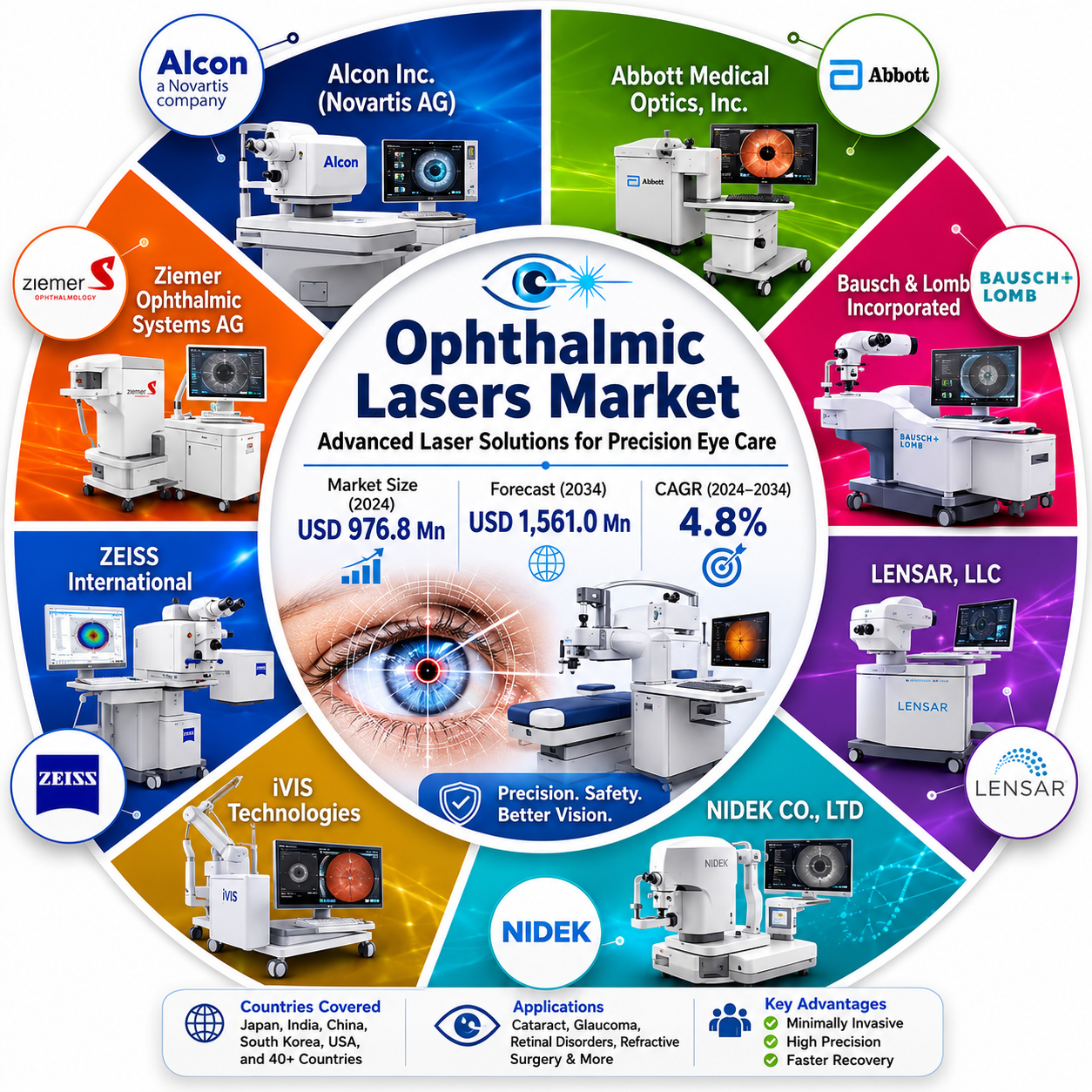
NEWARK, Del., Aug. 14, 2026 — The global Ophthalmic Lasers Market is expanding as ophthalmology practices increasingly adopt precision-based laser technologies for treating refractive errors, glaucoma, retinal disorders, and other vision-related conditions. According to Future Market Insights (FMI), the market is projected to grow from USD 976.8 million in 2024 to USD 1,561.0 million by 2034, registering a 4.8% CAGR during the forecast period.
Ophthalmic laser systems have become an important component of modern eye-care procedures because they can target specific ocular tissues with controlled energy delivery. Improvements in femtosecond lasers, selective laser trabeculoplasty (SLT), photocoagulation, and other laser-based modalities are supporting demand for less invasive and more precise treatment approaches.
👉 Get Detailed Market Forecasts, Competitive Benchmarking, and Pricing Trends
The market is expected to create an absolute dollar opportunity of approximately USD 584.2 million between 2024 and 2034. Future growth will increasingly depend on treatment precision, clinical outcomes, equipment reliability, technological innovation, affordability, and the ability of ophthalmic practices to replace older laser platforms with advanced systems.
Key Ophthalmic Lasers Market Highlights at a Glance
- Market Size (2024): USD 976.8 Million
- Forecast Market Size (2034): USD 1,561.0 Million
- Historical Market Size (2023): USD 932.1 Million
- Forecast Period: 2024–2034
- CAGR (2024–2034): 4.8%
- Absolute Dollar Opportunity: Approximately USD 584.2 Million
- Key Laser Types: Excimer and Femtosecond Lasers
- Key Applications: Refractive Correction, Glaucoma, Retinal Disorders and Other Ophthalmic Conditions
- Key Growth Areas: North America, Western Europe and Other Developed Healthcare Markets
- Key Companies: Abbott Medical Optics, Alcon, Bausch & Lomb, LENSAR, NIDEK, iVIS Technologies, ZEISS, Ziemer Ophthalmic Systems, and SCHWIND eye-tech-solutions
Analyst Viewpoint
“Ophthalmic laser technology continues to evolve toward greater procedural precision, reduced invasiveness, and improved control of energy delivery. As ophthalmology practices address growing volumes of refractive, retinal, and glaucoma procedures, technology selection is increasingly influenced by clinical versatility, accuracy, equipment reliability, and patient outcomes. Manufacturers that combine advanced laser platforms with strong clinical support and service capabilities are expected to remain competitive as providers modernize their ophthalmic treatment infrastructure.”
Why Is the Ophthalmic Lasers Market Growing?
The increasing prevalence of ophthalmic disorders is creating sustained demand for advanced treatment technologies.
Conditions such as cataracts, glaucoma, diabetic retinopathy, retinal disorders, macular degeneration, myopia, hyperopia, astigmatism, and other vision problems continue to increase the need for specialized ophthalmic interventions.
Ophthalmic lasers can selectively deliver energy to targeted ocular tissues, supporting procedures that may reduce dependence on conventional surgical approaches in appropriate clinical applications.
The growing geriatric population is another important demand driver because aging is associated with a higher incidence of several ophthalmic conditions.
Healthcare systems are consequently placing greater emphasis on early diagnosis, treatment precision, and technologies that can improve procedural efficiency.
Key Growth Drivers
- Increasing prevalence of glaucoma and retinal disorders.
- Growing geriatric population.
- Rising demand for minimally invasive ophthalmic procedures.
- Increasing adoption of femtosecond laser technology.
- Improvements in laser precision and energy delivery.
- Growing demand for refractive error correction.
- Increasing healthcare expenditure in developed economies.
- Supportive reimbursement environments in selected markets.
- Rising investment in advanced ophthalmic equipment.
Ophthalmic lasers are increasingly being evaluated as part of broader efforts to improve treatment accuracy while reducing procedural invasiveness.
How Are Ophthalmic Lasers Used in Modern Eye Care?
Ophthalmic laser systems can be used across several clinical applications depending on the laser wavelength, energy characteristics, and targeted ocular tissue.
For example, laser photocoagulation can be used in the management of selected retinal conditions, while laser-based procedures such as SLT are used for glaucoma management.
Excimer lasers are associated with refractive procedures, where controlled tissue removal can reshape the cornea to address certain refractive errors.
Femtosecond lasers provide highly controlled pulses and have expanded the precision available in several ophthalmic procedures.
The ability to customize energy delivery according to the clinical indication is therefore an important factor supporting the continued adoption of ophthalmic laser systems.
Why Is Precision Becoming Important in Ophthalmic Laser Treatment?
Precision is one of the central advantages associated with modern ophthalmic laser systems.
Traditional treatment approaches may involve greater dependence on manual intervention, whereas advanced laser platforms can provide highly controlled energy delivery to defined tissue areas.
Laser systems can support procedures requiring precise tissue ablation, coagulation, or restructuring while limiting unnecessary exposure of surrounding tissue.
Continued improvements in laser engineering, optical systems, cooling mechanisms, delivery interfaces, and computer-assisted controls are expected to strengthen the clinical value proposition of ophthalmic lasers.
What Technology Is Used in Ophthalmic Laser Systems?
Most ophthalmic laser systems incorporate several core components, including a laser pump, laser medium, cooling system, and laser cavity.
These components work together to generate and deliver controlled laser energy through specialized ophthalmic interfaces.
Slit-lamp biomicroscopes, flexible fiber-optic systems, intraocular probes, indirect ophthalmoscopes, and other delivery interfaces can support different clinical applications.
The development of more precise delivery mechanisms is enabling manufacturers to expand the capabilities of ophthalmic laser platforms while improving procedural control.
What Are the Latest Ophthalmic Laser Technology Trends?
Innovation is reshaping the ophthalmic lasers industry.
Major trends include:
- Increasing development of femtosecond laser platforms.
- Greater adoption of selective laser trabeculoplasty.
- Improvements in laser energy precision.
- Increasing use of minimally invasive treatment approaches.
- Development of advanced retinal laser systems.
- Integration of sophisticated optical delivery systems.
- Greater focus on patient comfort and procedural efficiency.
- Expansion of laser applications across ophthalmic specialties.
- Increasing modernization of aging ophthalmic laser equipment.
Manufacturers are increasingly focusing on systems designed to provide more targeted treatment while improving clinical workflow and reducing unwanted tissue exposure.
What Are the Key Market Challenges and Restraints?
High equipment and procedure costs remain important barriers to broader adoption.
Ophthalmic clinics and hospitals may also face substantial expenses when replacing older laser systems with newer platforms. Capital constraints can therefore delay equipment modernization, particularly among smaller practices.
Training requirements, maintenance costs, reimbursement differences, and the availability of specialized ophthalmic professionals can also influence purchasing decisions.
Healthcare providers must balance the clinical advantages of advanced laser platforms with acquisition, servicing, and operating costs.
What Is the Regional Outlook?
North America remains a major market for ophthalmic lasers, supported by advanced healthcare infrastructure, high adoption of ophthalmic technologies, established reimbursement systems, and significant investment in specialized eye care.
Western Europe is expected to remain another important regional market. Established ophthalmology networks, healthcare expenditure, and demand for sophisticated treatment technologies support the adoption of ophthalmic laser systems.
Developed healthcare markets are expected to maintain relatively strong demand because providers have greater access to capital equipment and advanced ophthalmic procedures.
Emerging markets may offer additional opportunities as healthcare infrastructure expands, ophthalmic treatment access improves, and awareness of laser-based procedures increases.
What Is the Competitive Landscape?
Competition in the ophthalmic lasers market is increasingly focused on laser precision, treatment versatility, clinical reliability, optical delivery systems, procedural efficiency, and technological differentiation.
Manufacturers are investing in advanced laser platforms designed to address multiple ophthalmic indications while improving control over energy delivery.
The competitive environment includes global ophthalmic technology companies as well as specialized laser manufacturers developing platforms for refractive, retinal, and glaucoma procedures.
Key Companies
- Abbott Medical Optics, Inc.
- Alcon Inc.
- Bausch & Lomb Incorporated
- LENSAR, LLC
- NIDEK CO., LTD
- iVIS Technologies
- ZEISS International
- Ziemer Ophthalmic Systems AG
- SCHWIND eye-tech-solutions GmbH & Co. KG
These companies compete through femtosecond and excimer laser platforms, ophthalmic surgical systems, refractive technologies, treatment precision, product innovation, and expanded clinical applications.
Frequently Asked Questions
- What is the projected size of the Ophthalmic Lasers Market by 2034? The global Ophthalmic Lasers Market is projected to reach USD 1,561.0 million by 2034, increasing from USD 976.8 million in 2024.
- What is the expected CAGR of the Ophthalmic Lasers Market? The market is forecast to expand at a 4.8% CAGR between 2024 and 2034.
- What was the size of the Ophthalmic Lasers Market in 2023? The global market generated approximately USD 932.1 million in revenue in 2023.
- Which laser technologies are covered in the market? Key laser technologies include excimer and femtosecond lasers, alongside other ophthalmic laser technologies used across different clinical applications.
- What conditions can ophthalmic lasers address? Ophthalmic lasers are used across procedures involving refractive errors, glaucoma, retinal disorders, diabetic retinopathy, macular conditions, and other ophthalmic diseases, depending on the technology and clinical indication.
- Which region dominates the Ophthalmic Lasers Market? North America remains a leading regional market, supported by advanced healthcare infrastructure, established ophthalmic treatment capabilities, and strong adoption of medical technologies.
- What factors are driving the Ophthalmic Lasers Market? Increasing ophthalmic disease prevalence, population aging, demand for minimally invasive procedures, advances in femtosecond and other laser technologies, improved treatment precision, and healthcare investment are key market growth drivers.
Related Reports:
- https://sites.google.com/view/healthcarewellnessinsights/lab-automation-specimen-handling-robotics-market
- https://sites.google.com/view/healthcarewellnessinsights/pharmacy-automation-robotics-market
- https://sites.google.com/view/healthcarewellnessinsights/dna-encoded-library-market
- https://sites.google.com/view/healthcarewellnessinsights/varicose-ulcer-market
- https://sites.google.com/view/healthcarewellnessinsights/viral-sensitizers-market
About Future Market Insights (FMI)
Future Market Insights (FMI) is a global market intelligence and consulting firm providing comprehensive market research, competitive intelligence, and strategic business insights across industries. The firm delivers detailed forecasts, technology analysis, and data-driven recommendations that support informed decision-making for manufacturers, investors, distributors, and policymakers worldwide.
For Press & Corporate Inquiries
Rahul Singh
AVP – Marketing and Growth Strategy
Future Market Insights, Inc.
+91 8600020075
For Sales – sales@futuremarketinsights.com
For Media – Rahul.singh@futuremarketinsights.com
For Web – https://www.futuremarketinsights.com