

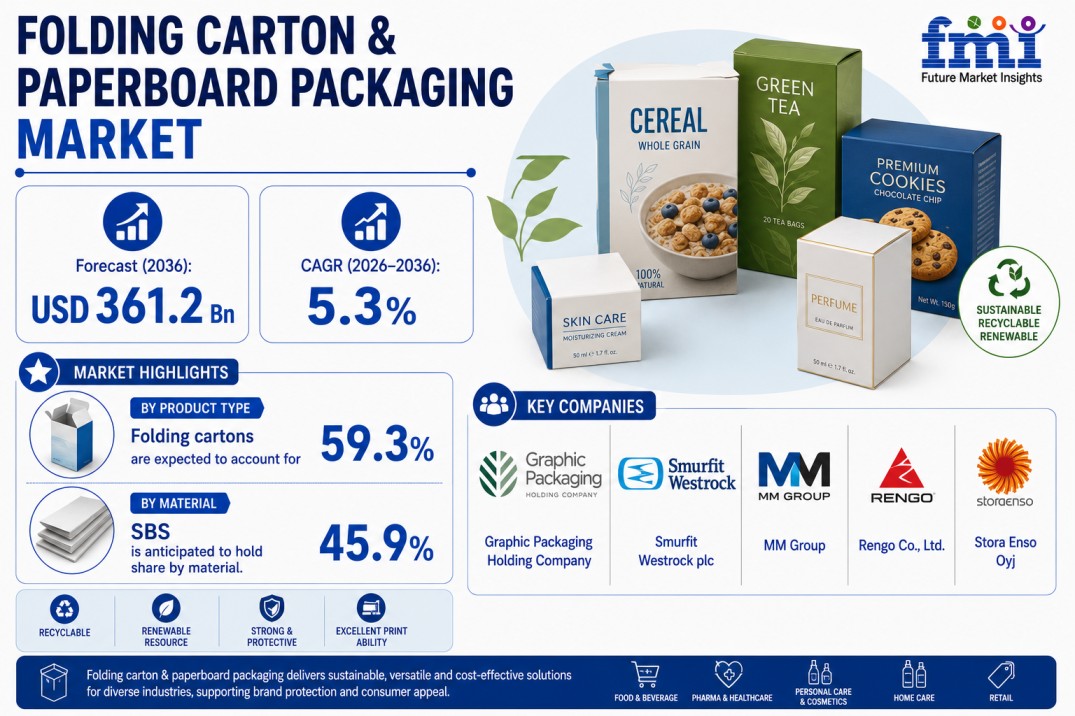
The global folding carton & paperboard packaging market is expected to reach USD 215.5 billion in 2026 and is projected to grow to USD 361.2 billion by 2036, registering a CAGR of 5.3% during the forecast period. Increasing demand for recyclable packaging, tightening environmental regulations, and the rapid expansion of food, healthcare, cosmetics, and e-commerce industries are creating sustained opportunities for paperboard packaging manufacturers worldwide.
Paper and paperboard continue to be the preferred packaging materials due to their recyclability, print quality, lightweight nature, and compatibility with automated packaging lines. As brands focus on reducing plastic waste and improving sustainability performance, folding cartons are becoming an essential packaging format across multiple industries.
Market Overview
The folding carton and paperboard packaging industry is undergoing a significant transformation as governments and brand owners accelerate the transition toward circular packaging systems. Regulatory initiatives such as the European Union’s Packaging and Packaging Waste Regulation (PPWR) are encouraging manufacturers to redesign packaging for improved recyclability while maintaining product protection and production efficiency.
The market is also benefiting from increasing consumption of packaged food, pharmaceuticals, cosmetics, and personal care products. Manufacturers are investing in high-performance paperboard materials that offer excellent printability, structural integrity, and compatibility with high-speed packaging operations.
Growing investments in sustainable fiber sourcing, recycled paperboard production, and advanced converting technologies are further strengthening long-term market prospects.
Market Size and Forecast
The market is projected to witness steady expansion over the next decade.
- Market Size (2026): USD 215.5 Billion
- Forecast Value (2036): USD 361.2 Billion
- CAGR (2026–2036): 5.3%
The market’s growth is supported by increasing packaging demand across food processing, pharmaceutical manufacturing, consumer goods, and e-commerce logistics.
Why is the Folding Carton & Paperboard Packaging Market Growing?
One of the primary factors driving market expansion is the global shift toward sustainable packaging materials. Governments are implementing stricter regulations on plastic packaging while encouraging recyclable and renewable alternatives. Paperboard packaging aligns well with these objectives due to its high recycling rate and renewable raw material base.
Food manufacturers increasingly prefer folding cartons because they provide excellent shelf presentation while protecting products throughout transportation and storage. Healthcare companies rely on paperboard cartons for labeling accuracy, product safety, and regulatory compliance. Cosmetic brands also utilize premium paperboard grades to improve product appearance and brand visibility.
Rapid growth in online retail has created additional demand for lightweight yet durable paperboard packaging capable of protecting products during shipping while minimizing environmental impact.
Product Insights
Among product categories, folding cartons are expected to remain the dominant segment, accounting for approximately 59.3% of the global market in 2026.
Their popularity is attributed to:
- High production efficiency
- Excellent print quality
- Lightweight construction
- Easy storage and transportation
- Compatibility with automated filling systems
Compared to rigid boxes, folding cartons require less material, occupy less warehouse space, and reduce transportation costs while maintaining structural performance.
Rigid boxes continue to serve premium packaging applications but represent a comparatively smaller portion of overall demand.
Material Analysis
Based on material type, Solid Bleached Sulfate (SBS) paperboard is projected to account for approximately 45.9% of the market in 2026.
SBS offers several commercial advantages including:
- Smooth printing surface
- Superior brightness
- High stiffness
- Consistent folding performance
- Excellent appearance for premium packaging
These characteristics make SBS particularly suitable for pharmaceuticals, cosmetics, luxury consumer goods, and premium food packaging.
Recycled paperboard and coated recycled board (CRB) continue to gain popularity in cost-sensitive applications where sustainability objectives outweigh premium appearance requirements.
End-use Industry Analysis
The food industry is anticipated to remain the largest end-use sector, capturing nearly 36.2% of total market demand during 2026.
Food manufacturers increasingly rely on folding cartons because they offer:
- Strong product protection
- Excellent branding opportunities
- Moisture and grease resistance (with suitable barrier coatings)
- High-speed filling compatibility
- Recyclability
Apart from food packaging, demand is also increasing across:
- Pharmaceuticals
- Beauty and personal care
- Consumer goods
- E-commerce
- Household products
Healthcare packaging continues to expand as pharmaceutical companies require packaging solutions that combine product protection with precise labeling and regulatory compliance.
Market Drivers
Several structural factors continue to support long-term market growth. The rising adoption of recyclable packaging materials remains the strongest demand driver. Consumer preference for environmentally responsible packaging is encouraging companies to replace plastic containers with fiber-based alternatives.
Advancements in paperboard manufacturing are enabling producers to develop lighter yet stronger packaging materials capable of reducing transportation costs while maintaining product safety. Automation within packaging facilities is also driving demand for paperboard grades that deliver consistent converting performance, accurate creasing, and reliable carton erection during high-speed production.
Market Challenges
Despite favorable growth prospects, the industry faces several challenges. Maintaining consistent recycled fiber quality remains difficult due to contamination during waste collection and recycling processes. Variations in fiber quality can affect print performance, stiffness, and structural strength.
Manufacturers must also comply with increasingly stringent food-contact regulations, requiring continuous investment in material testing, certification, and product development. In addition, fluctuating pulp prices and energy costs continue to influence production economics for paperboard manufacturers.
Regional Outlook
Asia Pacific is expected to remain the fastest-growing regional market throughout the forecast period.
India is projected to register the highest CAGR of 5.5%, supported by expanding food processing industries, increasing packaged consumer goods demand, and growing domestic paperboard converting capacity.
China follows closely with a 5.1% CAGR, driven by large-scale manufacturing, rising e-commerce packaging demand, and continuous investments in sustainable packaging production.
The United States continues to experience stable demand from foodservice, healthcare, and consumer goods industries while benefiting from ongoing packaging innovation.
European countries are witnessing increasing adoption of recyclable folding cartons due to stricter environmental legislation and extended producer responsibility (EPR) regulations.
Competitive Landscape
Competition within the folding carton and paperboard packaging market is characterized by continuous investments in paperboard production capacity, sustainable material innovation, and advanced converting technologies.
Leading companies are strengthening their market position by expanding manufacturing facilities, developing premium paperboard grades, and offering integrated packaging solutions across global markets.
Major industry participants include:
- Graphic Packaging Holding Company
- Smurfit Westrock plc
- MM Group
- Rengo Co., Ltd.
- Stora Enso Oyj
- Oji Holdings Corporation
- Clearwater Paper Corporation
- Metsä Board Corporation
These companies continue investing in recycled paperboard production, lightweight packaging technologies, automation, and sustainable material development to meet evolving customer requirements.
Future Outlook
The folding carton & paperboard packaging market is expected to experience steady growth through 2036 as sustainability regulations, consumer preferences, and corporate environmental commitments reshape the global packaging industry.
Increasing adoption of recyclable materials, continued expansion of food and healthcare packaging, and investments in high-performance paperboard products will remain the key drivers supporting market growth. As manufacturers seek packaging solutions that combine environmental responsibility with operational efficiency, folding cartons are expected to strengthen their position as one of the world’s most important packaging formats over the coming decade.
Related Research Reports:
Heat Seal Paper Coatings Market: USD 1,480.6 million in 2026 and USD 3,736.8 million by 2036 at a 9.7% CAGR.
PFAS-Free Grease Resistant Paper Packaging Market: USD 101.6 million in 2026 and USD 178.5 million by 2036 at a 5.8% CAGR.
Paper-Based Sachet Packaging Market: USD 464.0 million in 2026 and USD 947.5 million by 2036 at a 7.4% CAGR.
About Future Market Insights (FMI)
Future Market Insights is a leading provider of market intelligence, consulting services, and syndicated research reports. FMI delivers actionable insights across packaging, logistics, industrial manufacturing, food and beverage, healthcare, chemicals, and emerging technologies, helping organizations identify growth opportunities and make informed strategic decisions in rapidly evolving markets.
Contact
Future Market Insights Inc.
Christiana Corporate
200 Continental Drive, Suite 401
Newark, Delaware 19713, USA