

The global dairy ingredients market is undergoing a value transformation where purchasing decisions are no longer driven solely by protein concentration, milk solids, or ingredient cost. Increasingly, food manufacturers are evaluating dairy ingredients based on source transparency, certification, processing perception, and their ability to support consumer-facing clean-label claims without compromising formulation performance.
Organic, grass-fed, non-GMO, hormone-free, traceable, and lactose-reduced dairy ingredients are creating new opportunities for premium pricing across milk powders, whey proteins, milk proteins, casein, lactose, butter powders, and specialty dairy fractions. However, these premiums are sustainable only when cleaner sourcing is matched by consistent taste, solubility, nutritional quality, processing stability, and reliable supply.
Featured Snippet: Key Market Answer
Q: Why are clean-label dairy ingredients commanding higher prices in the market?
A: Clean-label dairy ingredients generate premium value because they allow brands to support claims such as organic, grass-fed, non-GMO, traceable, hormone-free, and minimally processed while maintaining trusted dairy nutrition. However, buyers are willing to pay more only when these ingredients also deliver formulation performance, including excellent solubility, neutral taste, heat stability, shelf life, and processing consistency. Clean-label positioning alone is rarely sufficient to justify a premium.
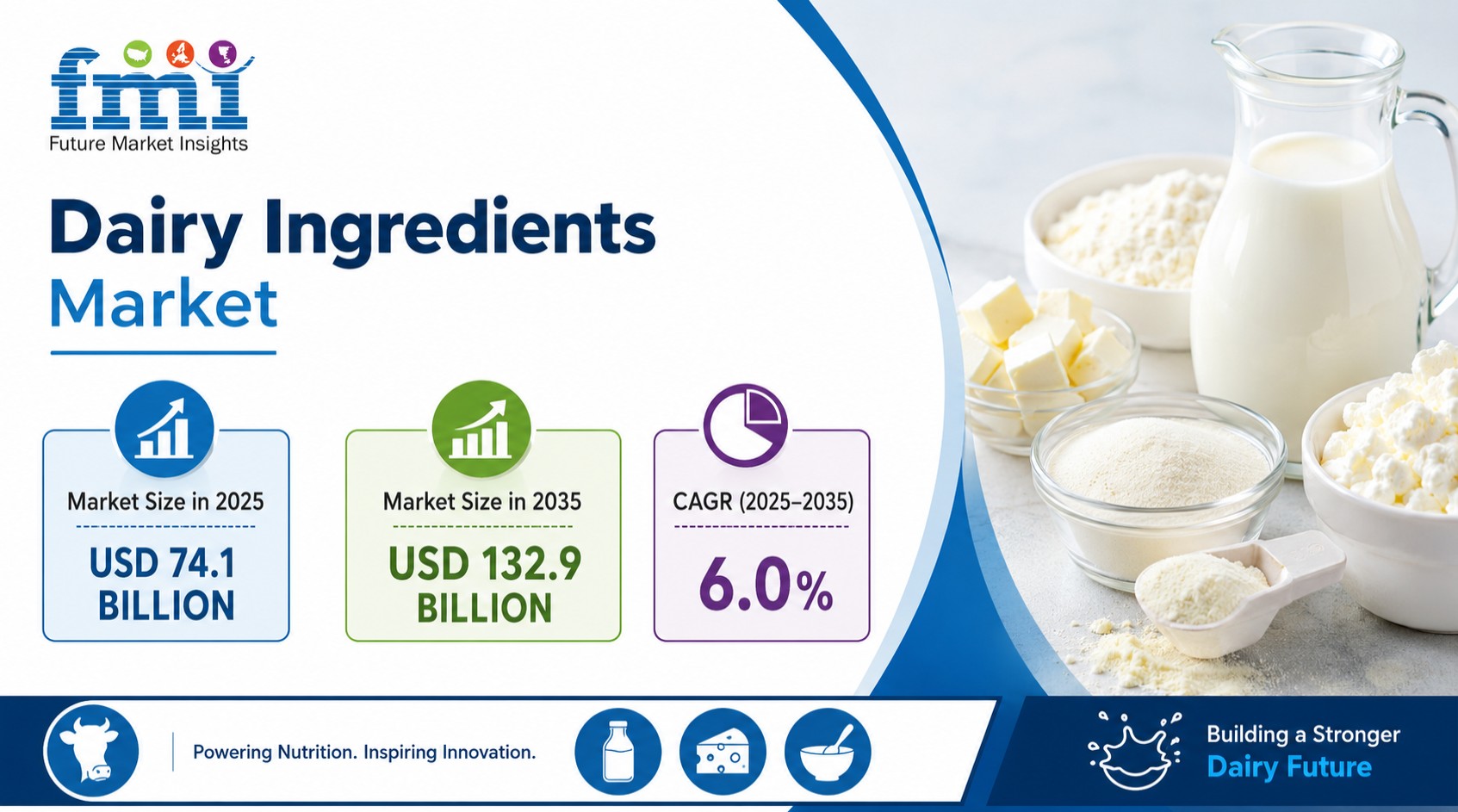
Quick Stats of the Dairy Ingredients Market
- Core Growth Theme: Certification-Driven Premium Dairy Formulation
- 2025 Market Size: USD 74.1 Billion
- 2035 Market Size: USD 132.7 Billion
- Forecast CAGR (2025–2035):0%
- Leading Product Segment: Milk Powder
- Dominant Product Form: Powdered Dairy Ingredients
- Critical Commercial Variable: Balance between clean-label claims and functional performance
Market Overview: Clean Label Is Redefining Dairy Ingredient Value
The dairy ingredients industry has moved beyond commodity pricing toward value-based procurement. Manufacturers increasingly seek ingredients that not only provide nutrition and functionality but also strengthen consumer confidence through transparent sourcing and simplified ingredient declarations.
This shift reflects broader changes across food and beverage markets, where consumers actively examine ingredient lists, production practices, animal welfare standards, and certification labels before making purchasing decisions. As a result, dairy ingredients are increasingly evaluated according to three interconnected value drivers: source credibility, claim potential, and formulation performance.
Milk powder, whey proteins, milk protein concentrates, caseinates, lactose, butter powders, and specialty dairy ingredients remain foundational components of modern food production. Yet identical functional performance can now command different market values depending on origin, certification, and consumer perception.
Key Growth Drivers Across Clean-Label Dairy Ingredients
Consumer Demand for Ingredient Transparency
Food brands increasingly require dairy ingredients that support simple, recognizable ingredient statements backed by traceable sourcing and credible certifications. Transparency has become a competitive advantage across premium food, beverage, and nutritional products.
Expansion of Premium Nutrition Categories
Infant nutrition, sports nutrition, medical nutrition, functional dairy, and premium bakery continue driving demand for dairy ingredients capable of supporting higher-value positioning through trusted sourcing and quality assurance.
Certification Supports Premium Pricing
Organic certification, grass-fed production, non-GMO verification, hormone-free positioning, and traceability programs enable manufacturers to differentiate products in competitive markets while strengthening consumer trust.
Reformulation Toward Cleaner Ingredient Systems
As manufacturers reduce artificial additives and simplify formulations, dairy ingredients increasingly replace synthetic alternatives by providing natural flavor, texture, protein fortification, browning characteristics, and nutritional functionality.
Technical & Ingredient Economics Behind Clean-Label Premiums
Premium dairy ingredients succeed only when commercial claims are supported by manufacturing performance.
- Source Premium: Organic production, grass-fed milk sourcing, regional traceability, animal welfare practices, and controlled farm management contribute to higher ingredient value by strengthening consumer confidence and certification-backed positioning.
- Claim Premium: Non-GMO verification, hormone-free production, lactose reduction, natural processing, and clean ingredient declarations enable brands to differentiate finished products in premium retail channels.
- Performance Premium: Solubility, emulsification, neutral flavor, heat stability, protein quality, browning characteristics, shelf-life performance, and processing consistency remain essential requirements regardless of clean-label positioning.
- Supply Chain Investment: Delivering clean-label dairy ingredients requires identity preservation, segregation systems, residue monitoring, quality assurance, documentation, and certification management throughout the production process.
Segment Deep Dive: Where Clean-Label Premiums Create the Most Value
Milk Powder: The Foundation of Premium Dairy Formulation
Milk powder remains the largest dairy ingredient category because of its versatility, shelf stability, transportation efficiency, and broad application across food manufacturing.
The market increasingly differentiates between conventional milk powders and premium variants supported by organic certification, grass-fed sourcing, traceability, and regional origin, allowing manufacturers to build stronger consumer-facing narratives.
Whey Protein: Premium Performance Meets Transparency
Sports nutrition, meal replacement beverages, recovery products, and functional foods continue expanding demand for premium whey protein ingredients.
Beyond protein concentration, buyers increasingly value whey proteins that support grass-fed, non-GMO, hormone-free, and transparent sourcing claims while maintaining excellent solubility, neutral flavor, and superior digestibility.
Milk Proteins and Specialty Dairy Fractions
Milk protein concentrates, milk protein isolates, caseins, caseinates, lactose, butter powders, and specialty dairy ingredients continue gaining importance across premium food formulations.
Manufacturers increasingly evaluate these ingredients according to their ability to support nutritional claims while maintaining texture, emulsification, stability, and processing efficiency.
Infant and Clinical Nutrition
Infant formula and clinical nutrition remain among the highest-value applications for clean-label dairy ingredients.
In these sectors, premium pricing depends on rigorous quality assurance, contaminant control, traceability, nutritional consistency, and regulatory compliance rather than marketing claims alone.
Functional Dairy and Premium Bakery
High-protein yogurts, dairy beverages, bakery products, confectionery, desserts, and nutritional snacks increasingly utilize clean-label dairy ingredients to improve flavor, mouthfeel, nutritional quality, and consumer trust while simplifying ingredient declarations.
Regional Market Dynamics
North America
North American consumers increasingly associate premium dairy products with transparency, grass-fed sourcing, organic certification, and natural ingredient positioning. Manufacturers continue investing in value-added dairy ingredients that support differentiated retail positioning.
Europe
European markets emphasize animal welfare, sustainable dairy production, clean-label formulation, and certification-backed quality systems. Regulatory oversight and consumer awareness continue strengthening demand for traceable premium dairy ingredients.
Asia-Pacific
Asia-Pacific represents one of the fastest-growing markets for premium dairy ingredients, driven by expanding infant nutrition, sports nutrition, functional beverages, and high-protein food categories. While price sensitivity remains important, demand for trusted imported dairy ingredients continues growing.
Oceania
Oceania benefits from its global reputation for grass-fed dairy production, enabling suppliers to capitalize on premium export opportunities supported by origin credibility and established dairy quality standards.
Competitive Differentiation Strategies
Leading dairy ingredient suppliers increasingly compete through trust, technical expertise, and supply chain transparency.
- Certification and Traceability: Organic, grass-fed, non-GMO, and origin verification programs strengthen customer confidence while supporting premium product positioning.
- Application-Specific Technical Support: Manufacturers provide formulation guidance for infant nutrition, bakery, beverages, sports nutrition, dairy products, and functional foods to maximize ingredient performance.
- Quality Assurance Systems: Batch consistency, contaminant monitoring, allergen documentation, microbiological control, and specification management reinforce premium positioning.
- Supply Chain Transparency: Farm-level sourcing information, residue management, animal welfare documentation, and sustainability reporting improve customer trust throughout the value chain.
- Balanced Value Proposition: Successful suppliers combine certification with measurable improvements in functionality, taste, processing efficiency, and nutritional performance rather than relying on marketing claims alone.
Industry FAQs
Why are brands paying more for clean-label dairy ingredients?
Brands increasingly invest in dairy ingredients that support organic, grass-fed, non-GMO, traceable, and natural positioning because these claims strengthen consumer trust and justify premium finished-product pricing when supported by reliable performance.
Which dairy ingredient categories offer the strongest clean-label opportunities?
Milk powders, whey proteins, milk protein concentrates, caseins, lactose-reduced systems, butter powders, and specialty dairy fractions provide significant opportunities when combined with credible certifications and strong formulation functionality.
Is organic certification enough to justify higher ingredient prices?
No. Organic certification adds value, but buyers also expect excellent solubility, neutral flavor, heat stability, nutritional consistency, processing reliability, and dependable supply before accepting premium pricing.
Which industries generate the highest demand for clean-label dairy ingredients?
Infant nutrition, sports nutrition, clinical nutrition, premium bakery, functional dairy products, nutritional beverages, confectionery, and clean-label snack manufacturing represent the strongest commercial opportunities.
How are suppliers differentiating premium dairy ingredients?
Manufacturers increasingly compete through certification programs, traceable sourcing, quality assurance, formulation expertise, technical documentation, application support, and consistent ingredient performance rather than relying solely on clean-label messaging.
Conclusion
The future of the dairy ingredients market will be shaped by the industry’s ability to combine trusted sourcing with dependable functionality. Clean-label positioning has become an important source of pricing power, but premiums will continue flowing only to suppliers capable of demonstrating measurable value throughout the entire product lifecycle.
Conventional dairy ingredients will remain the foundation of global food manufacturing because of their scale, affordability, and proven functionality. At the same time, organic, grass-fed, traceable, non-GMO, and specialty dairy ingredients will continue expanding across premium applications where consumer trust, certification, and ingredient transparency justify additional investment.
Ultimately, clean-label success in dairy ingredients will not depend on certification alone. The strongest market positions will belong to suppliers that integrate transparent sourcing, rigorous quality systems, application expertise, and consistent technical performance into complete ingredient solutions that help brands build stronger, more trusted finished products.
Related Research Reports
- Clean-Label Ingredients Market – Strategic assessment of clean-label reformulation trends across global food and beverage manufacturing.
- Organic Milk Powder Market – Market intelligence covering certified organic dairy powders, premium pricing, and application growth.
- Clean Labelled Food Additives Market – Strategic overview of ingredient simplification and clean-label reformulation across processed foods.
FMI Custom Research: Strategic Intelligence for Confident Decision-Making
In today’s rapidly evolving business environment, leadership teams need more than market data they need clear, actionable intelligence tailored to their strategic objectives. FMI’s Custom Research solutions are designed around the specific business questions organizations need answered, enabling executives to evaluate growth opportunities, validate investments, assess competitive dynamics, and reduce uncertainty before making critical decisions. By combining deep industry expertise, primary research, and proprietary market intelligence, FMI delivers insights that help organizations move from assumptions to evidence-based strategies with greater speed and confidence.
Key Executive Benefits
- Decision-Ready Insights: Research tailored to your specific business challenges, growth plans, and investment priorities.
- Reduced Strategic Risk: Validate market opportunities, customer demand, and competitive positioning before committing resources.
- Market Entry Confidence: Assess opportunity size, regulatory barriers, channel dynamics, and competitive landscapes with precision.
- Competitive Advantage: Gain proprietary intelligence unavailable through syndicated reports or internal datasets.
- Faster Growth Decisions: Accelerate expansion, product development, portfolio optimization, and investment planning.
- Primary Market Validation: Access real-world customer, buyer, and stakeholder insights that support high-confidence decision-making.
- Global Industry Expertise: Powered by 100+ analysts, 20,000+ published reports, and 1.6 million+ hours of research experience.
- Proven Track Record: Over 7,000 market-entry engagements completed across six regions and 14 industry sectors with strong client retention.
Business Impact
FMI helps organizations transform market complexity into strategic clarity, enabling leadership teams to identify growth opportunities faster, optimize resource allocation, strengthen competitive positioning, and make high-stakes business decisions with confidence.
To explore how FMI Custom Research can support your strategic priorities, please connect with our team at – sales@futuremarketinsights.com
About Future Market Insights (FMI)
Future Market Insights is a leading provider of market intelligence, consulting services, and syndicated research reports. FMI delivers actionable insights across food and beverage, healthcare, consumer goods, biotechnology, chemicals, industrial products, and emerging technologies, helping organizations identify growth opportunities and make informed strategic decisions in evolving global markets.
Contact Us:
Future Market Insights Inc.
Christiana Corporate, 200 Continental Drive,
Suite 401, Newark, Delaware – 19713, USA
T: +1-347-918-3531
Why FMI: https://www.futuremarketinsights.com/why-fmi
For Sales Enquiries: sales@futuremarketinsights.com
Website: https://www.futuremarketinsights.com