

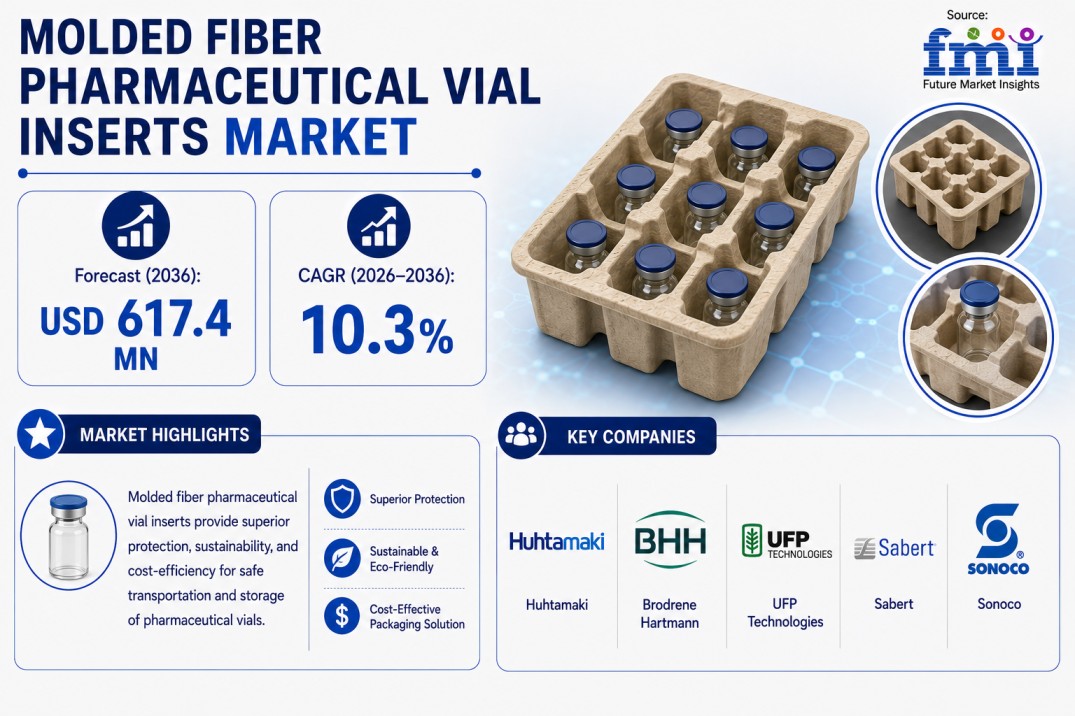
The global Molded Fiber Pharmaceutical Vial Inserts Market is witnessing strong momentum as pharmaceutical manufacturers increasingly adopt sustainable and protective packaging solutions for sensitive medical products. According to Future Market Insights (FMI), the market is projected to grow from USD 231.6 million in 2026 to USD 617.4 million by 2036, registering a robust CAGR of 10.3% during the forecast period.
Growing regulatory pressure to reduce plastic waste, rising pharmaceutical exports, and the expansion of biologics and injectable drug manufacturing are creating strong demand for molded fiber vial inserts. These inserts provide reliable cushioning, shock absorption, and product protection while supporting sustainability initiatives across pharmaceutical packaging supply chains. Unlike conventional plastic inserts, molded fiber alternatives are recyclable, compostable, and increasingly preferred by pharmaceutical companies aiming to meet environmental compliance standards without compromising product safety.
Market Overview
The pharmaceutical industry requires packaging solutions capable of protecting delicate glass vials throughout manufacturing, storage, transportation, and cold-chain distribution. Molded fiber pharmaceutical vial inserts have emerged as an effective solution by combining structural strength with environmentally friendly materials.
As pharmaceutical manufacturers focus on reducing packaging waste and improving supply chain sustainability, molded fiber inserts are replacing expanded polystyrene (EPS) foam and plastic-based protective packaging across several applications. Increasing adoption of injectable drugs, vaccines, biologics, and diagnostic kits is expected to create long-term opportunities for manufacturers offering customized molded fiber packaging solutions.
Market Drivers Fueling Industry Growth
Several structural trends continue to support the expansion of the molded fiber pharmaceutical vial inserts market. One of the primary growth drivers is the pharmaceutical industry’s transition toward sustainable packaging. Regulatory initiatives such as the European Union Packaging and Packaging Waste Regulation (PPWR) encourage manufacturers to adopt recyclable and fiber-based packaging materials, accelerating the shift away from plastic-based inserts.
The rapid expansion of biologics, vaccines, and injectable pharmaceuticals has also increased demand for highly protective packaging solutions. Pharmaceutical companies require packaging capable of minimizing breakage while maintaining product integrity during shipping and handling. Growth in global pharmaceutical exports and expanding cold-chain logistics networks further support market expansion. Longer transportation routes and stricter quality standards require packaging that delivers reliable cushioning and consistent performance throughout the distribution process. In addition, pharmaceutical procurement teams increasingly evaluate packaging suppliers based on documented performance, including drop protection, compression strength, material certification, and manufacturing consistency.
Product Segment Analysis
Among product forms, vial trays are expected to remain the leading segment, accounting for 35.4% of the global market in 2026.
Vial trays are widely used because they provide secure positioning for pharmaceutical containers during transportation while reducing movement that could result in damage. Their lightweight construction and compatibility with automated packaging lines further increase their adoption across pharmaceutical manufacturing facilities. Other important product categories include cell dividers, cradles, corner protectors, and unit inserts, each serving specialized packaging applications depending on vial size, shipping configuration, and customer requirements.
Feedstock Trends
Low-endotoxin fiber is projected to account for approximately 30.9% of total market demand in 2026.
Pharmaceutical manufacturers increasingly prefer this material because it offers excellent cleanliness, low contamination risk, reliable compression performance, and compatibility with strict pharmaceutical quality requirements. Other feedstock materials used in production include recycled paper, virgin wood pulp, bamboo fiber, and bagasse, supporting the industry’s growing preference for renewable and recyclable packaging materials.
Cell Configuration Insights
Single-vial configurations are expected to dominate the market with an estimated 31.2% share in 2026.
Individual vial protection minimizes product movement during shipping while simplifying packaging for premium injectable drugs and high-value biologics. Pharmaceutical companies continue to prioritize packaging formats that maximize product protection while minimizing material usage. Additional configurations including 5-cell, 10-cell, 24-cell, and customized inserts address varying pharmaceutical packaging requirements across hospitals, laboratories, and commercial drug manufacturers.
Application Analysis
Injectable vials are forecast to account for 33.8% of the global market in 2026, making them the largest application segment.
Injectable medicines require highly reliable packaging because damaged containers can result in product loss, increased replacement costs, regulatory complications, and supply chain disruptions. Beyond injectable pharmaceuticals, molded fiber vial inserts are increasingly used for diagnostic kits, ampoules, prefilled syringes, and cold-chain shipping systems where product protection remains essential throughout transportation.
Regional Market Outlook
North America is expected to maintain a leading market position with approximately 39.3% share in 2026, supported by its advanced pharmaceutical manufacturing sector, strong regulatory framework, and early adoption of sustainable packaging technologies.
India is projected to emerge as the fastest-growing country, registering an impressive 9.3% CAGR through 2036. Rising pharmaceutical production, expanding healthcare infrastructure, and increasing exports of generic medicines are creating favorable opportunities for molded fiber packaging suppliers.
China is anticipated to grow at 7.9% CAGR, driven by large-scale pharmaceutical manufacturing, export-oriented production facilities, and increasing adoption of environmentally responsible packaging materials. Other important markets include the United States (6.5% CAGR), South Korea (6.3%), the United Kingdom (6.0%), Germany (5.6%), and Japan (4.8%), where pharmaceutical companies continue investing in sustainable and compliant packaging solutions.
Competitive Landscape
Competition within the molded fiber pharmaceutical vial inserts market focuses on product performance, sustainable material innovation, customization capabilities, and global manufacturing reach. Leading companies continue expanding their product portfolios while investing in recyclable materials, improved production technologies, and pharmaceutical-grade packaging solutions.
Major companies operating in the market include:
- Huhtamaki
- Brodrene Hartmann
- UFP Technologies
- Sabert
- Sonoco
- Henry Molded Products
- EnviroPAK
- Mondi
These companies compete by offering customized molded fiber packaging solutions that meet pharmaceutical quality standards while helping customers achieve sustainability goals.
Future Outlook
The outlook for the molded fiber pharmaceutical vial inserts market remains highly positive through 2036. Rising demand for injectable pharmaceuticals, stricter environmental regulations, and increasing adoption of recyclable protective packaging will continue driving market expansion.
Manufacturers capable of delivering high-performance molded fiber inserts supported by verified transit testing, material certifications, and scalable production capabilities are expected to strengthen their competitive position. As pharmaceutical companies increasingly prioritize both product protection and environmental responsibility, molded fiber pharmaceutical vial inserts are expected to become an essential component of next-generation pharmaceutical packaging systems.
Related Research Reports
Pharmaceuticals Pouch Market: The pharmaceuticals pouch market grow at a CAGR of 7.5% between 2026-2036 to reach USD 16.0 billion by 2036.
Pharmaceutical Vials Market: The pharmaceutical vials market is projected to reach USD 27.6 billion by 2035, registering a compound annual growth rate (CAGR) of 7.1% over the forecast period.
Pharmaceutical Plastic Pots Market: The Pharmaceutical Plastic Pots Market is projected to reach USD 3.3 billion by 2035, registering a compound annual growth rate (CAGR) of 7.5% over the forecast period.
About Future Market Insights (FMI)
Future Market Insights is a leading provider of market intelligence, consulting services, and syndicated research reports. FMI delivers actionable insights across packaging, logistics, industrial manufacturing, food and beverage, healthcare, chemicals, and emerging technologies, helping organizations identify growth opportunities and make informed strategic decisions in rapidly evolving markets.
Economics
Contact
Future Market Insights Inc.
Christiana Corporate
200 Continental Drive, Suite 401
Newark, Delaware 19713, USA
Email: sales@futuremarketinsights.com
Website: www.futuremarketinsights.com