

The global texturized vegetable protein market is entering a new stage where manufacturing capability is becoming as valuable as the protein ingredients themselves. While soy, pea, wheat, fava, chickpea, and blended proteins remain the building blocks of plant-based foods, commercial success increasingly depends on the ability to transform these raw materials into consistent, application-ready textured proteins through industrial extrusion.
As demand expands across plant-based meat, hybrid meat, ready meals, frozen foods, foodservice, and industrial food manufacturing, extrusion capacity has emerged as one of the industry’s most important competitive assets. Manufacturers are no longer selecting suppliers solely based on protein source or price they are choosing partners capable of delivering repeatable texture, hydration performance, cooking stability, and large scale production reliability.
Featured Snippet: Key Market Answer
Q: Why is extrusion capacity becoming a strategic advantage in the textured protein market?
A: Extrusion technology determines whether plant proteins can consistently deliver the texture, bite, hydration, and structural performance required by modern food applications. As demand for plant-based meat, hybrid meat, and industrial food ingredients grows, manufacturers increasingly prioritize suppliers with reliable extrusion capacity, application expertise, quality control, and scalable production rather than simply sourcing protein powders. Consistent texturization has become a major factor influencing product quality, manufacturing efficiency, and long-term supply security.
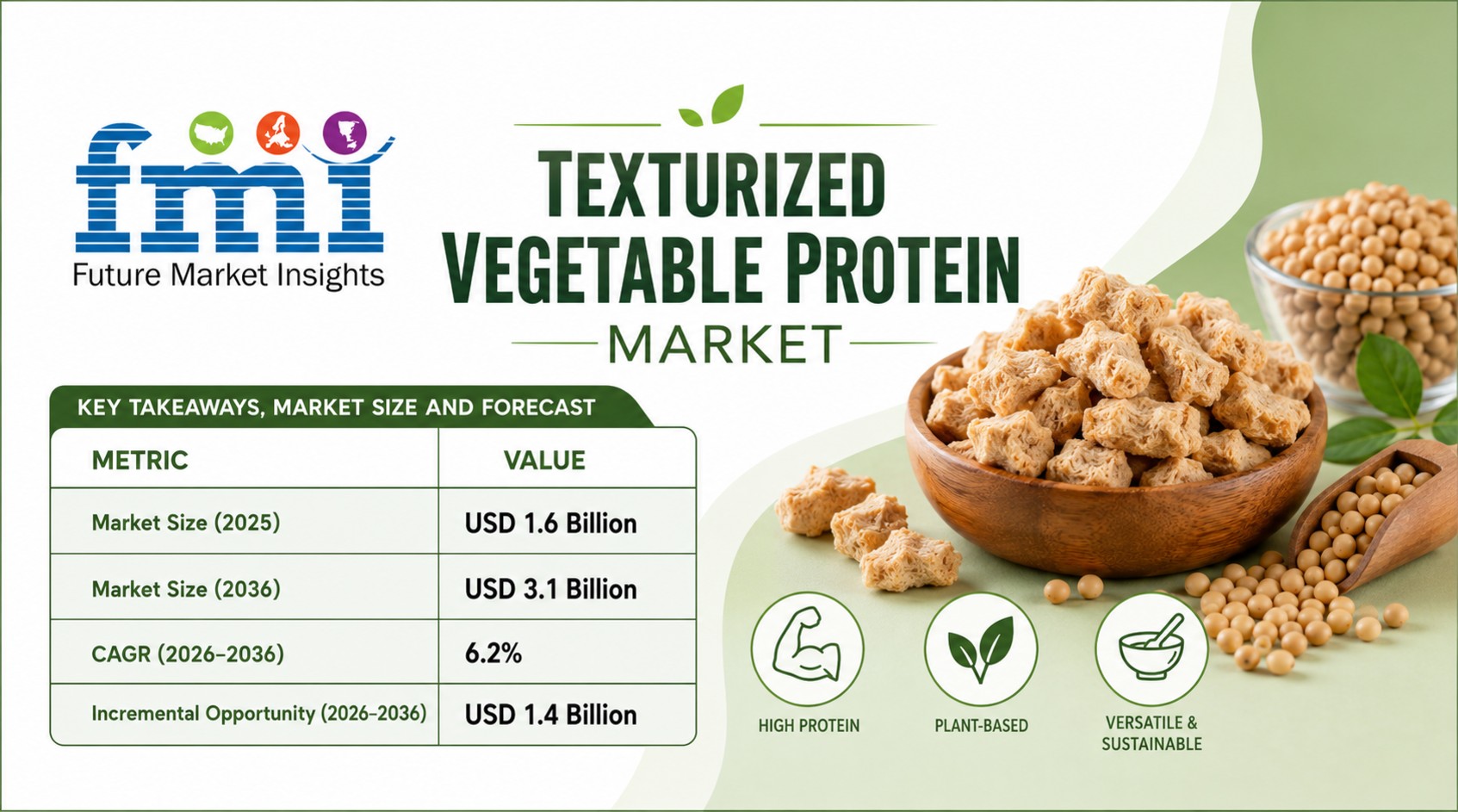
Quick Stats of the Texturized Vegetable Protein Market
- Core Growth Theme: Industrial Extrusion Capacity and Application-Driven Manufacturing
- 2026 Market Size: USD 1.7 Billion
- 2036 Market Size: USD 3.1 Billion
- Forecast CAGR (2026–2036):2%
- Leading End Use: Industrial Food Manufacturing (78.5% market share in 2026)
- Critical Competitive Variable: Extrusion consistency across commercial production batches
Market Overview: Capacity Has Become a Competitive Advantage
The textured protein industry has evolved beyond ingredient selection into a manufacturing execution business where production capability determines commercial success.
Unlike conventional protein powders, textured proteins perform structural functions within finished foods. They must absorb water consistently, maintain fibrous structure during cooking, withstand freezing and reheating, and reproduce the sensory characteristics expected in meat alternatives, hybrid meat products, ready meals, fillings, and processed foods.
As industrial food manufacturers scale production, dependable extrusion partners increasingly become strategic collaborators rather than simple ingredient suppliers.
Key Growth Drivers Across Textured Protein Manufacturing
Industrial Demand Continues to Expand
Business-to-business food manufacturers remain the largest consumers of textured proteins as demand increases across plant-based meat, hybrid meat products, prepared meals, frozen foods, foodservice applications, and processed meat alternatives.
Large-scale processors require suppliers capable of delivering identical functionality across every production batch.
Texture Defines Consumer Acceptance
Consumers increasingly evaluate plant-based foods according to eating experience rather than sustainability messaging alone.
Texture, bite, juiciness, hydration behavior, and cooking performance now determine repeat purchases, placing greater importance on extrusion quality throughout ingredient manufacturing.
Protein Diversification Increases Manufacturing Complexity
Manufacturers continue expanding beyond soy into pea, wheat, fava bean, chickpea, rice, and blended protein systems.
Each raw material requires different extrusion parameters, processing conditions, moisture control, and post-processing techniques, increasing demand for experienced manufacturing partners.
Commercial Scale Requires Reliable Capacity
Growing production volumes require extrusion facilities capable of supporting long-term contracts, rapid scale-up, consistent quality, and dependable delivery schedules without compromising product performance.
Technical & Manufacturing Economics Behind Extrusion Leadership
Extrusion transforms functional proteins into structured food ingredients capable of replacing or complementing animal proteins.
- Raw Material Flexibility: Leading co-packers increasingly process multiple protein sources including soy, pea, wheat, fava, chickpea, and blended formulations, allowing manufacturers to adjust sourcing strategies based on cost, allergen requirements, sustainability goals, and regional availability.
- Process Control: Moisture levels, temperature profiles, screw configuration, residence time, pressure, and drying conditions all influence final texture, hydration ratio, particle structure, and cooking stability.
- Quality Consistency: Industrial buyers increasingly require standardized specifications covering bulk density, particle size, moisture content, hydration performance, protein concentration, color, flavor neutrality, and functional behavior during processing.
- Application Engineering: Technical support has become increasingly valuable as suppliers assist customers with formulation optimization, seasoning compatibility, binding systems, hydration protocols, cooking performance, and shelf-life evaluation.
Segment Deep Dive: Why Co-packer Selection Matters
Plant-Based Meat Manufacturing
Plant-based meat products demand highly engineered textures capable of replicating muscle fiber structure, chewiness, juiciness, and cooking performance.
Poor extrusion consistency can negatively affect sensory quality, requiring costly reformulation and reducing consumer acceptance.
Hybrid Meat Applications
Hybrid meat products combine conventional animal proteins with textured vegetable proteins to improve yield, reduce ingredient costs, and enhance sustainability.
These applications prioritize predictable hydration, processing efficiency, and consistent manufacturing performance over premium consumer marketing.
Ready Meals and Processed Foods
Prepared meals, frozen foods, sauces, fillings, and convenience products require textured proteins capable of maintaining structure throughout cooking, freezing, reheating, and extended shelf life.
Extrusion quality directly influences finished-product stability and manufacturing efficiency.
Industrial Ingredient Supply
Industrial food manufacturers increasingly prioritize suppliers capable of delivering standardized ingredients supported by technical documentation, reliable logistics, and scalable production rather than commodity pricing alone.
This trend explains the continued dominance of business-to-business demand across the textured protein industry.
Regional Market Dynamics
North America
North America continues leading advanced extrusion technology through significant investment in plant-based foods, food processing innovation, and industrial manufacturing infrastructure.
Growing demand for meat alternatives and hybrid protein systems continues supporting expansion of commercial extrusion capacity.
Europe
European manufacturers increasingly emphasize clean-label formulation, sustainable protein sourcing, quality assurance, and advanced processing technologies.
Extrusion expertise has become an important differentiator as food companies pursue premium plant-based products with improved sensory performance.
Asia-Pacific
Rapid growth in plant-based foods, convenience products, and industrial food manufacturing continues driving demand for scalable texturization capacity throughout Asia-Pacific.
Regional investment increasingly focuses on flexible extrusion systems capable of processing diverse plant protein sources.
Competitive Differentiation Strategies
Leading textured protein manufacturers increasingly compete through production capability rather than ingredient portfolios alone.
- Advanced Extrusion Technology: Modern extrusion systems enable greater control over texture, fiber development, hydration performance, and application-specific product design.
- Application Development Services: Suppliers increasingly provide formulation assistance, pilot trials, hydration testing, cooking validation, and sensory optimization to accelerate commercial product development.
- Capacity Planning & Supply Reliability: Manufacturers with available commercial capacity, flexible production scheduling, and dependable logistics strengthen long-term customer relationships.
- Comprehensive Quality Management: Consistent specifications, analytical testing, documentation, traceability, and process standardization reduce manufacturing risk for food processors.
- Multi-Protein Processing Capability: Facilities capable of processing soy, pea, wheat, fava, chickpea, and blended proteins offer greater flexibility as customer requirements evolve.
Industry FAQs
Why is extrusion capacity becoming a competitive advantage?
Extrusion determines the structural characteristics of textured proteins, including texture, hydration, cooking stability, and sensory performance. Reliable extrusion capability enables manufacturers to produce consistent ingredients suitable for commercial-scale food production.
Why can’t textured protein be evaluated like ordinary protein powder?
Unlike conventional protein ingredients, textured proteins provide physical structure within finished foods. Their commercial value depends on functional performance during hydration, cooking, processing, freezing, and consumer preparation.
Why does industrial manufacturing dominate textured protein demand?
Large food manufacturers require dependable ingredients capable of supporting high-volume production across multiple product categories. Industrial customers prioritize specification consistency, reliable supply, and technical support throughout manufacturing operations.
How should manufacturers evaluate extrusion partners?
Companies increasingly assess extrusion providers according to processing capability, quality control, application expertise, production capacity, raw material flexibility, documentation, and long-term supply reliability rather than price alone.
Why is application support becoming increasingly important?
Modern food formulations require suppliers capable of assisting with hydration optimization, binding systems, seasoning interactions, cooking performance, sensory development, and commercial scale-up, reducing product development time and manufacturing risk.
Conclusion
The future of the texturized vegetable protein market will be shaped not only by advances in plant protein innovation but also by access to reliable commercial extrusion capacity. As food manufacturers pursue improved texture, greater production efficiency, and consistent consumer experiences, extrusion has become one of the industry’s most valuable strategic capabilities.
Industrial processors increasingly require partners capable of combining raw material flexibility, advanced processing technology, quality assurance, formulation expertise, and scalable manufacturing into integrated production solutions.
Companies that position themselves as complete texturization partners rather than simply ingredient suppliers will be best equipped to support the next generation of plant-based meat, hybrid protein products, ready meals, and functional food innovation.
Related Research Reports
- Plant-Based Food Market – Analysis of plant-based food innovation, ingredient trends, and consumer adoption.
- Meat Substitutes Market – Strategic evaluation of meat alternative technologies, formulation trends, and commercial opportunities.
- Plant-Based Beef Market – Market intelligence covering beef alternatives, protein technologies, and product development.
FMI Custom Research: Strategic Intelligence for Confident Decision-Making
In today’s rapidly evolving business environment, leadership teams need more than market data they need clear, actionable intelligence tailored to their strategic objectives. FMI’s Custom Research solutions are designed around the specific business questions organizations need answered, enabling executives to evaluate growth opportunities, validate investments, assess competitive dynamics, and reduce uncertainty before making critical decisions. By combining deep industry expertise, primary research, and proprietary market intelligence, FMI delivers insights that help organizations move from assumptions to evidence-based strategies with greater speed and confidence.
Key Executive Benefits
- Decision-Ready Insights: Research tailored to your specific business challenges, growth plans, and investment priorities.
- Reduced Strategic Risk: Validate market opportunities, customer demand, and competitive positioning before committing resources.
- Market Entry Confidence: Assess opportunity size, regulatory barriers, channel dynamics, and competitive landscapes with precision.
- Competitive Advantage: Gain proprietary intelligence unavailable through syndicated reports or internal datasets.
- Faster Growth Decisions: Accelerate expansion, product development, portfolio optimization, and investment planning.
- Primary Market Validation: Access real-world customer, buyer, and stakeholder insights that support high-confidence decision-making.
- Global Industry Expertise: Powered by 100+ analysts, 20,000+ published reports, and 1.6 million+ hours of research experience.
- Proven Track Record: Over 7,000 market-entry engagements completed across six regions and 14 industry sectors with strong client retention.
Business Impact
FMI helps organizations transform market complexity into strategic clarity, enabling leadership teams to identify growth opportunities faster, optimize resource allocation, strengthen competitive positioning, and make high-stakes business decisions with confidence.
To explore how FMI Custom Research can support your strategic priorities, please connect with our team at – sales@futuremarketinsights.com
About Future Market Insights (FMI)
Future Market Insights is a leading provider of market intelligence, consulting services, and syndicated research reports. FMI delivers actionable insights across food and beverage, healthcare, consumer goods, biotechnology, chemicals, industrial products, and emerging technologies, helping organizations identify growth opportunities and make informed strategic decisions in evolving global markets.
Contact Us:
Future Market Insights Inc.
Christiana Corporate, 200 Continental Drive,
Suite 401, Newark, Delaware – 19713, USA
T: +1-347-918-3531
Why FMI: https://www.futuremarketinsights.com/why-fmi
For Sales Enquiries: sales@futuremarketinsights.com
Website: https://www.futuremarketinsights.com