

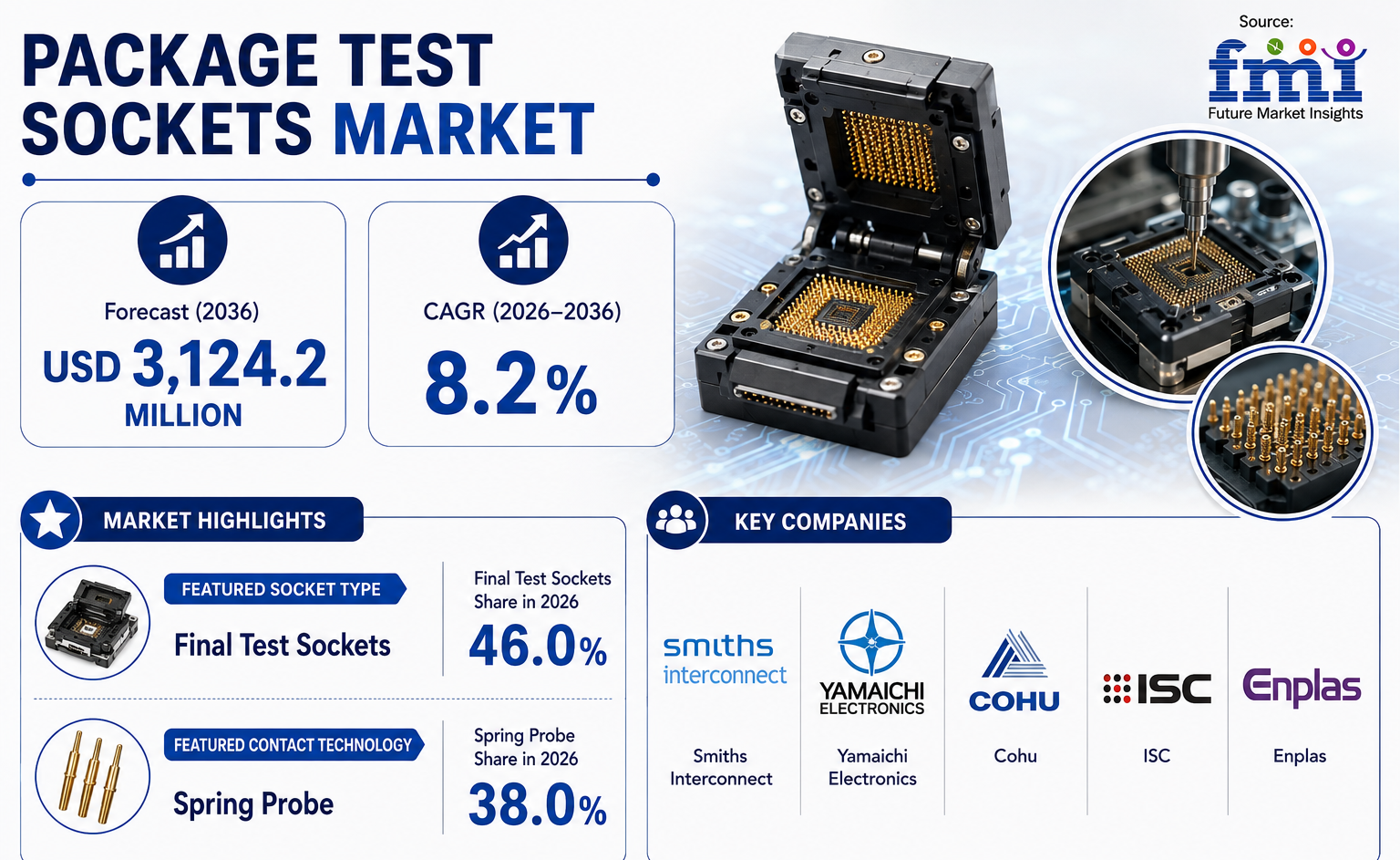
The global Package Test Sockets Market is poised for steady expansion as semiconductor manufacturers continue investing in advanced testing infrastructure to support increasingly complex integrated circuits. The market was valued at USD 1,312.9 million in 2025 and is estimated to reach USD 1,420.6 million in 2026. According to Future Market Insights, the market is projected to attain USD 3,124.2 million by 2036, registering a CAGR of 8.2% during the forecast period. Rising demand for high-performance chips across artificial intelligence (AI), automotive electronics, consumer devices, data centers, and telecommunications is accelerating the need for highly reliable package test sockets. Final Test Sockets are expected to account for 46.0% of the market in 2026, while Spring Probe technology is projected to hold 38.0% of the contact technology segment.
Rising Semiconductor Complexity is Driving Market Growth
The package test sockets market has become an indispensable part of the semiconductor manufacturing ecosystem. Every semiconductor device must undergo rigorous electrical and functional testing before reaching commercial deployment. As chip designs become smaller, faster, and more sophisticated, manufacturers require precision-engineered test sockets capable of delivering consistent electrical performance while minimizing signal loss and ensuring testing accuracy. The transition toward advanced semiconductor packaging technologies such as Ball Grid Array (BGA), Land Grid Array (LGA), Chip Scale Package (CSP), System-in-Package (SiP), and flip-chip architectures has significantly increased demand for specialized testing solutions. These advanced packages contain higher pin counts and operate at faster frequencies, requiring package test sockets with superior durability, lower contact resistance, and excellent mechanical stability.
Growing investments in semiconductor fabrication facilities across Asia, North America, and Europe are also strengthening long-term demand. Governments worldwide are introducing incentives to establish domestic semiconductor manufacturing capabilities, creating new opportunities for test socket manufacturers throughout the supply chain.
Final Test Sockets Continue to Lead Industry Demand
Among various socket types, Final Test Sockets continue to dominate the global market. They are expected to represent approximately 46.0% of total demand in 2026, reflecting their critical role in verifying semiconductor functionality before products are shipped to customers. Unlike engineering or burn-in sockets, final test sockets must support extremely high production volumes while maintaining testing consistency over extended operating cycles. Semiconductor manufacturers rely on these sockets to ensure every integrated circuit meets electrical, thermal, and performance specifications before entering commercial distribution. As production volumes continue to increase across automotive electronics, smartphones, networking equipment, and industrial automation systems, demand for high-performance final test sockets is expected to remain robust throughout the forecast period.
Spring Probe Technology Maintains Competitive Advantage
Contact technology remains one of the most important differentiators within the package test sockets market. Among available technologies, Spring Probe systems are expected to account for 38.0% of the market in 2026 due to their excellent electrical conductivity, extended service life, and ability to accommodate high-density semiconductor packages. Spring probes provide consistent electrical contact even after thousands of testing cycles, reducing maintenance requirements and minimizing equipment downtime. They also support higher-frequency semiconductor devices, making them increasingly attractive for manufacturers producing advanced processors, memory chips, RF components, and AI accelerators. Continuous innovations in probe materials, plating technologies, and precision manufacturing are further improving the reliability and lifespan of spring probe solutions, strengthening their adoption across semiconductor testing facilities worldwide.
Asia Pacific Remains the Global Manufacturing Hub
- Asia Pacific continues to dominate the package test sockets market owing to its concentration of semiconductor manufacturing facilities and outsourced semiconductor assembly and testing (OSAT) providers. Countries including Taiwan, South Korea, China, Japan, Singapore, and Malaysia collectively account for a significant share of global semiconductor production.
- China remains one of the largest consumers of semiconductor testing equipment due to extensive investments in domestic chip manufacturing. Meanwhile, Taiwan and South Korea continue leading advanced semiconductor fabrication, generating substantial demand for precision testing solutions.
- India is emerging as one of the fastest-growing regional markets and is projected to register a CAGR of 9.2% through 2036. Government initiatives promoting semiconductor manufacturing, increasing investments in electronics production, and the establishment of new fabrication facilities are expected to accelerate adoption of advanced package test sockets across the country.
- North America also remains an important market, driven by technological innovation, AI chip development, aerospace electronics, and data center infrastructure. Europe continues expanding its semiconductor capabilities to strengthen supply chain resilience, creating additional opportunities for testing equipment suppliers.
Innovation and Reliability Shape Competitive Dynamics
Competition within the package test sockets market is increasingly centered on product performance, durability, precision engineering, and customization capabilities. Semiconductor manufacturers demand sockets capable of supporting higher testing frequencies, increased pin densities, and longer operating life while maintaining minimal signal degradation.
Leading companies continue investing heavily in research and development to improve electrical performance, reduce insertion force, and enhance compatibility with emerging semiconductor package formats. Manufacturers are also developing customized socket solutions tailored to specific customer requirements, enabling greater testing flexibility across diverse semiconductor applications.
In addition to product innovation, companies are strengthening regional manufacturing capabilities and expanding customer support networks to reduce lead times and improve supply chain responsiveness. Strategic collaborations with semiconductor equipment manufacturers and integrated device manufacturers are becoming increasingly common as suppliers seek long-term business partnerships.
Future Outlook
The future outlook for the package test sockets market remains highly positive as semiconductor demand continues expanding across virtually every industry. Artificial intelligence, electric vehicles, 5G infrastructure, cloud computing, industrial automation, healthcare electronics, and consumer devices all depend on increasingly sophisticated semiconductor components that require comprehensive testing before commercialization. As semiconductor technologies continue evolving toward smaller geometries and more advanced packaging architectures, the importance of precision testing solutions will only increase. Manufacturers capable of delivering highly reliable, long-life, and performance-oriented package test sockets are expected to strengthen their competitive positions over the next decade. Companies that invest in advanced engineering capabilities, application-specific product development, and global manufacturing expansion are expected to capture the greatest share of future market opportunities.
Related Research Reports
Molded Pulp Packaging Market: The molded pulp packaging market is projected to reach USD 8.8 billion by 2035, Grow at a 5.1% over the forecast period.
Starch-Based Bioplastics Packaging Market: The starch based bioplastics packaging market to USD 41.5 billion by 2035, grow at a CAGR of 8.6% during the forecast period.
Molded Fiber Pulp Packaging Market: The molded fiber pulp packaging market is projected to stand at USD 8.4 billion in 2026 and move to USD 15.8 billion by 2036.
About Future Market Insights (FMI)
Future Market Insights is a leading provider of market intelligence, consulting services, and syndicated research reports. FMI delivers actionable insights across packaging, logistics, industrial manufacturing, food and beverage, healthcare, chemicals, and emerging technologies, helping organizations identify growth opportunities and make informed strategic decisions in rapidly evolving markets.
Contact
Future Market Insights Inc.
Christiana Corporate
200 Continental Drive, Suite 401
Newark, Delaware 19713, USA
Email: sales@futuremarketinsights.com
Website: www.futuremarketinsights.com