

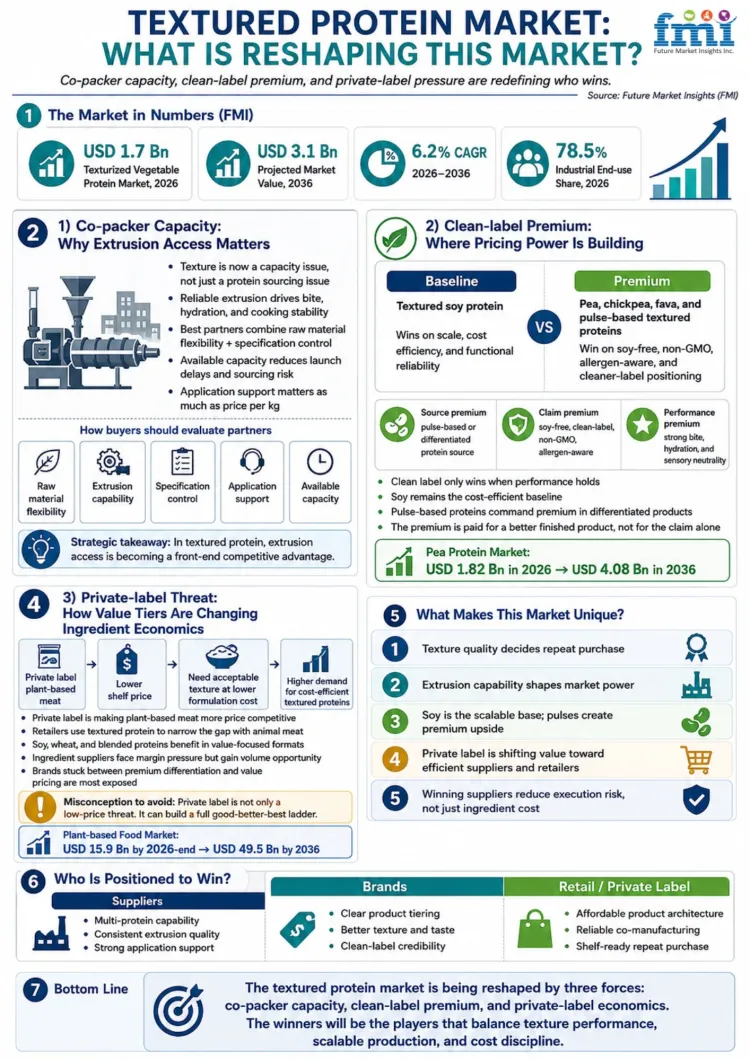
Retailer-Led Value Competition Is Reshaping Textured Protein Economics
According to the latest insights by Future Market Insights, the global Texturized Vegetable Protein Market is witnessing a major shift as private label growth changes the competitive landscape of plant-based meat and alternative protein categories. Retailers are increasingly using value-focused product strategies to narrow the price gap between plant-based products and conventional meat options.
Textured protein suppliers are expected to experience stronger demand as private label manufacturers prioritize:
- Cost-efficient protein systems
• Consistent texture performance
• Scalable production capabilities
• Reliable ingredient supply
• Application-ready solutions
• Competitive formulation economics
Industry analysts highlight that private label success is no longer based only on lower pricing. Retailers increasingly require ingredients that deliver acceptable taste, texture, cooking performance, and consumer satisfaction while maintaining cost advantages.
Textured Protein Becomes a Strategic Cost Lever
The plant-based meat industry has historically competed through:
- Innovation
• Sustainability positioning
• Brand differentiation
• Premium product claims
• Consumer education
However, as plant-based categories move into mainstream retail channels, the market focus is shifting toward affordability and repeat purchase behavior.
Textured protein plays a critical role because it supports:
- Meat-like structure
• Chewiness
• Moisture retention
• Bite consistency
• Protein enhancement
• Cost optimization
The strongest suppliers are those capable of delivering functional performance at competitive costs.
Private Label Growth Creates New Ingredient Demand
Private label expansion is increasing demand for textured protein systems across:
- Plant-based meat products
• Frozen foods
• Ready meals
• Nuggets and patties
• Alternative protein formats
• Hybrid protein products
Retailers are increasingly evaluating suppliers based on:
- Manufacturing efficiency
• Ingredient consistency
• Supply reliability
• Quality standards
• Total formulation cost
A low-cost protein ingredient that fails to deliver texture or cooking performance cannot support long-term category growth.
Premium Brands Face Pressure from Value-Based Alternatives
Premium plant-based brands have traditionally competed through:
- Sustainability claims
• Clean-label positioning
• Innovation
• Brand identity
• Consumer trust
However, private label products are changing shopper expectations by offering acceptable quality at lower price points.
The competitive challenge increases when consumers perceive products as interchangeable.
Brands must differentiate through:
- Superior taste
• Better texture
• Functional nutrition
• Unique formulations
• Strong consumer connection
Without meaningful differentiation, private label alternatives can capture market share.
Soy, Wheat, and Blended Proteins Gain Importance
Private label manufacturers are likely to favor textured proteins that provide:
- Reliable processing performance
• Lower ingredient cost
• Consistent availability
• Easy formulation integration
Key ingredient opportunities include:
- Textured soy protein
• Textured wheat protein
• Textured pea protein
• Multi-protein blends
The future competitive advantage will depend on balancing cost efficiency with consumer expectations.
The Shift from Lowest Cost to Lowest Performance Cost
Private label competition is not only about selecting the cheapest ingredient.
Successful products require:
- Stable hydration
• Strong texture retention
• Cooking consistency
• Flavor compatibility
• Production reliability
The winning ingredient strategy is the lowest total performance cost rather than the lowest purchase price.
Suppliers that combine affordability with functionality will gain stronger market positioning.
Supply Chain Scale Determines Competitive Strength
Textured protein markets are becoming increasingly influenced by supply chain capabilities.
Manufacturers must manage:
- Raw material sourcing
• Production consistency
• Quality control
• Processing efficiency
• Customer-specific requirements
Private label buyers demand:
- Reliable volume supply
• Stable specifications
• Competitive pricing
• Long-term partnerships
Ingredient suppliers with scalable operations will be better positioned as retailer-owned brands expand.
Retailers Create New Growth Opportunities
Private label expansion also creates opportunities for ingredient suppliers.
Retailers are helping plant-based foods move from niche purchases into regular grocery categories.
This creates demand for:
- High-volume textured protein production
• Cost-effective protein platforms
• Custom ingredient systems
• Application-specific solutions
Although margins may face pressure, increased volume can become a major growth driver.
The Future of Textured Protein Competition
The future of the Texturized Vegetable Protein Market will depend on how effectively companies balance:
- Cost efficiency
• Functional performance
• Supply reliability
• Consumer expectations
• Product innovation
The strongest suppliers will be those that help manufacturers create affordable plant-based foods without compromising eating quality.
Private label will not only compete with brands on store shelves — it will reshape the economics of the ingredients behind those products.
FMI Custom Research: Strategic Intelligence for Confident Decision-Making
In today’s rapidly evolving business environment, leadership teams need more than market data—they need clear, actionable intelligence tailored to their strategic objectives.
FMI’s Custom Research solutions are designed around the specific business questions organizations need answered, enabling executives to evaluate growth opportunities, validate investments, assess competitive dynamics, and reduce uncertainty before making critical decisions.
By combining deep industry expertise, primary research, and proprietary market intelligence, FMI delivers insights that help organizations move from assumptions to evidence-based strategies with greater speed and confidence.
Key Executive Benefits
- Decision-Ready Insights
• Reduced Strategic Risk
• Market Entry Confidence
• Competitive Advantage
• Faster Growth Decisions
• Primary Market Validation
• Global Industry Expertise
• Proven Track Record
Business Impact
FMI helps organizations transform market complexity into strategic clarity, enabling leadership teams to identify opportunities faster, strengthen competitive positioning, optimize investments, and make confident business decisions.
To explore how FMI Custom Research can support your strategic priorities, connect with our team at: sales@futuremarketinsights.com
Explore More Related Studies Published by FMI Research:
Plant-Based Food Market is segmented by Product (Plant Based Dairy Alternatives, Plant Based Meat Alternatives, Plant Based Ready Meals, Plant Based Snacks), Application (Food And Beverage, Nutritional Products), End Use (Household Consumers, Foodservice Industry, Food Manufacturers), and Region. Forecast for 2026 to 2036.
The Meat Substitutes Market is segmented by Source (Plant-based Chicken, Plant-based Beef, Plant-based Pork, Plant-based Seafood, Others), Product Type (Nuggets, Burgers, Sausages, Strips, Mince, Others), and Region. Forecast for 2026 to 2036.
The Plant-Based Beef Market is segmented by Product Type (Burger Patty, Sausages, Nuggets, Crumbles & Grounds, Hot Dogs, Bacon Chips), Source (Soy-based Protein, Pea-based Protein, Fava Bean-based Protein, Wheat-based Protein, Canola-based Protein, Potato-based Protein), Distribution Channel (Retail, Online Retail, HoReCa) and Region. Forecast for 2026 to 2036.
The plant-based meat market is projected to reach USD 5,356.6 million by 2025 and is expected to grow to USD 8,005.7 million by 2035, reflecting a CAGR of 4.1% during the forecast period. By product, plant-based meatballs are expected to hold 19.6% of the market share in 2025, while soy is projected to dominate the type segment with a 25.7% market share by source.
The Soy Protein Ingredient Market is segmented by Product Type (Soy Protein Isolates, Soy Protein Concentrates, Textured Vegetable Protein, Soy Flours), Form (Powder, Liquid), End Use (Food & Beverages, Animal Feed, Pharmaceuticals), and Region. Forecast for 2026 to 2036.
About Future Market Insights (FMI)
Future Market Insights, Inc. (FMI) is an ESOMAR-certified, ISO 9001:2015 market research and consulting organization, trusted by Fortune 500 clients and global enterprises.
With operations in the U.S., UK, India, and Dubai, FMI provides data-backed insights and strategic intelligence across 30+ industries and 1200 markets worldwide.
Contact Us:
Future Market Insights Inc.
Christiana Corporate, 200 Continental Drive,
Suite 401, Newark, Delaware – 19713, USA
T: +1-347-918-3531
Why FMI: https://www.futuremarketinsights.com/why-fmi
Website: https://www.futuremarketinsights.com
LinkedIn| Twitter| Blogs | YouTube