

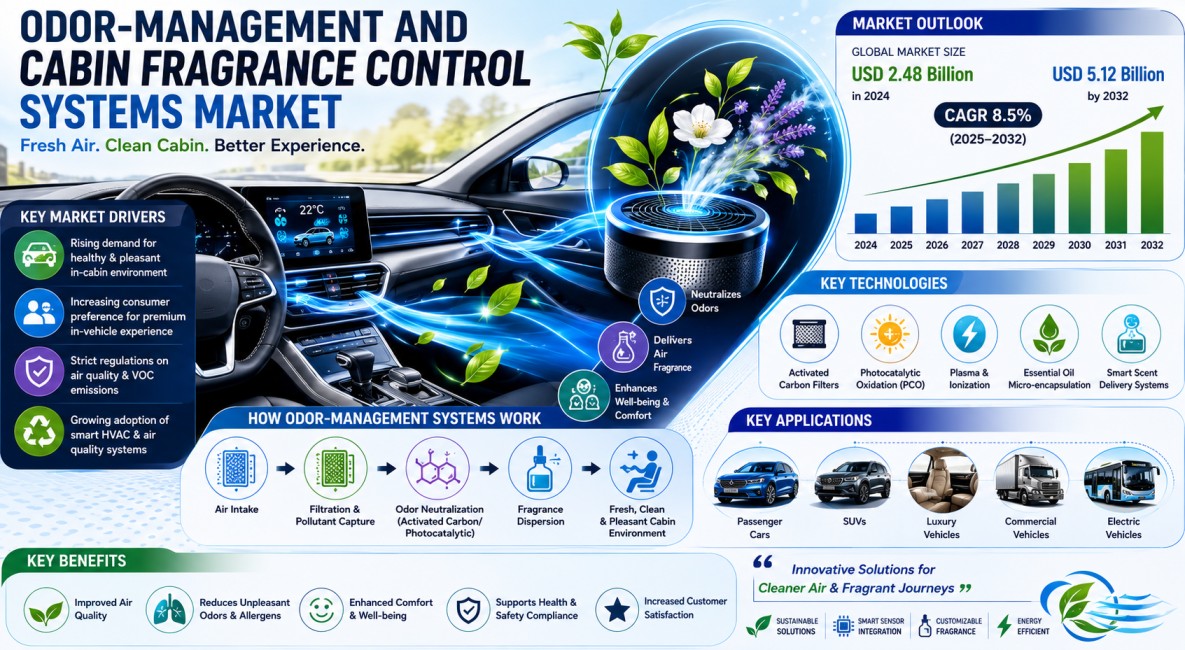
The global Odor-Management and Cabin Fragrance Control Systems Market is entering a new phase of growth as vehicle manufacturers increasingly focus on cabin air quality, passenger comfort, and personalized in-car experiences. The market, valued at USD 1.5 billion in 2025, is projected to reach USD 1.6 billion in 2026 and further expand to USD 3.0 billion by 2036, registering a CAGR of 6.5% during the forecast period.
Growing consumer awareness regarding cabin air cleanliness, rising urban pollution levels, and the integration of premium comfort features across vehicle categories are driving demand for advanced odor-control and fragrance management technologies. OEM fitment is expected to account for 61% of market demand in 2026, while premium passenger cars are forecast to contribute 52% of total revenue as automakers continue enhancing the in-cabin experience.
Cabin Air Quality Becomes a Key Vehicle Comfort Priority
Modern vehicle buyers are placing greater importance on interior air quality as part of the overall ownership experience. Daily exposure to traffic emissions, industrial pollutants, tunnel fumes, and heat-related odors has increased consumer demand for cleaner and more comfortable cabin environments.
Automotive manufacturers are responding by integrating advanced odor-management systems capable of reducing unwanted smells while maintaining consistent airflow quality. These systems help eliminate fuel odors, road pollutants, stale cabin air, and airborne contaminants that can negatively impact passenger comfort.
As vehicle interiors evolve into multifunctional living and working spaces, maintaining a clean and pleasant cabin atmosphere has become a critical design objective for OEMs worldwide.
Premium Vehicle Manufacturers Drive Fragrance Technology Adoption
The growing popularity of luxury and premium vehicle segments is accelerating the adoption of cabin fragrance control technologies. Automakers are increasingly using fragrance systems as a differentiating feature to enhance perceived vehicle quality and create a more personalized passenger experience.
Integrated fragrance diffusers allow occupants to customize cabin scents according to their preferences while maintaining balanced fragrance distribution throughout the vehicle interior. These systems are becoming particularly popular in premium passenger cars, where comfort, wellness, and sensory experiences play an important role in purchasing decisions.
According to Nikhil Kaitwade, Principal Consultant at FMI, “Odor control is becoming part of cabin comfort planning. Drivers want clean air and a pleasant cabin feel without extra noise or service difficulty. Suppliers combining activated carbon media with reliable HVAC control will get better access to vehicle programs.”
Activated Carbon Filters Remain the Market’s Core Technology
Activated carbon odor filters continue to dominate product demand due to their proven ability to capture harmful gases, unpleasant odors, and airborne contaminants.
These filtration systems effectively remove traffic-related pollutants such as ozone, nitrogen oxides, fuel vapors, and industrial emissions before they enter the passenger compartment. Their effectiveness, ease of integration, and compatibility with existing HVAC systems make them the preferred choice across both premium and mass-market vehicles.
As governments tighten air-quality regulations and consumers become more health-conscious, activated carbon filtration technologies are expected to remain the foundation of vehicle odor-management strategies.
HVAC Integration Enhances System Efficiency
Vehicle manufacturers are increasingly favoring HVAC-integrated odor-management and fragrance systems because they leverage existing air distribution networks without requiring significant design modifications.
By utilizing cabin ventilation ducts and air-conditioning channels, integrated systems provide more uniform odor removal and fragrance distribution throughout the vehicle. This approach improves performance while minimizing packaging complexity and installation costs.
HVAC-based integration also enables better control of airflow patterns, ensuring consistent air quality and passenger comfort across different seating positions within the vehicle.
Service and Maintenance Channels Create New Revenue Opportunities
The odor-management market is expanding beyond original vehicle installation into recurring service and maintenance opportunities. Workshops and service centers are increasingly promoting cabin filter replacement as part of routine air-conditioning maintenance programs.
In February 2026, MANN+HUMMEL highlighted that activated carbon cabin filters provide protection against unpleasant odors and harmful gases such as ozone and nitrogen oxides. The company also continues to emphasize the importance of regular filter replacement to maintain optimal air quality performance.
Similarly, MANN-FILTER noted that its FreciousPlus nanofiber cabin filter should be replaced annually or every 15,000 kilometers. Such replacement intervals are helping service providers transform odor-management products from one-time purchases into recurring maintenance solutions.
As awareness of cabin air quality increases, aftermarket demand for replacement filters, fragrance cartridges, and purification modules is expected to rise steadily.
Fleet Operators Adopt Evidence-Based Odor Management
Fleet operators, rental car companies, and mobility service providers are becoming important customers for advanced odor-management technologies. Maintaining clean and odor-free vehicle interiors helps improve customer satisfaction while protecting vehicle value and utilization rates.
Technological advancements are making fleet odor management more data-driven. In April 2025, DENSO International America received a patent for a system that measures and manages odors in rental vehicles using volatile organic compound (VOC) and particulate sensing technologies.
Such innovations allow operators to make informed cleaning and redeployment decisions based on actual cabin air quality conditions rather than visual inspections alone.
Asia-Pacific Emerges as the Fastest-Growing Regional Market
Asia-Pacific is expected to lead global growth over the forecast period as vehicle ownership expands and consumer expectations for comfort features increase.
China is projected to register the highest growth rate among major markets, with a CAGR of 7.8% through 2036. Rapid premium vehicle adoption, growing EV production, and increasing consumer focus on cabin wellness are supporting demand for advanced odor-management solutions.
India is also emerging as a key growth market due to rising passenger vehicle sales, expanding urbanization, and greater awareness of vehicle comfort technologies. As more automakers introduce premium features into mid-range vehicles, odor-control and fragrance systems are becoming accessible to a broader customer base.
Germany and Japan continue to support strong demand for high-performance cabin air management systems, particularly within premium automotive segments where refinement and passenger comfort remain central product attributes.
Suppliers Focus on Filtration Performance and Safe Fragrance Delivery
Competition within the market is increasingly centered on filter efficiency, fragrance safety, system reliability, and integration flexibility. Suppliers capable of delivering proven filtration performance alongside controlled fragrance distribution are gaining stronger positions within OEM sourcing programs.
Manufacturers are investing in advanced filter media, low-emission materials, sensor-based monitoring technologies, and intelligent HVAC integration solutions to differentiate their offerings. The ability to balance air purification, odor elimination, and user comfort without adding complexity or maintenance challenges will remain a critical success factor.
Future Outlook: Cabin Wellness Expands Beyond Traditional Comfort Features
The future of the odor-management and cabin fragrance control systems market will be shaped by broader trends in vehicle wellness, air quality monitoring, and personalized passenger experiences.
As automakers continue transforming vehicle interiors into comfortable and health-focused environments, odor control technologies will become increasingly integrated with air purification, climate management, and smart cabin systems. Consumers are expected to view clean air and pleasant cabin environments as standard vehicle features rather than luxury upgrades.
With growing demand for healthier and more comfortable driving experiences, the odor-management and cabin fragrance control systems market is well positioned for sustained expansion, reaching USD 3.0 billion by 2036 and becoming an essential component of next-generation automotive interior design.
Browse More Industry Reports
In-Cabin Lighting-Climate-Audio Synchronized Experience Systems Market – https://www.futuremarketinsights.com/reports/in-cabin-lighting-climate-audio-synchronized-experience-systems-market
Cabin Air Filter Housing Replacement Parts Market – https://www.futuremarketinsights.com/reports/cabin-air-filter-housing-replacement-parts-market
Premium Leisure Cabin Interior Configuration Kits Market – https://www.futuremarketinsights.com/reports/premium-leisure-cabin-interior-configuration-kits-market