


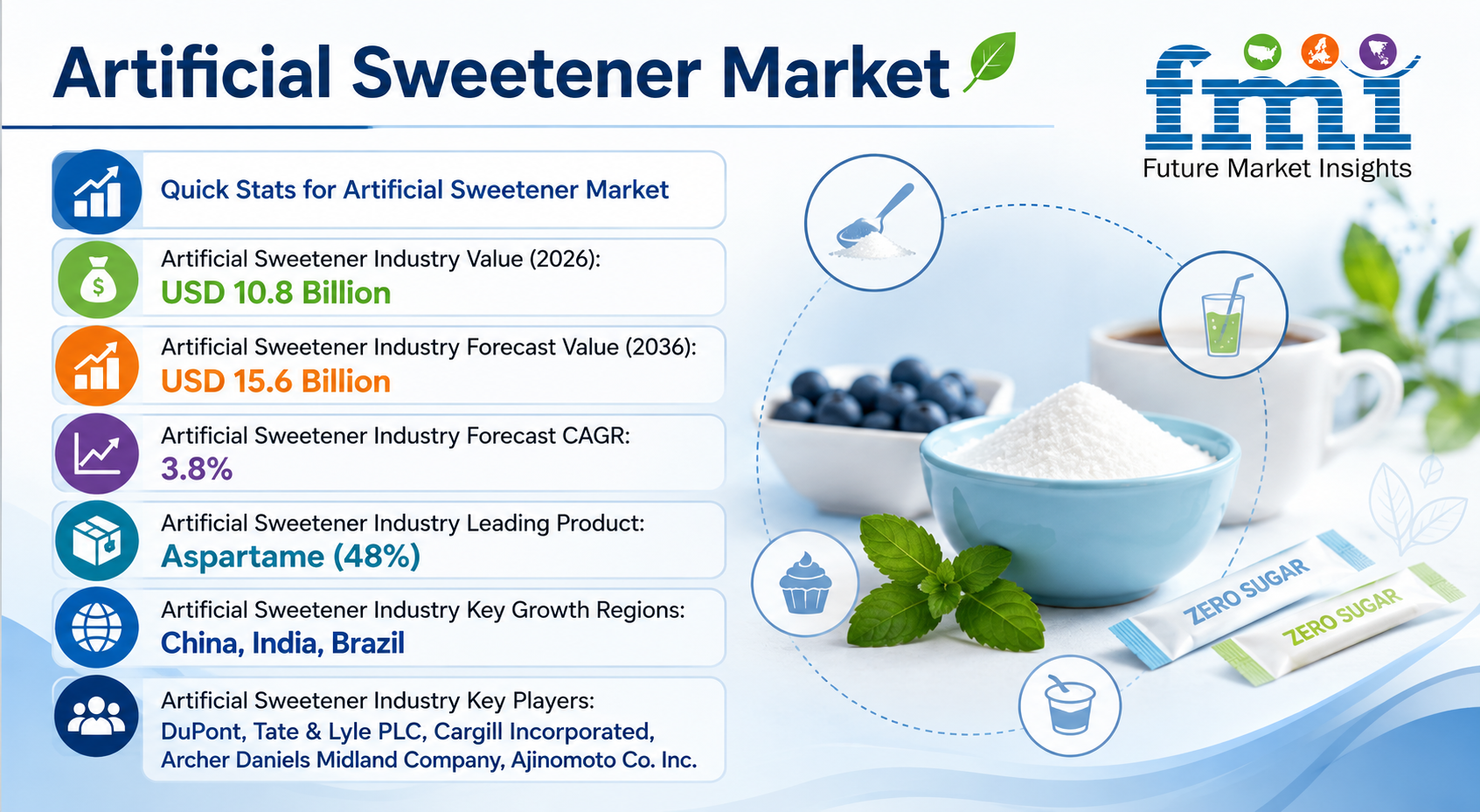
The global low-calorie and diet food market is undergoing a structural cost transformation driven by alternative sweeteners, formulation complexity, and brand-led pricing control. As multinational food giants such as Nestlé and Unilever expand their health-focused portfolios, pricing power is increasingly decoupled from raw ingredient costs and instead anchored in brand equity, regulatory barriers, and proprietary formulation systems.
In 2025, the artificial and natural sweetener ecosystem supporting low-calorie foods is valued at approximately USD 6.8 billion and is projected to reach USD 15.4 billion by 2036, expanding at a CAGR of 7.5%. This growth reflects accelerating demand for sugar reduction, clean-label reformulation, and premium diet-focused product categories including protein snacks, functional beverages, and reduced-calorie dairy alternatives.
However, the most critical transformation is not volume growth—it is cost stack reconfiguration, where sweeteners, regulatory compliance, and formulation science now outweigh traditional commodity ingredient economics.
Featured Snippet: Key Market Answer
Q: How do Nestlé and Unilever maintain pricing control in low-calorie food markets despite rising ingredient costs?
A: Nestlé and Unilever maintain pricing control through scale purchasing of alternative sweeteners, proprietary formulation platforms, strong brand equity, and dominant retail distribution networks. These advantages allow them to absorb higher ingredient and compliance costs while sustaining premium pricing across low-calorie and health-positioned food categories.
Quick Stats of Low-Calorie Food Pricing and Sweetener Economics
- Market Size (2025): USD 6.8 Billion (Sweetener-driven low-calorie ecosystem)
- Forecast Market Value (2036): USD 15.4 Billion
- CAGR (2025–2036):5%
- Leading Cost Driver: Alternative Sweetener Systems (Stevia, Monk Fruit, Blends)
- Leading Competitive Advantage: Brand-led premium pricing power
- Fastest Emerging Trend: Multi-sweetener formulation systems and hybrid sugar reduction technologies
Market Overview: The Rise of Cost Stack Complexity in Diet Foods
The low-calorie food industry is no longer defined by simple sugar replacement. It is now structured around multi-layered cost engineering systems that include:
- Natural sweetener extraction and refinement
- Synthetic sweetener blending systems
- Functional protein integration
- Shelf-life stabilization technologies
- Regulatory compliance for health claims
- Clean-label formulation requirements
This has fundamentally changed food economics. While traditional foods depend on commodity pricing, low-calorie foods operate on engineering-driven pricing models, where formulation expertise is as important as ingredient sourcing.
The result is a market where identical taste outcomes can be achieved through multiple ingredient pathways, but at significantly different cost structures.
Key Growth Drivers
Rising Demand for Sugar Reduction and Health Positioning
Global consumer demand for reduced sugar intake continues to accelerate across beverages, dairy, bakery, and snack categories. Governments and health agencies are increasingly promoting sugar taxes and labeling requirements.
Expansion of Alternative Sweetener Supply Chains
Stevia, monk fruit, erythritol, and hybrid sweetener systems are becoming mainstream inputs. However, agricultural dependency and extraction inefficiencies maintain high cost volatility.
Regulatory Pressure on Clean Labeling
Food manufacturers are under increasing pressure to eliminate artificial additives while maintaining taste parity, increasing reliance on expensive natural sweeteners.
Premiumization of Health Foods
Low-calorie products are no longer positioned as substitutes but as premium health goods, enabling higher retail pricing regardless of underlying ingredient costs.
Market Trends Shaping the Industry
Rise of Multi-Sweetener Blending Systems
Manufacturers increasingly combine multiple sweeteners to balance cost, taste, and regulatory compliance. This reduces reliance on any single expensive input while improving flavor performance.
Formulation-Led Competitive Advantage
Competitive advantage is shifting from ingredient sourcing to food science capability, including taste engineering, texture optimization, and sensory matching with full-calorie equivalents.
Brand-Controlled Pricing Architecture
Nestlé, Unilever, and similar giants maintain pricing control through brand trust, allowing them to price significantly above cost-driven competitors.
Retail Shelf Space Consolidation
Retailers increasingly prioritize established brands in health-focused categories, reinforcing pricing power and limiting entry for smaller manufacturers.
Regulatory-Driven Market Entry Barriers
Compliance requirements for nutrient claims, sugar reduction labeling, and health assertions create structural barriers that favor large incumbents.
Segment Insights
Cost Leadership Layer: Alternative Sweetener Ecosystem
The sweetener segment is the most critical cost determinant in low-calorie foods.
Key cost characteristics include:
- High extraction costs for natural sweeteners
- Agricultural dependency (stevia, monk fruit)
- Low yield efficiency per raw material unit
- Complex purification and standardization requirements
- Volatility in global supply chains
Despite high costs, natural sweeteners dominate due to clean-label demand and regulatory alignment.
Brand Leadership Layer: Nestlé and Unilever Advantage
Major FMCG companies maintain dominance through:
- Scale purchasing agreements with sweetener suppliers
- Proprietary formulation systems
- Global regulatory approval portfolios
- Integrated R&D and sensory testing labs
- Strong retail negotiation power
This allows them to maintain margins even when ingredient costs rise significantly.
Cost Structure Breakdown in Low-Calorie Foods
- Sweetener Systems: 25%–40% of total cost impact
- Formulation & R&D: 15%–25%
- Regulatory Compliance: 10%–18%
- Manufacturing Complexity: 15%–20%
- Branding & Distribution: 20%–35% (pricing power offset layer)
This structure highlights why pricing is not directly tied to raw ingredient cost in diet foods.
Competitive Landscape
The low-calorie food market is increasingly dominated by large multinational food corporations with integrated supply chains and strong retail presence.
Key Players
- Nestlé S.A.
- Unilever PLC
- PepsiCo Inc.
- Danone S.A.
- Kraft Heinz Company
- Coca-Cola Company (diet beverage segment)
- Mondelez International
- General Mills Inc.
- Kerry Group
- Tate & Lyle PLC
Competitive Differentiation Factors
- Sweetener sourcing scale
- Proprietary formulation platforms
- Regulatory compliance infrastructure
- Brand trust and consumer loyalty
- Retail channel dominance
- R&D intensity in flavor engineering
Recent Developments
- Expansion of plant-based and low-sugar product lines by global FMCG leaders
- Increased investment in stevia and monk fruit supply chain partnerships
- Growth of hybrid sweetener formulation technologies
- Rising use of AI-driven flavor optimization systems
- Strengthening of clean-label certification frameworks
- Retailers expanding dedicated “better-for-you” product shelves
Expert Insight
The low-calorie food market is entering a phase of structural pricing separation, where ingredient cost and retail price are no longer directly correlated.
Instead, pricing power is increasingly determined by:
- Brand trust
- Regulatory compliance capability
- Formulation expertise
- Retail access strength
This creates a system where multinational companies effectively control pricing architecture, while alternative sweetener innovation reshapes underlying cost structures without fully disrupting market leadership.
FAQs
Why do low-calorie foods cost more than regular foods?
Low-calorie foods require expensive alternative sweeteners, advanced formulation systems, regulatory compliance, and specialized manufacturing processes that increase overall production costs.
How do Nestlé and Unilever control pricing in this market?
They leverage scale purchasing, brand equity, proprietary formulation systems, and retail distribution control to maintain pricing power despite higher input costs.
Why are natural sweeteners more expensive?
Natural sweeteners require agricultural sourcing, extraction, purification, and yield significantly lower output per unit of raw material compared to synthetic alternatives.
Can smaller companies compete in this segment?
Small manufacturers face challenges in ingredient sourcing, compliance costs, and retail access, making large-scale competition difficult without niche positioning.
Will alternative sweeteners reduce product prices in the future?
While innovation may reduce costs over time, premium branding, regulatory requirements, and formulation complexity will likely sustain higher price structures.
Conclusion
The low-calorie food market demonstrates a unique economic structure where pricing power is dominated not by raw ingredients but by control over formulation systems, regulatory compliance, and brand positioning.
Nestlé and Unilever exemplify how multinational food companies convert structural advantages into sustained pricing power, even as alternative sweeteners reshape the underlying cost stack.
As the market evolves, the key competitive frontier will shift from sugar replacement to full-stack food engineering and brand-controlled value creation, defining the next phase of diet and health-focused food innovation.
Related Research Reports
Clean Label Food Market is projected to grow rapidly as consumers demand transparency and natural ingredient sourcing across packaged food categories.
Low-Calorie Food Ingredients Market is expanding due to increasing adoption of stevia, monk fruit, and hybrid sweetener systems in processed foods and beverages.
About Future Market Insights (FMI)
Future Market Insights is a leading provider of market intelligence, consulting services, and syndicated research reports. FMI delivers actionable insights across food and beverage, consumer products, healthcare, chemicals, biotechnology, industrial products, and emerging technologies, helping organizations identify growth opportunities and make informed strategic decisions in rapidly evolving markets.
Contact Us:
Future Market Insights Inc.
Christiana Corporate, 200 Continental Drive,
Suite 401, Newark, Delaware – 19713, USA
T: +1-347-918-3531
Why FMI: https://www.futuremarketinsights.com/why-fmi
For Sales Enquiries: sales@futuremarketinsights.com
Website: https://www.futuremarketinsights.com