

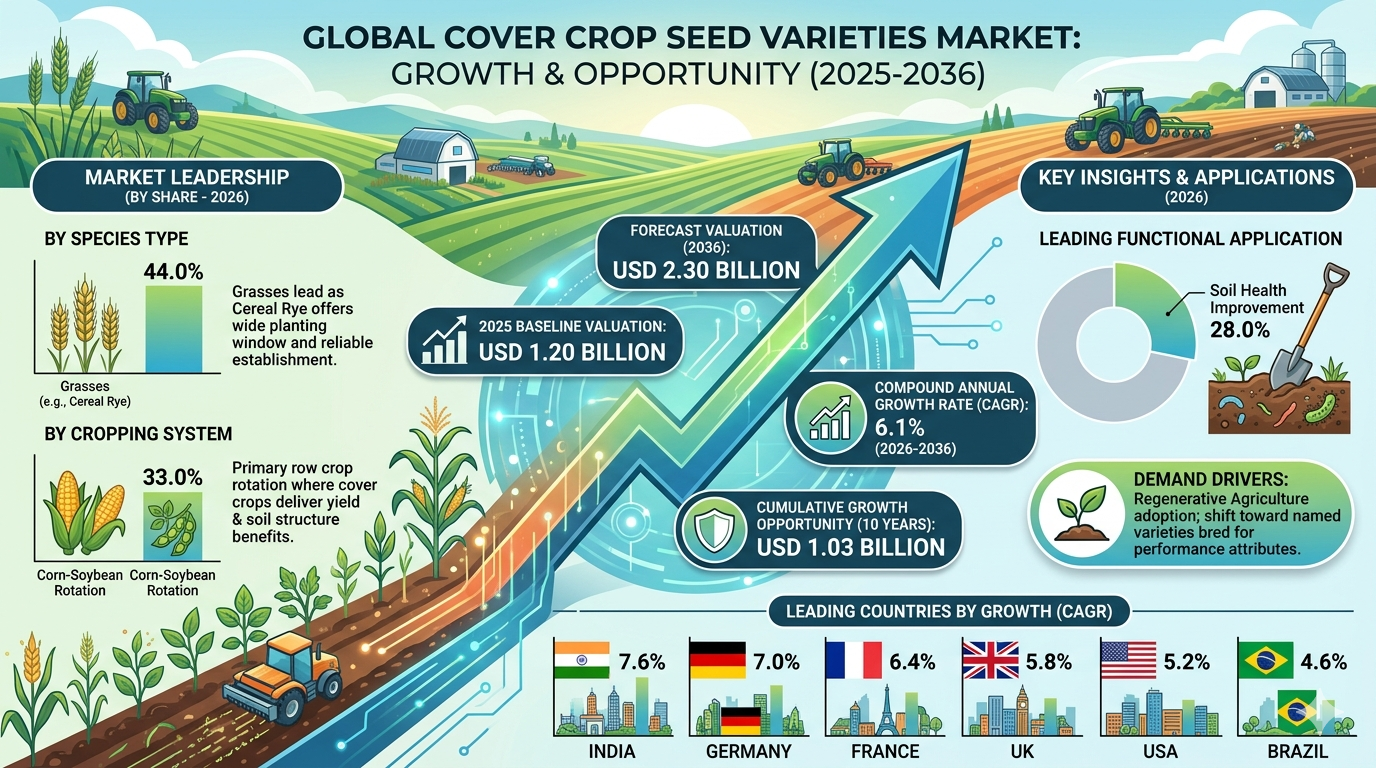
According to the latest insights by Future Market Insights, the global Cover Crop Seed Varieties Market is entering a sustained growth phase as farmers worldwide increasingly prioritize soil regeneration, nutrient efficiency, and long-term agricultural sustainability. The market, valued at USD 1.20 billion in 2025, is projected to reach USD 1.27 billion in 2026 and further expand to USD 2.30 billion by 2036, reflecting a CAGR of 6.1% during the forecast period.
Growing awareness of soil health management, coupled with government conservation programs and expanding participation in carbon credit initiatives, is driving demand for genetically improved and regionally adapted cover crop seed varieties. As agricultural producers seek alternatives to conventional input-intensive farming systems, cover crops are emerging as a critical tool for enhancing soil productivity, biodiversity, and climate resilience.
The industry is witnessing a shift from generic seed purchases toward performance-oriented varieties specifically developed for biomass production, winter hardiness, nitrogen fixation, and erosion control. This transformation is creating new opportunities for breeders, seed suppliers, agronomists, and sustainable agriculture stakeholders across global markets.
Quick Market Highlights
- Cover Crop Seed Varieties Market expected to reach USD 2.30 billion by 2036
- Industry forecast to expand at a CAGR of 6.1% between 2026 and 2036
- Grasses segment projected to lead with 44.0% market share in 2026
- Soil Health Improvement application expected to account for 28.0% share in 2026
- Corn-Soybean Rotation Systems to hold 33.0% share among end-use systems
- India anticipated to lead growth among major markets with a CAGR of 7.6%
Regenerative Agriculture Becomes the Foundation of Market Expansion
The accelerating adoption of regenerative agriculture practices is emerging as one of the most influential growth drivers for the cover crop seed varieties market.
Farmers are increasingly recognizing the long-term agronomic and economic benefits associated with cover cropping, including improved soil structure, enhanced nutrient cycling, reduced erosion, and increased organic matter accumulation. As sustainability becomes a core priority across agricultural supply chains, cover crops are being integrated into conventional and organic farming systems alike.
Government-backed conservation initiatives and environmental stewardship programs are further supporting adoption. Incentive-based schemes that reward soil conservation, biodiversity enhancement, and carbon sequestration are encouraging growers to invest in specialized cover crop varieties tailored to specific production objectives.
Industry analysts observe that cover crop adoption is shifting from experimental implementation to a mainstream agronomic practice in many agricultural regions.
Performance-Based Varietal Selection Reshapes Purchasing Decisions
A notable trend influencing the market is the transition from commodity seed purchasing toward performance-differentiated varietal selection.
Farmers who previously relied on generic cereal rye, clover, or brassica seeds are increasingly selecting named varieties bred for measurable performance outcomes. Characteristics such as rapid fall establishment, winter survival, drought tolerance, nitrogen fixation efficiency, and biomass production are becoming key purchasing criteria.
Agronomic advisory services and precision farming platforms are also contributing to this shift by linking varietal performance with soil health metrics, crop productivity improvements, and profitability outcomes.
As a result, seed breeders are intensifying research efforts to develop region-specific varieties capable of addressing diverse environmental and cropping conditions.
Soil Health Improvement Drives Application Demand
Among all functional applications, soil health improvement is expected to maintain its dominant position throughout the forecast period.
The segment is projected to account for 28.0% of market revenue in 2026 as concerns surrounding soil degradation, declining fertility, and reduced organic matter continue to intensify worldwide.
Cover crop varieties designed for soil health enhancement support microbial activity, improve water infiltration, increase carbon sequestration, and help restore biological diversity within agricultural ecosystems. Farmers are increasingly utilizing these solutions to reduce dependence on synthetic fertilizers while improving long-term productivity.
The growing focus on climate-smart agriculture and resilient farming systems is expected to further reinforce demand for soil health-oriented cover crop programs over the coming decade.
Grasses Continue to Dominate Species Type Segmentation
The grasses segment is expected to retain market leadership, accounting for 44.0% of total revenue share in 2026.
Cereal rye varieties remain particularly attractive due to their adaptability across diverse climates and soil conditions. Their broad planting window, reliable establishment rates, and ability to generate significant biomass make them a preferred choice among growers adopting cover crop systems for the first time.
Additionally, grasses provide effective weed suppression, erosion control, moisture retention, and nutrient capture capabilities. Their extensive root systems contribute significantly to soil stabilization and organic matter accumulation, reinforcing their role within regenerative agriculture programs.
As conservation-focused farming expands globally, demand for advanced grass-based cover crop varieties is expected to remain robust.
Corn-Soybean Rotation Systems Generate Significant Adoption Opportunities
Corn-soybean rotation systems are projected to account for 33.0% of market revenue in 2026, making them the largest end-use segment.
The widespread use of these rotations, particularly across North America, has created substantial opportunities for cover crop integration. Farmers are increasingly utilizing cover crops between production cycles to improve nutrient management, suppress weeds, enhance soil fertility, and mitigate erosion risks.
Furthermore, participation in conservation compliance programs and carbon credit initiatives is encouraging greater adoption within large-scale row crop operations.
The documented benefits of cover crops in improving yield stability and soil resilience are making them a strategic component of modern corn-soybean production systems.
Precision Agriculture and Seed Innovation Support Market Advancement
Technological innovation is playing an increasingly important role in shaping the future of the cover crop seed varieties industry.
Advancements in breeding technologies, genetic improvement programs, and precision agriculture platforms are enabling the development of highly specialized seed varieties tailored to specific environmental conditions and management objectives.
Seed companies are investing in:
- Regionally adapted cover crop varieties
- Improved drought and pest resistance traits
- Enhanced nitrogen fixation performance
- Precision planting compatibility
- Data-driven agronomic recommendation systems
- Multi-species cover crop blend development
The integration of digital farm management tools is also helping growers optimize variety selection based on soil conditions, climate forecasts, and crop rotation requirements.
These innovations are expected to accelerate adoption while improving return on investment for agricultural producers.
Regional Markets Demonstrate Strong Growth Potential
Growth momentum remains strong across both developed and emerging agricultural economies.
China is forecast to lead the market with an impressive CAGR of 8.2% through 2036, supported by large-scale regenerative agriculture programs and government-led soil restoration initiatives.
India follows closely with a CAGR of 7.6%, driven by national soil health missions, organic farming expansion, and increasing awareness among smallholder farmers regarding sustainable land management practices.
Germany is projected to expand at 7.0%, benefiting from European Union eco-scheme requirements and conservation-focused agricultural policies. France is expected to grow at 6.4%, while the United Kingdom is forecast to register a CAGR of 5.8%.
The United States is projected to maintain steady growth at 5.2%, supported by USDA conservation programs and expanding carbon market participation.
Competitive Landscape Centers on Innovation and Agronomic Support
Competition within the cover crop seed varieties market is increasingly centered on product innovation, regional adaptation, and value-added agronomic services.
Leading industry participants continue to invest in breeding programs designed to improve biomass production, nitrogen fixation efficiency, disease resistance, and climate adaptability.
Key companies operating in the market include:
- Beck’s Hybrids
- Barenbrug USA
- Grassland Oregon
- Blue River Organic Seed
- PGG Wrightson Seeds
- DLF Seeds
- Albert Lea Seed
Market leaders are differentiating themselves through customized seed blends, precision agriculture partnerships, sustainability initiatives, and advisory support services that help growers maximize agronomic outcomes.
Strategic collaborations with research institutions, conservation agencies, and ag-tech providers are expected to remain central to long-term competitive success.
Outlook: Cover Crops Become a Core Component of Sustainable Agriculture
Looking ahead to 2036, cover crop seed varieties are expected to play an increasingly important role in advancing regenerative agriculture, soil carbon management, and climate-resilient food production systems.
As governments, food companies, and agricultural producers intensify efforts to improve environmental performance while maintaining productivity, demand for advanced cover crop varieties will continue to strengthen.
The next decade is expected to favor seed suppliers capable of delivering region-specific solutions, measurable agronomic benefits, and data-driven support services. Companies that successfully align innovation with sustainability objectives will be well-positioned to capture emerging opportunities across the evolving global agricultural landscape.
Related Reports:
Have a specific Requirements and Need Assistant on Report Pricing or Limited Budget please contact us – sales@futuremarketinsights.com
About Future Market Insights (FMI)
Future Market Insights, Inc. (FMI) is an ESOMAR-certified, ISO 9001:2015 market research and consulting organization, trusted by Fortune 500 clients and global enterprises. With operations in the U.S., UK, India, and Dubai, FMI provides data-backed insights and strategic intelligence across 30+ industries and 1200 markets worldwide.
Contact Us:
Future Market Insights Inc.
Christiana Corporate, 200 Continental Drive,
Suite 401, Newark, Delaware – 19713, USA
T: +1-347-918-3531
Why FMI: https://www.futuremarketinsights.com/why-fmi
For Sales Enquiries: sales@futuremarketinsights.com
Website: https://www.futuremarketinsights.com