

The global fish processing industry is undergoing a rapid technological transformation as processors seek to maximize yield, reduce labor dependency, improve traceability, and enhance product quality. While countries such as China, Thailand, and Vietnam process larger overall seafood volumes, Norway has emerged as the undisputed global benchmark in Fish Processing Technology through its leadership in automation, machine vision, cold chain precision, and byproduct valorization.
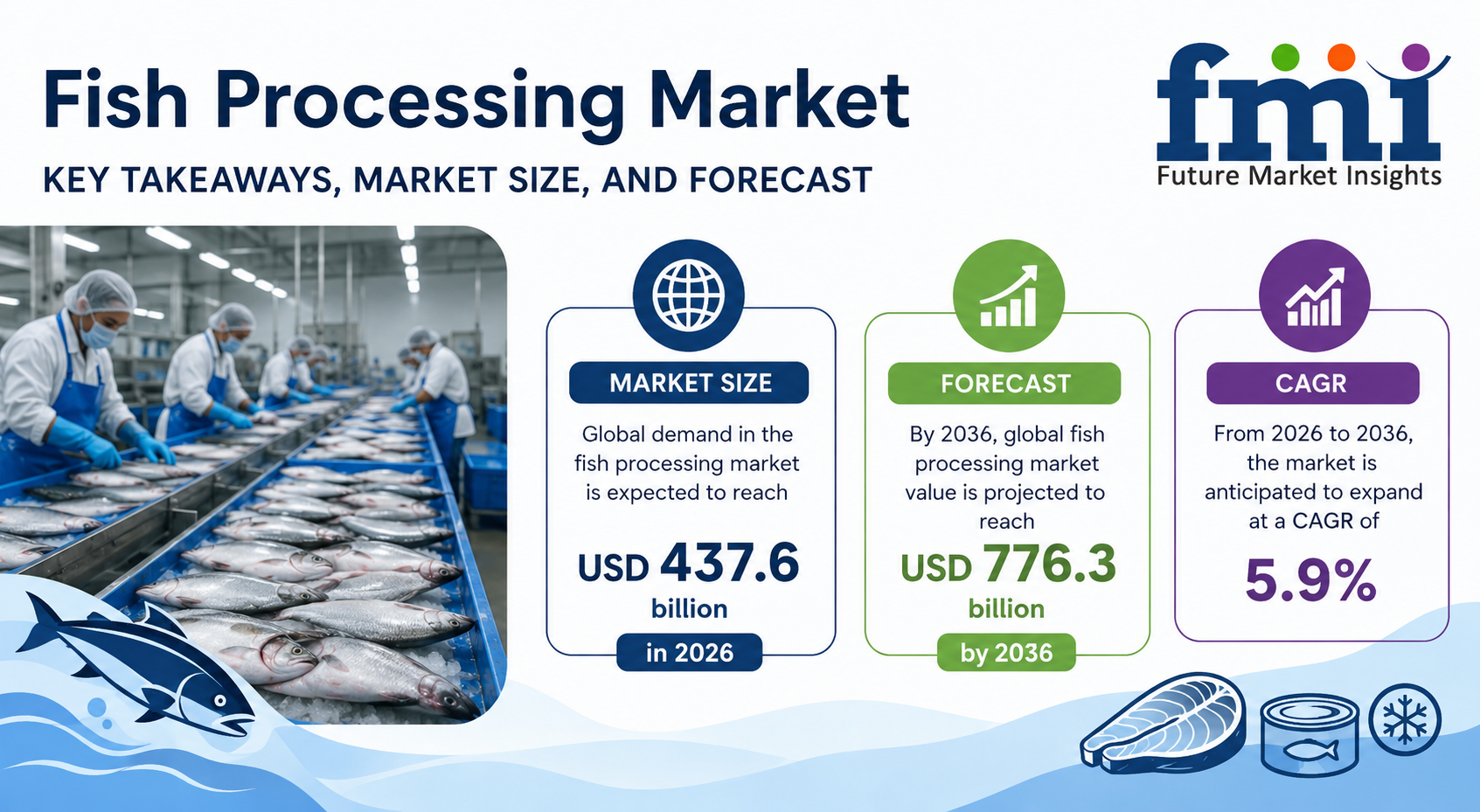
According to industry analysis, the Fish Processing Market is projected to witness robust expansion between 2026 and 2036, driven by increasing seafood consumption, premium export demand, automation investments, and growing requirements for traceability and food safety compliance.
Norway’s leadership demonstrates that technological sophistication not processing volume determines competitive advantage in modern seafood processing.
Featured Snippet: Key Market Answer
Q: Why does Norway lead Fish Processing Technology despite processing lower global seafood volumes?
A: Norway leads Fish Processing Technology because of its highly automated salmon-processing ecosystem, high labor costs that incentivize robotics adoption, advanced machine vision systems, precision cold chain infrastructure, and integrated byproduct recovery technologies. These factors allow Norwegian processors to achieve superior yields, higher product quality, stronger traceability, and significantly greater profitability compared to many higher-volume processing regions.
Quick Stats of Fish Processing Technology Market
Leading Technology Hub: Norway
Global Atlantic Salmon Share Processed in Norway: 55%
Average Automation Yield Improvement: 3–5 Percentage Points
Fresh Salmon Shelf-Life Extension: Up to 16 Days
Fastest Emerging Trend: AI-Powered Yield Optimization and Predictive Processing
Key Profit Driver: Byproduct Valorization Technologies
Market Overview: Why Processing Efficiency Matters More Than Volume
Fish Processing Technology encompasses automated filleting, grading, trimming, freezing, packaging, traceability, cold chain management, and byproduct recovery systems used throughout seafood processing operations.
Historically, seafood processing relied heavily on manual labor. However, rising labor costs, increasing food safety requirements, and growing demand for premium seafood exports are accelerating adoption of advanced processing technologies.
Today, competitive advantage is increasingly determined by:
- Yield optimization
- Automation intensity
- Product quality consistency
- Traceability capabilities
- Cold chain precision
- Byproduct monetization
Norway has successfully integrated all of these capabilities into a highly specialized salmon-processing ecosystem, creating a technology leadership position that influences seafood processing globally.
Key Growth Drivers
High Labor Costs Accelerating Automation
Norwegian seafood processors operate in one of the world’s highest-cost labor environments, with processing wages frequently exceeding USD 30 per hour.
A conventional filleting operation employing 40 workers may incur annual labor costs exceeding USD 10 million. Automated processing systems costing USD 5 million to USD 8 million can often achieve payback periods of less than three years through labor savings alone.
This economic pressure has encouraged continuous investment in robotics, machine vision systems, and automated processing equipment.
Salmon Production Scale and Standardization
Norway produces approximately 1.4 million tonnes of Atlantic salmon annually, accounting for around 55% of global supply.
Uniform fish size, predictable quality characteristics, and year-round production volumes create ideal conditions for automation deployment. Equipment manufacturers can optimize systems specifically for salmon morphology, enabling highly precise processing outcomes.
Strong Industry Collaboration
Norway benefits from close collaboration among:
- Aquaculture producers
- Seafood processors
- Technology suppliers
- Research institutions
This integrated ecosystem accelerates innovation cycles and enables rapid testing and deployment of new technologies before global commercialization.
Rising Demand for Premium Seafood
Consumers increasingly demand premium seafood products with:
- Longer shelf life
- Superior quality consistency
- Traceable sourcing
- Sustainable production credentials
Advanced processing technologies allow exporters to meet these requirements while maximizing profitability.
Market Trends Shaping the Industry
AI-Driven Yield Optimization
Machine learning algorithms are increasingly being used to analyze fish anatomy, optimize cutting patterns, and maximize fillet recovery.
These systems continuously improve processing accuracy while reducing waste.
Machine Vision-Based Processing
Modern processing plants utilize cameras, sensors, and X-ray systems to assess each fish individually.
Technology-driven processing decisions are replacing manual operator judgment, improving consistency across production lines.
Digital Cold Chain Management
Real-time monitoring systems now track temperature throughout the processing and distribution process.
This capability supports regulatory compliance and enables premium export pricing.
Full Traceability Ecosystems
Food safety regulations and consumer expectations are driving adoption of integrated traceability platforms that connect harvesting, processing, transportation, and retail operations.
Circular Seafood Processing Models
Processors increasingly view byproducts as valuable revenue streams rather than waste, creating new opportunities in nutraceuticals, cosmetics, animal nutrition, and aquaculture feed.
Segment Insights
Technology Leadership: Automated Filleting and Machine Vision Systems
Automated filleting systems equipped with machine vision and X-ray imaging represent the most advanced segment of fish processing technology.
Key benefits include:
- Precise bone detection
- Consistent cutting accuracy
- Reduced labor dependency
- Increased throughput
- Improved yield performance
Traditional manual filleting generally achieves yields of 58–62%.
Advanced automated systems consistently achieve:
- 64–67% fillet yields
- Reduced trimming losses
- Improved product uniformity
For facilities processing 100,000 tonnes annually, these gains can generate an additional USD 30 million to USD 40 million in product value.
Application Leadership: Quality Grading and Product Optimization
Automated grading systems evaluate:
- Color
- Texture
- Fat content
- Size characteristics
By accurately directing products toward appropriate market segments, processors can improve realized revenues by 8–12% compared with manual grading approaches.
The Critical Role of Cold Chain Technology
Temperature control remains one of the most important value drivers in seafood processing.
Norwegian processors maintain fish temperatures between 0°C and 2°C throughout primary processing operations using:
- Plate chillers
- Ice slurry systems
- Refrigerated air technologies
This approach extends fresh salmon shelf life to 14–16 days compared to 7–10 days for products exposed to temperature fluctuations.
Extended shelf life enables profitable exports to:
- North America
- Europe
- Japan
- South Korea
- China
Premium export markets frequently reward superior cold chain management with price premiums ranging from USD 2 to USD 4 per kilogram.
Byproduct Processing: Transforming Waste into Profit
Modern fish processing facilities increasingly generate value from byproducts including:
- Heads
- Frames
- Skins
- Viscera
- Trimmings
These materials represent approximately 35–40% of total fish weight.
Advanced recovery technologies produce:
High-purity omega-3 oils can command:
- USD 8–15 per kilogram
compared to approximately USD 2 per kilogram for conventional feed-grade oils.
Protein Hydrolysates
Recovered proteins are increasingly used in:
- Functional foods
- Premium pet nutrition
- Aquaculture feeds
- Nutraceutical formulations
These products often generate values of USD 4–8 per kilogram.
A salmon processing facility handling 50,000 tonnes annually can generate an additional USD 15 million to USD 25 million in revenue through integrated byproduct recovery operations.
Why Other High-Volume Processing Countries Lag Behind
Lower Labor Costs Reduce Automation Incentives
Major seafood-processing countries such as China, Thailand, and Vietnam often operate with labor costs between USD 3 and USD 8 per hour.
As a result, manual processing remains economically attractive for many applications.
Greater Species Diversity
Many Asian facilities process multiple seafood species including:
- Tuna
- Shrimp
- Tilapia
- Whitefish
- Squid
Species diversity makes standardization difficult and reduces the economic viability of highly specialized automated systems.
Broader Product Mix
Many processors serve lower-value industrial and institutional markets that do not require premium processing standards.
Without premium pricing opportunities, investments in advanced automation are often difficult to justify financially.
Regional Insights
Norway
Norway remains the global leader in advanced fish processing technology due to:
- Salmon production concentration
- High automation adoption
- Strong R&D investment
- Premium export orientation
- Advanced cold chain infrastructure
Europe
European seafood processors continue investing heavily in:
- Traceability systems
- Food safety technologies
- Sustainability compliance
- Digital processing platforms
Asia-Pacific
Asia-Pacific remains the largest seafood processing region by volume.
Technology adoption is accelerating as processors increasingly target premium export markets requiring higher quality standards.
Latin America
Chile is emerging as a major adopter of Norwegian processing technologies due to its growing salmon industry and increasing export orientation.
Competitive Landscape
The fish processing technology sector is characterized by strong collaboration between equipment manufacturers, software providers, and seafood processors.
Key Players
- Marel
- Baader
- Arenco
- Skaginn 3X
- Optimar
- MMC First Process
- Cabinplant
- Valka
- JBT Corporation
- Scanvaegt Systems
Competitive Differentiation Factors
- Machine vision capabilities
- AI-driven yield optimization
- X-ray bone detection
- Integrated traceability
- Cold chain monitoring
- Byproduct processing technologies
- Predictive maintenance systems
Recent Developments
- Expansion of AI-powered filleting and trimming platforms
- Increased use of machine vision grading systems
- Growth of digital traceability infrastructure
- Greater investment in omega-3 extraction technologies
- Integration of predictive maintenance software in processing facilities
- Adoption of cloud-based quality monitoring platforms
Expert Insight
The future of Fish Processing Technology will be defined less by processing volume and more by processing intelligence.
Norway’s success demonstrates that competitive advantage emerges when automation, precision cold chain management, machine vision systems, and byproduct utilization operate as an integrated ecosystem.
As seafood producers seek to improve profitability and meet increasingly stringent regulatory requirements, technology-intensive processing models are expected to become the global industry standard.
FAQs
Why does Norway lead global fish processing technology?
Norway combines high automation adoption, advanced machine vision systems, premium salmon production, and world-class cold chain infrastructure, enabling superior processing efficiency and profitability.
How much yield improvement can automated fish processing deliver?
Advanced automated systems typically improve fillet yield from approximately 60% to 65–67%, generating substantial revenue gains for large processors.
Why is salmon processing easier to automate?
Farmed salmon exhibits highly consistent size, shape, and quality characteristics, making it ideal for species-specific automation systems.
How does cold chain management influence seafood value?
Effective temperature control extends shelf life, supports export compliance, reduces spoilage, and allows processors to access premium global markets.
What role do byproducts play in modern seafood processing?
Byproducts can generate significant additional revenue through production of fish oils, collagen, protein hydrolysates, and specialty ingredients.
Can Norwegian processing models be replicated elsewhere?
Yes, particularly in regions serving premium export markets. However, success depends on production scale, species standardization, and access to high-value distribution channels.
Conclusion
Norway has established itself as the global benchmark in Fish Processing Technology by proving that automation intensity, yield optimization, cold chain precision, and byproduct monetization can generate greater competitive advantage than processing volume alone.
As seafood markets become increasingly quality-driven and traceability-focused, processors worldwide are expected to adopt technologies pioneered within the Norwegian salmon ecosystem. The next decade will likely see accelerated investment in AI-enabled processing, advanced grading systems, digital cold chains, and circular processing models, positioning Fish Processing Technology as one of the most important value-creation segments within the global seafood industry.
Related Research Reports
Seafood Market is expected to witness steady growth driven by expanding aquaculture production, rising health-conscious consumption of seafood as a protein source, and ongoing investments in cold chain infrastructure that improve access to fresh and frozen seafood across inland markets.
Aquaculture Equipment Market is expected to witness robust growth driven by rising global demand for sustainable seafood production, increasing adoption of automated feeding and monitoring systems, and growing investments in commercial aquaculture farms focused on improving productivity and operational efficiency.
About Future Market Insights (FMI)
Future Market Insights, Inc. (FMI) is an ESOMAR-certified, ISO 9001:2015 market research and consulting organization, trusted by Fortune 500 clients and global enterprises. With operations in the U.S., UK, India, and Dubai, FMI provides data-backed insights and strategic intelligence across 30+ industries and 1200 markets worldwide.
Contact Us:
Future Market Insights Inc.
Christiana Corporate, 200 Continental Drive,
Suite 401, Newark, Delaware – 19713, USA
T: +1-347-918-3531
Why FMI: https://www.futuremarketinsights.com/why-fmi
For Sales Enquiries: sales@futuremarketinsights.com
Website: https://www.futuremarketinsights.com