

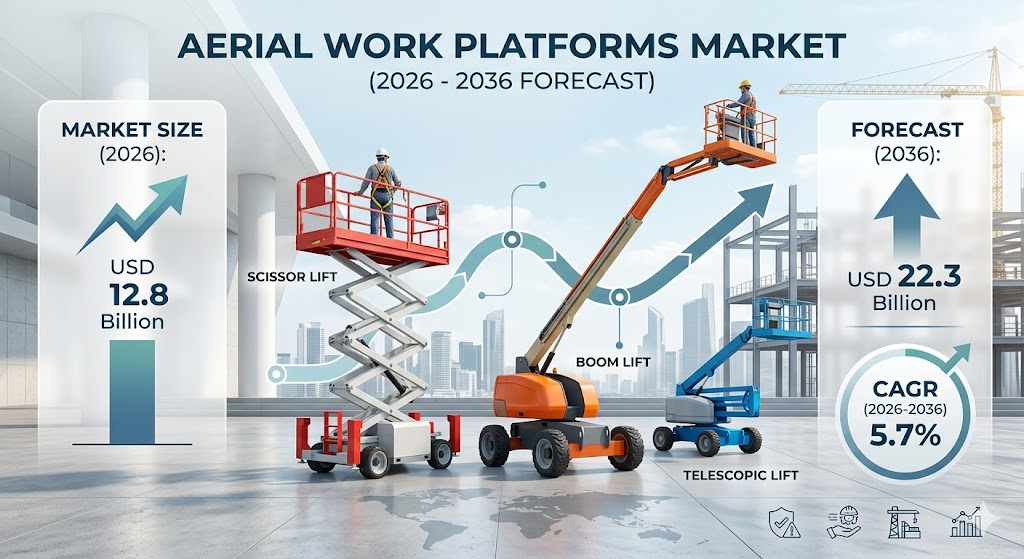
According to the latest analysis by Future Market Insights, the global Aerial Work Platforms (AWP) Market is experiencing steady growth as workplace safety regulations, infrastructure development, warehouse expansion, and equipment rental adoption continue to reshape access-at-height operations worldwide. According to the latest analysis by Future Market Insights, the market is projected to expand at a CAGR of 5.7% through 2036, supported by increasing demand for safer, more efficient alternatives to ladders and scaffolding across construction, logistics, maintenance, utilities, and industrial sectors.
As governments strengthen worker protection standards and urban emissions regulations become increasingly stringent, contractors and fleet operators are accelerating investments in modern aerial access equipment, particularly electric and hybrid platforms designed for indoor and low-emission environments.
Quick Stats – Aerial Work Platforms Market
- Projected CAGR (2026–2036): 5.7%
- Key Growth Driver: Workplace Safety Compliance
- Leading Product Segment: Scissor Lifts
- Fastest-Growing Trend: Electrified and Hybrid Platforms
- Major End Users: Construction, Warehousing, Logistics, Utilities, and Facility Management
- Growth Hotspots: India, China, North America, and Western Europe
Safety Compliance Continues to Drive Equipment Adoption
Workplace safety remains the most influential factor shaping demand across the AWP industry. Falls from height continue to represent one of the leading causes of workplace fatalities, prompting stricter enforcement of safety regulations and encouraging the use of engineered access solutions.
The implementation of ANSI A92 standards has significantly increased requirements related to operator training, load sensing systems, machine stability, gated entry designs, and documented risk assessments. As a result, many contractors are replacing older equipment with newer compliant models that improve jobsite safety while reducing liability risks.
Industry experts indicate that safety-focused procurement decisions are becoming increasingly common across both developed and emerging construction markets.
Warehouse Expansion Creates Strong Indoor Equipment Demand
The rapid growth of e-commerce fulfillment networks and logistics facilities is generating sustained demand for indoor aerial work platforms.
Electric scissor lifts and vertical mast lifts have become preferred solutions for warehouse construction, maintenance, inventory management, and facility upgrades due to their compact footprint, low noise levels, and zero on-site emissions.
As distribution centers become larger and more automated, aerial access equipment is playing a critical role in supporting operational efficiency and worker productivity.
Demand is particularly strong for:
- Electric scissor lifts
- Vertical mast lifts
- Compact indoor access platforms
- Maintenance and facility management equipment
- Low-emission warehouse access solutions
Electrification Reshapes Product Development Strategies
One of the most significant shifts occurring within the industry is the transition toward electrified and hybrid aerial work platforms.
Environmental regulations across major urban centers are encouraging fleet operators to reduce diesel-powered equipment usage. New emissions requirements are accelerating investments in electric machines that can operate in environmentally sensitive locations, indoor projects, and low-emission zones.
Manufacturers are increasingly prioritizing:
- Lithium-ion battery technologies
- Hybrid boom lifts
- Extended runtime capabilities
- Faster charging systems
- Reduced lifecycle emissions
These innovations are expected to play a major role in future purchasing decisions across rental fleets and end-user organizations.
Rental Industry Remains Central to Market Growth
Equipment rental companies continue to represent a major distribution channel for aerial work platforms worldwide.
Although rental fleet expansion moderated during 2024–2025 following several years of strong growth, the sector remains highly influential in shaping purchasing trends and equipment utilization patterns.
Rental operators are increasingly focused on:
- Fleet modernization
- Electrified equipment deployment
- Utilization optimization
- Maintenance efficiency
- Operator training services
The growing preference for renting rather than owning equipment is expected to support long-term market expansion by lowering capital barriers for contractors and project operators.
Regional Markets Present Diverse Growth Opportunities
Growth prospects remain positive across both mature and emerging economies.
North America continues to benefit from strong safety compliance initiatives, infrastructure investments, and established rental markets.
Europe is witnessing growing adoption of electric aerial work platforms as urban emissions policies become increasingly stringent.
Meanwhile, Asia Pacific is expected to emerge as one of the fastest-growing regions, supported by rapid industrialization, urban infrastructure projects, logistics expansion, and rising workplace safety awareness.
Countries such as India and China are anticipated to provide substantial long-term opportunities as construction activity and industrial modernization initiatives accelerate.
Competitive Landscape Focuses on Innovation and Fleet Efficiency
The competitive environment remains characterized by continuous innovation, product diversification, and strategic investments in electrification technologies.
Manufacturers are concentrating on:
- Smart fleet management solutions
- Advanced safety technologies
- Battery-powered equipment
- Remote diagnostics capabilities
- Service network expansion
The ability to provide reliable, compliant, and environmentally sustainable access solutions will increasingly determine competitive success throughout the forecast period.
Key Players
- JLG Industries
- Genie (Terex Corporation)
- Haulotte Group
- Skyjack Inc.
- Snorkel International
- Manitou Group
- MEC Aerial Work Platforms
- Dingli Machinery
- Niftylift Ltd.
- Tadano Ltd.
Outlook: Access Equipment Becomes Safer, Smarter, and Cleaner
By 2036, aerial work platforms are expected to become even more integral to construction, industrial maintenance, warehousing, and infrastructure development activities worldwide.
As safety expectations rise and environmental regulations tighten, demand will increasingly favor intelligent, connected, and low-emission equipment platforms. Companies capable of delivering advanced safety features, electric mobility solutions, and strong fleet support services will be best positioned to capitalize on the next phase of market growth.
The future of the aerial work platforms industry is no longer defined solely by lifting workers higher—it is defined by enabling safer, cleaner, and more productive work at height.
Related Reports:
BRICS Aerial Work Platforms Market
UK Aerial Work Platform Market
Have a specific Requirements and Need Assistant on Report Pricing or Limited Budget please contact us – sales@futuremarketinsights.com
About Future Market Insights (FMI)
Future Market Insights, Inc. (FMI) is an ESOMAR-certified, ISO 9001:2015 market research and consulting organization, trusted by Fortune 500 clients and global enterprises. With operations in the U.S., UK, India, and Dubai, FMI provides data-backed insights and strategic intelligence across 30+ industries and 1200 markets worldwide.
Contact Us:
Future Market Insights Inc.
Christiana Corporate, 200 Continental Drive,
Suite 401, Newark, Delaware – 19713, USA
T: +1-347-918-3531
Why FMI: https://www.futuremarketinsights.com/why-fmi
For Sales Enquiries: sales@futuremarketinsights.com
Website: https://www.futuremarketinsights.com
LinkedIn| Twitter| Blogs | YouTube