

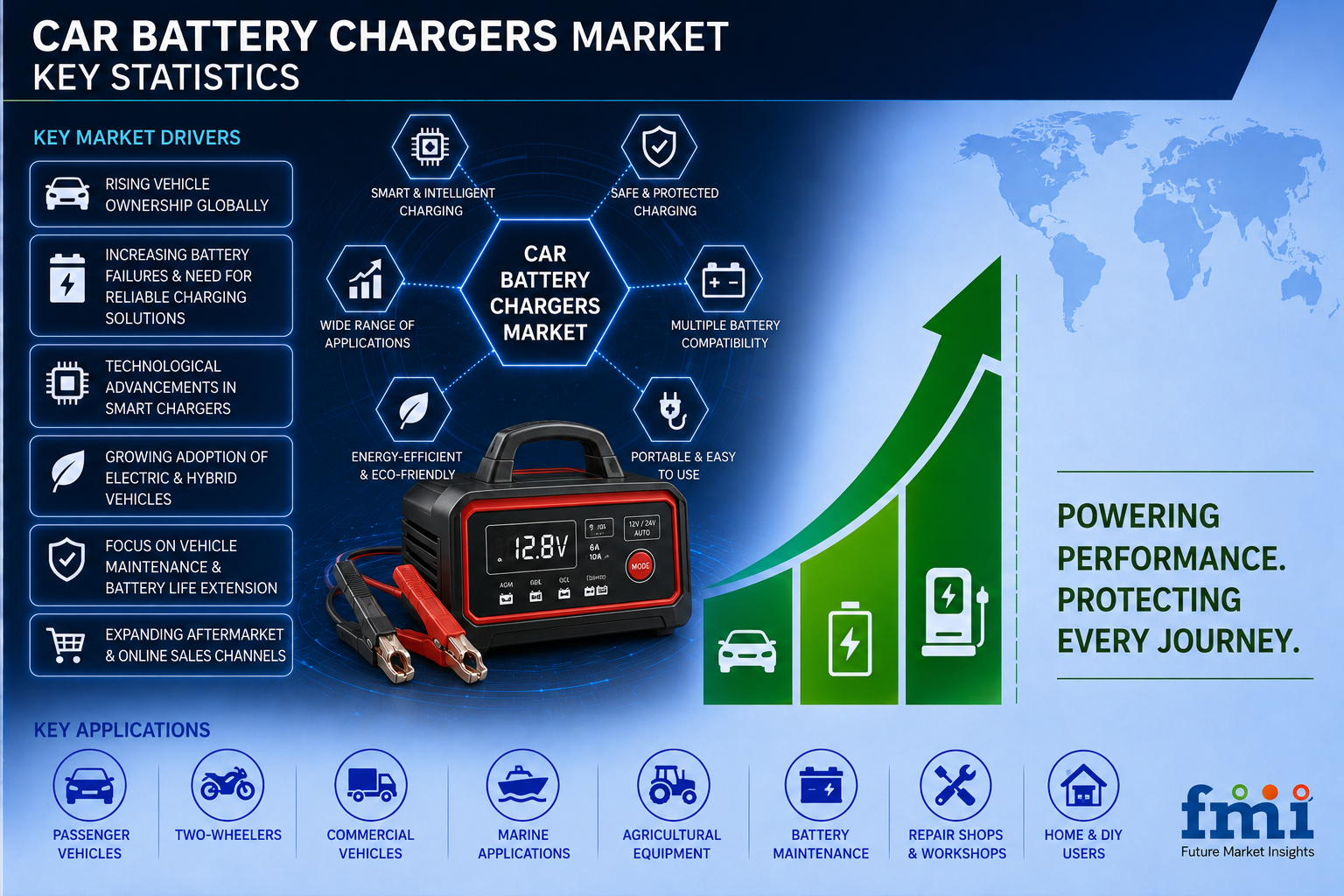
The global Car Battery Chargers Market is undergoing a significant transformation as advances in battery technology, vehicle electrification, and connected charging systems reshape buyer expectations. What was once considered a simple maintenance accessory has evolved into a sophisticated power management tool capable of extending battery life, improving vehicle reliability, and supporting increasingly complex electrical architectures.
Demand is expanding across consumer, professional, fleet, marine, recreational vehicle (RV), and industrial applications. At the same time, competition is intensifying among branded manufacturers, professional workshop specialists, fleet-focused equipment providers, Chinese OEM producers, and precision electronics companies seeking leadership in specialized charging segments.
Why Smart Charger Brands Continue to Dominate the Consumer Market
The consumer smart charger segment has become one of the most dynamic areas of the market, driven by growing demand for convenience, safety, and battery protection.
Modern vehicles increasingly utilize AGM, enhanced flooded batteries (EFB), lithium-ion systems, and start-stop technologies that require more sophisticated charging profiles than traditional lead-acid batteries. As a result, consumers are gravitating toward smart chargers capable of automatically adjusting voltage, current, and charging stages based on battery condition.
Leading brands have established strong positions by combining advanced charging algorithms with user-friendly features such as automatic battery detection, reverse-polarity protection, spark-proof connections, and maintenance charging modes. These capabilities reduce user error while helping maximize battery lifespan.
Consumer purchasing decisions are increasingly influenced by online reviews, brand reputation, warranty coverage, and ease of use rather than charging output alone. As a result, premium smart chargers continue to command substantial pricing premiums over generic alternatives.
Retail Distribution and E-Commerce Strengthen Brand Leadership
Distribution has become a critical competitive advantage within the consumer charger segment.
Brands that secure visibility through major automotive retailers, e-commerce marketplaces, powersports dealers, marine suppliers, and RV networks benefit from both planned purchases and emergency replacement demand. Strong retail placement increases consumer confidence while expanding market reach beyond traditional automotive enthusiasts.
Packaging quality, instructional support, customer service responsiveness, and digital marketing effectiveness also play increasingly important roles in influencing consumer purchasing behavior.
As online shopping continues to grow, successful brands are investing heavily in product education, customer engagement, and review management to reinforce market leadership.
Professional Workshops Prioritize Certification and Diagnostic Capability
While consumers focus on convenience, professional automotive service centers evaluate chargers through a very different lens.
Workshop environments require equipment capable of operating continuously while supporting multiple vehicle service cycles each day. Reliability, diagnostic functionality, and compatibility with modern vehicle electronics have become essential purchasing criteria.
Professional-grade chargers increasingly incorporate advanced battery analysis functions that help technicians identify sulfation, cell imbalance, charging system issues, and battery degradation before failures occur. These capabilities reduce diagnostic errors and improve service efficiency.
OEM approval has also emerged as a significant competitive differentiator. Chargers validated for use by premium vehicle manufacturers gain credibility within dealership service departments and independent repair facilities, where warranty compliance and electronic system protection are major concerns.
Fleet Operators Demand High-Amperage Charging Solutions
Fleet operators, logistics providers, municipalities, and industrial vehicle owners represent another rapidly growing market segment.
Unlike consumer users, fleet managers prioritize operational uptime above all other considerations. High-amperage charging systems capable of restoring depleted batteries quickly can significantly reduce vehicle downtime and improve asset utilization.
Heavy-duty chargers designed for fleet environments are engineered to withstand continuous operation, harsh conditions, temperature fluctuations, and frequent connection cycles. Procurement decisions often focus on durability, maintenance support, service contracts, and total cost of ownership rather than initial purchase price.
As commercial fleet electrification accelerates and vehicle utilization rates continue rising, demand for industrial-grade charging infrastructure is expected to strengthen throughout the forecast period.
Chinese Manufacturers Continue to Influence Global Pricing
Chinese OEM manufacturers remain a dominant force in global charger production, controlling significant portions of worldwide manufacturing capacity.
Extensive supply chain integration enables these producers to source transformers, semiconductors, enclosures, microcontrollers, and power electronics components efficiently while maintaining highly competitive cost structures. Their ability to manufacture products for both private-label customers and direct-to-consumer channels creates substantial economies of scale.
Many factories produce chargers for multiple global brands while simultaneously offering their own products through online marketplaces. This manufacturing model allows Chinese suppliers to achieve high production volumes while exerting considerable influence over global pricing trends.
As direct-to-consumer e-commerce channels continue expanding, price competition is expected to remain intense across entry-level and mid-range charger categories.
Precision Electronics Companies Focus on Battery Longevity
At the premium end of the market, precision electronics manufacturers are targeting specialized applications where battery protection and long-term performance outweigh cost considerations.
Luxury vehicles, marine vessels, recreational vehicles, backup power systems, and advanced auxiliary battery applications increasingly require sophisticated charging systems capable of preserving battery health under demanding operating conditions.
These chargers incorporate advanced temperature compensation, multi-stage charging algorithms, voltage stabilization technologies, and thermal management systems that minimize battery degradation. By reducing stress on battery cells, such systems can significantly extend service life while improving overall performance.
For buyers facing high battery replacement costs, investment in premium charging technologies is increasingly viewed as a preventative maintenance strategy rather than an accessory purchase.
Technology Innovation Is Reshaping Competitive Dynamics
Several technological trends are expected to influence market competition over the next decade:
- AI-assisted charging algorithms
- Bluetooth and Wi-Fi-enabled charger monitoring
- Cloud-based battery diagnostics
- Multi-chemistry charging compatibility
- Enhanced thermal management systems
- Predictive battery health analytics
- Integration with vehicle telematics platforms
- Smart energy management capabilities
These innovations are transforming battery chargers into intelligent energy management devices capable of providing actionable insights and extending battery performance across a wide range of vehicle platforms.
Future Outlook: Smart Charging Becomes Central to Vehicle Reliability
As automotive batteries become more advanced and vehicle electronics grow increasingly complex, battery charging technology will play a larger role in maintaining vehicle reliability and operational efficiency.
Consumer buyers will continue seeking safe, easy-to-use smart chargers that simplify battery maintenance. Professional workshops will prioritize diagnostic capability and OEM-approved solutions. Fleet operators will focus on uptime, durability, and charging speed, while premium users will demand advanced battery protection features.
At the same time, Chinese manufacturing scale will continue driving pricing pressure throughout the industry, encouraging branded suppliers to differentiate through innovation, engineering quality, service support, and distribution strength.
As these trends converge, the Car Battery Chargers Market is expected to evolve from a traditional aftermarket category into a critical component of modern vehicle power management and battery lifecycle optimization.
Browse more industry reports