

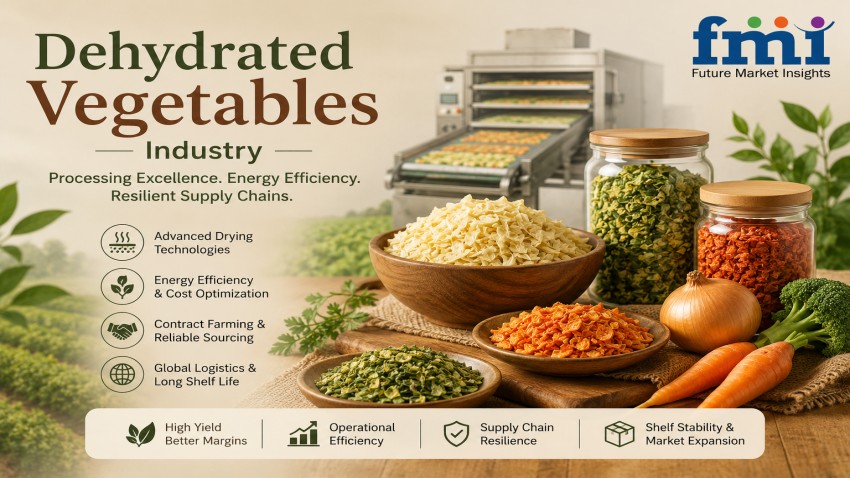
According to the latest insights by Future Market Insights, the global dehydrated vegetables industry is undergoing a significant transformation as manufacturers increasingly focus on processing efficiency, energy optimization, and resilient sourcing strategies to improve profitability and meet growing demand from foodservice, retail, and industrial food sectors. In 2026, leading processors are investing in advanced drying technologies, contract farming programs, and supply chain modernization initiatives to strengthen operational performance and maintain competitive advantage in a rapidly evolving market.
Industry analysts note that while vegetable prices remain an important factor, the long-term success of dehydrated vegetable manufacturers is increasingly determined by drying yields, energy consumption, raw material consistency, and logistics efficiency. Companies capable of optimizing these variables are better positioned to capture opportunities across global food manufacturing and convenience food markets.
Processing Technology Emerges as a Strategic Competitive Advantage
Drying technology continues to serve as the foundation of dehydrated vegetable production economics. Manufacturers are evaluating advanced processing methods that balance product quality, throughput, and operating costs.
Air drying remains the most widely adopted commercial technology due to its relatively low capital requirements and suitability for large-scale production. The process delivers consistent output for applications such as soups, seasoning blends, ready meals, and food ingredients, where moderate quality variations remain acceptable.
At the premium end of the market, freeze drying is gaining attention for its superior preservation of texture, color, nutritional integrity, and rehydration performance. While freeze-dried vegetables command significantly higher production costs and energy requirements, growing demand from premium convenience foods, outdoor nutrition products, and specialized foodservice applications is creating new growth opportunities.
Drum drying technology is also supporting increased demand for vegetable powders and concentrated ingredient solutions used in sauces, processed foods, seasonings, and functional food applications.
As food manufacturers seek higher-quality ingredients and longer shelf life, processing technology selection is becoming a critical determinant of market competitiveness.
Energy Efficiency Becomes a Major Driver of Profitability
Energy consumption remains one of the largest operational expenses in vegetable dehydration, often accounting for 40% to 60% of total processing costs.
Processors are increasingly investing in:
- Multi-stage drying systems
• Heat recovery technologies
• Advanced thermal management solutions
• Automated process optimization software
• Renewable and biomass-based energy systems
Modern facilities equipped with heat exchangers and energy recovery systems are reducing fuel consumption while improving overall production efficiency. In many regions, access to stable and affordable energy infrastructure is emerging as a decisive factor influencing facility expansion and investment decisions.
Companies operating large-scale dehydration facilities are leveraging technology upgrades to improve energy productivity and reduce exposure to fuel price volatility.
Contract Farming Strengthens Raw Material Supply Chains
Raw material consistency has become a key focus area for dehydrated vegetable manufacturers seeking to improve yield performance and product quality.
Processors are expanding contract farming programs that allow them to control:
- Crop varieties
• Planting schedules
• Harvest timing
• Agronomic practices
• Quality specifications
Higher solids content vegetables require less energy during dehydration and generate improved processing yields, directly enhancing profitability.
Industry experts report that manufacturers with established contract farming networks frequently achieve superior operational performance compared to company’s dependent on open-market procurement. Consistent access to high-quality vegetables also supports better color retention, flavor preservation, and product uniformity.
The trend is encouraging closer collaboration between agricultural producers and processing companies, strengthening supply chain resilience across the industry.
Quality Requirements Drive Application-Specific Production Strategies
The growing diversity of end-use applications is encouraging processors to align production methods with specific customer requirements.
For industrial food manufacturing, air-dried vegetables continue to provide a cost-effective solution for soups, bouillons, sauces, and seasoning blends.
Meanwhile, premium convenience foods, instant meal kits, and specialty foodservice products increasingly require enhanced color, texture, and rehydration performance, creating demand for freeze-dried ingredients.
Manufacturers are also developing customized processing approaches for:
- Instant noodle products
• Ready-to-eat meals
• Vegetable snacks
• Functional food ingredients
• Premium culinary applications
This application-focused strategy allows processors to maximize value while aligning technology investments with customer expectations.
Shelf Stability and Logistics Support Global Market Expansion
One of the most significant advantages of dehydrated vegetables remains their exceptional shelf stability and transportation efficiency.
By removing 85% to 92% of product weight and volume, dehydration significantly reduces logistics costs compared with fresh and frozen alternatives. The ability to store products under ambient conditions for extended periods further simplifies inventory management throughout the supply chain.
Food manufacturers, foodservice operators, institutional buyers, and emergency food suppliers increasingly favor dehydrated formats due to:
- Reduced storage requirements
• Lower transportation expenses
• Extended shelf life
• Improved inventory flexibility
• Reduced product waste
Advanced packaging technologies, including moisture-barrier materials and oxygen-control systems, continue to improve product stability and support international market expansion.
Future Outlook
The future of the dehydrated vegetables industry will be increasingly shaped by processing efficiency, energy optimization, and supply chain resilience. Manufacturers are expected to accelerate investments in advanced drying technologies, intelligent process controls, and strategic sourcing partnerships to strengthen competitiveness and support long-term growth.
Growing demand for convenience foods, shelf-stable ingredients, and cost-effective food manufacturing solutions is expected to create new opportunities across global markets. Companies that successfully combine operational efficiency with reliable agricultural sourcing and quality-focused production strategies will be best positioned to capitalize on the evolving needs of food manufacturers, foodservice operators, and consumers worldwide.
As the industry continues to modernize, processing excellence and resilient supply chains are expected to remain the defining factors driving success in the global dehydrated vegetables market.
Explore More Related Studies Published by FMI Research:
Vegetable Powders Market is Segmented by Grade (Feed Grade, Food Grade), Vegetable (Onion & Tomato, Corn, Mushroom, Beans, Others), Application (Thickener, Nutritional Enrichment, Flavour Enhancer), End-Use (Household, Food Service, Food and Beverage Products), and Distribution Channel (Supermarket/Hypermarket, Convenience Stores, Specialty Stores, Online Stores, Others). Forecast for 2025 to 2035.
Freeze-Drying Market is segmented by product (Freeze Dryers and Accessories), scale of operations (Pilot-Scale, Laboratory-Scale, and Industrial-Scale), application (Aseptic Applications, Non-Aseptic Applications, and Both Aseptic and Non-Aseptic), end user (Pharma, Biotechnology, CRO, CDMO, Academic and Government, Diagnostic, Other Healthcare Markets, Food and Agriculture, General and Environment, Chemicals, and Other), project type (Expansion, Greenfield, and Replacement), revenue stream (Equipment Sales, Service Contracts, and Aftermarket Parts), and region. Forecast for 2026 to 2036.
Shelf-Stable Soup Market is projected to grow from USD 12.8 billion in 2025 to USD 17.7 billion by 2035, at a CAGR of 3.3%. Gazpacho will dominate with a 47.6% market share, while conventional will lead the nature segment with a 62.3% share.
About Future Market Insights (FMI)
Future Market Insights, Inc. (FMI) is an ESOMAR-certified, ISO 9001:2015 market research and consulting organization, trusted by Fortune 500 clients and global enterprises. With operations in the U.S., UK, India, and Dubai, FMI provides data-backed insights and strategic intelligence across 30+ industries and 1200 markets worldwide.
Contact Us:
Future Market Insights Inc.
Christiana Corporate, 200 Continental Drive,
Suite 401, Newark, Delaware – 19713, USA
T: +1-347-918-3531
Why FMI: https://www.futuremarketinsights.com/why-fmi
For Sales Enquiries: sales@futuremarketinsights.com
Website: https://www.futuremarketinsights.com
LinkedIn| Twitter| Blogs | YouTube