

According to the latest insights by Future Market Insights, the global Textile Based pH Controllers Market is entering a phase of sustained expansion as textile manufacturers increasingly prioritize process optimization, chemical efficiency, and environmental compliance. Growing demand for high-quality fabrics, coupled with stringent wastewater discharge regulations and the adoption of advanced textile processing technologies, is accelerating the deployment of specialized pH control formulations across textile production facilities worldwide.
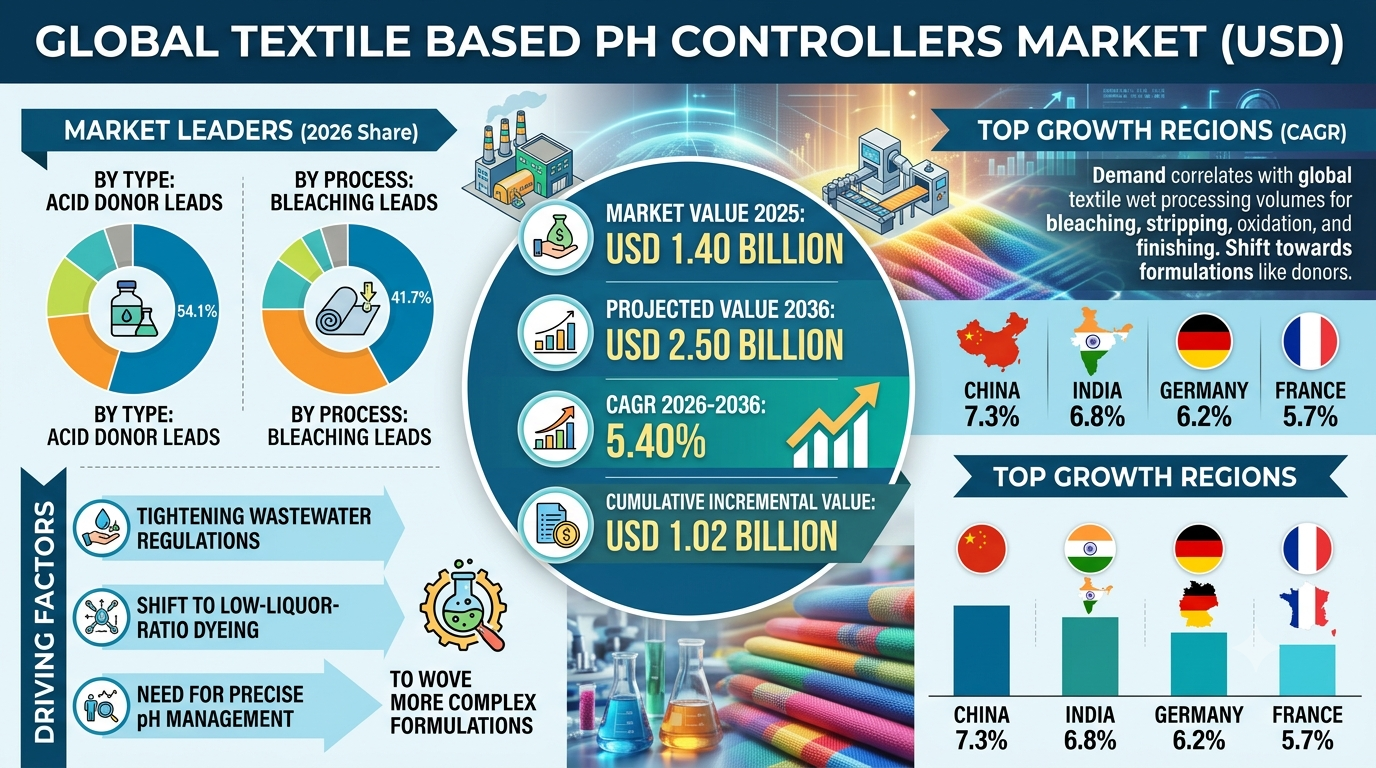
The market is projected to grow from USD 1.48 billion in 2026 to USD 2.50 billion by 2036, registering a CAGR of 5.40% during the forecast period. The increasing importance of maintaining precise pH levels during bleaching, dyeing, oxidation, stripping, and finishing operations is positioning textile-based pH controllers as an essential component of modern textile manufacturing.
As sustainability initiatives gain momentum and textile producers seek to reduce chemical waste, improve operational efficiency, and enhance product quality, demand for advanced pH management solutions continues to strengthen across both developed and emerging textile manufacturing hubs.
Quick Market Highlights
- Global market projected to reach USD 2.50 billion by 2036
- Industry expected to expand at a CAGR of 5.40% from 2026 to 2036
- Acid Donor segment anticipated to account for 54.1% market share in 2026
- Bleaching process segment projected to hold 41.7% share in 2026
- Growing environmental compliance requirements supporting adoption of automated pH control solutions
- Increasing textile production volumes in Asia driving market expansion
Precise Chemical Management Emerges as a Key Industry Requirement
Textile processing operations require strict control of pH conditions to ensure consistent product quality, color accuracy, and process efficiency. Manufacturers are increasingly adopting textile-based pH controllers to improve chemical dosing accuracy and eliminate variations that can impact fabric performance.
The growing complexity of textile manufacturing processes, combined with higher quality standards demanded by apparel brands and industrial textile users, has increased the need for advanced pH control formulations. These solutions help manufacturers optimize bleaching, dyeing, oxidation, and finishing operations while minimizing chemical consumption and production waste.
Industry stakeholders are increasingly viewing pH management as a strategic factor in maintaining competitiveness, operational consistency, and regulatory compliance.
Environmental Regulations Drive Market Adoption
One of the most influential growth factors shaping the Textile Based pH Controllers Market is the tightening regulatory landscape governing wastewater treatment and chemical discharge.
Environmental authorities worldwide are implementing stricter controls on textile effluent quality, compelling manufacturers to adopt more precise chemical management systems. Regulatory frameworks such as the European Industrial Emissions Directive and increasingly stringent discharge norms in major textile-producing nations are encouraging the adoption of advanced pH control technologies.
By maintaining optimal chemical balance throughout processing operations, textile-based pH controllers help manufacturers reduce environmental impact, lower treatment costs, and comply with evolving sustainability requirements.
Asia Pacific Continues to Lead Global Demand
Asia Pacific remains the dominant region in the global textile-based pH controllers industry, supported by its extensive textile manufacturing infrastructure and expanding garment production capacities.
China continues to lead global market growth, registering an anticipated CAGR of 7.3% through 2036. The country’s position as the world’s largest textile dyeing and finishing hub creates substantial demand for specialty pH control formulations across multiple processing stages.
India follows closely with a projected CAGR of 6.8%, driven by rapid expansion in textile manufacturing, increasing exports, and strengthening environmental regulations implemented by the Central Pollution Control Board. Growing investments in textile processing facilities and modernization initiatives are further supporting market growth throughout the country.
Germany and France continue to generate stable demand through their advanced technical textile sectors and adherence to stringent European environmental standards.
Acid Donor Formulations Maintain Market Leadership
Among product categories, Acid Donor formulations are expected to maintain their dominant market position, accounting for 54.1% of global market revenue in 2026.
The widespread adoption of acid donors is attributed to their critical role in maintaining optimal acidity levels during bleaching, dyeing, and finishing operations. Their compatibility with automated dosing systems allows manufacturers to achieve consistent process performance while reducing manual intervention and operational errors.
Additionally, acid donor formulations contribute to improved color consistency, enhanced fabric quality, and reduced chemical overconsumption, making them increasingly attractive to textile manufacturers focused on sustainability and operational efficiency.
As textile production becomes more automated, demand for reliable and predictable acid donor technologies is expected to remain strong throughout the forecast period.
Bleaching Operations Generate Significant Market Opportunities
By process, the bleaching segment is anticipated to command 41.7% of market revenue in 2026, making it the leading application area for textile-based pH controllers.
Bleaching processes require precise pH regulation to achieve desired fabric whiteness while protecting fiber integrity and ensuring product consistency. Improper pH management can result in excessive chemical usage, reduced fabric quality, and increased production costs.
The integration of advanced pH control systems within bleaching operations enables manufacturers to optimize chemical consumption, improve process reliability, and meet sustainability objectives. As demand for premium-quality textiles continues to rise, the importance of precision bleaching technologies is expected to increase significantly.
Digitalization and Smart Manufacturing Support Industry Evolution
The ongoing adoption of Industry 4.0 technologies is creating new growth opportunities across the textile-based pH controllers market.
Manufacturers are increasingly implementing smart manufacturing systems that incorporate real-time monitoring, automated chemical dosing, predictive analytics, and IoT-enabled process controls. These technologies enhance visibility into production operations while enabling rapid adjustments to maintain optimal pH conditions.
Advanced monitoring platforms help reduce operational risks, improve resource utilization, and minimize waste generation. As digital transformation initiatives accelerate across the textile sector, demand for intelligent pH management solutions is expected to expand considerably.
Supply Chain Optimization and Sustainability Shape Procurement Strategies
Procurement priorities within the textile industry are increasingly influenced by sustainability objectives, operational efficiency targets, and supply chain resilience.
Textile manufacturers are seeking long-term partnerships with suppliers capable of delivering reliable formulations, technical support, and innovative chemical solutions. Investments in sustainable textile processing technologies are driving demand for pH controllers that reduce environmental impact while supporting high production performance.
The growing popularity of textile recycling initiatives and circular economy strategies is also contributing to market expansion, as recycled textile processing often requires enhanced pH management to maintain quality standards.
Competitive Landscape Focuses on Innovation and Distribution Expansion
Competition within the Textile Based pH Controllers Market continues to intensify as manufacturers invest in product development, process innovation, and global distribution networks.
Leading industry participants include BASF, FCL, Rudolf GmbH, S&D, ZSCHIMMER & SCHWARZ, ICL, Seydel Companies, GIOVANNI BOZZETTO S.p.A., Jay Chemical Industries Ltd., Rung International, Avco Chemicals, and Denim Care Sdn Bhd.
Market participants are focusing on:
- Development of advanced acid and alkali donor formulations
- Expansion of global distribution capabilities
- Long-term supply agreements with textile manufacturers
- Research and development investments
- Sustainable chemical innovation
- Technical support and application engineering services
Companies capable of combining product performance with regulatory expertise and customer support are expected to strengthen their competitive position over the coming decade.
Outlook: Sustainable Textile Processing to Accelerate Long-Term Market Growth
Looking ahead to 2036, the Textile Based pH Controllers Market is expected to benefit from ongoing investments in textile modernization, environmental compliance, and smart manufacturing technologies.
As textile manufacturers seek greater operational efficiency, improved fabric quality, and reduced environmental impact, advanced pH control solutions will play an increasingly critical role in production processes. The growing adoption of automation, digital monitoring systems, and sustainable manufacturing practices is expected to create substantial opportunities for market participants worldwide.
Industry leaders that can deliver innovative formulations, technical expertise, and integrated process optimization solutions are likely to capture significant growth opportunities as the global textile industry continues its transition toward more sustainable and efficient production models.
Related Reports:
Have a specific Requirements and Need Assistant on Report Pricing or Limited Budget please contact us – sales@futuremarketinsights.com
About Future Market Insights (FMI)
Future Market Insights, Inc. (FMI) is an ESOMAR-certified, ISO 9001:2015 market research and consulting organization, trusted by Fortune 500 clients and global enterprises. With operations in the U.S., UK, India, and Dubai, FMI provides data-backed insights and strategic intelligence across 30+ industries and 1200 markets worldwide.
Contact Us:
Future Market Insights Inc.
Christiana Corporate, 200 Continental Drive,
Suite 401, Newark, Delaware – 19713, USA
T: +1-347-918-3531
Why FMI: https://www.futuremarketinsights.com/why-fmi
For Sales Enquiries: sales@futuremarketinsights.com
Website: https://www.futuremarketinsights.com