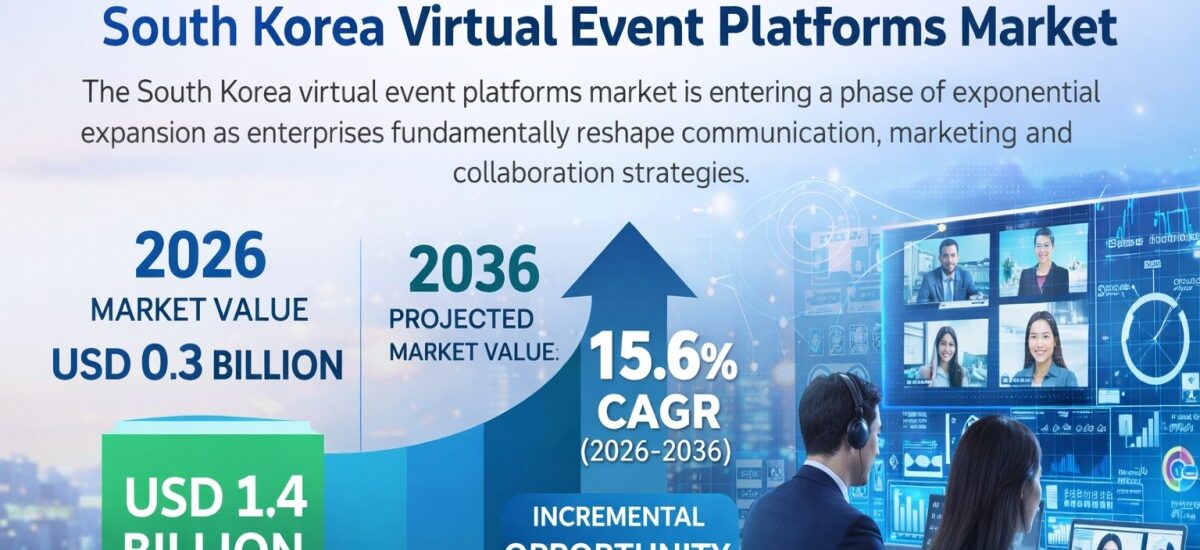
The South Korea virtual event platforms market is entering a phase of exponential expansion as enterprises fundamentally reshape communication, marketing, and collaboration strategies. According to the latest analysis, the market is valued at USD 0.3 billion in 2026 and is projected to reach USD 1.4 billion by 2036, growing at a robust CAGR of 15.6%. The sector is expected to generate an incremental opportunity of USD 1.1 billion over the forecast period.
This surge reflects a structural transformation in enterprise engagement models, where virtual and hybrid event platforms are no longer temporary substitutes but core digital infrastructure enabling scalable, data-driven, and globally accessible interactions.
Get detailed market forecasts, competitive benchmarking, and pricing trends
https://www.futuremarketinsights.com/reports/sample/rep-gb-31502
Featured Snippet: Key Market Answer
Q: What is driving the growth of the virtual event platforms market in South Korea?
A: Growth is driven by the rapid adoption of hybrid work models, increasing demand for cost-effective global engagement tools, and advancements in AI-driven features such as real-time analytics, matchmaking, and immersive virtual environments.
Quick Stats
• Market Size (2026): USD 0.3 billion
• Forecast (2036): USD 1.4 billion
• CAGR (2026-2036): 15.6%
• Incremental Opportunity: USD 1.1 billion
• Leading Solution Segment: Virtual Event Platform Software (73.2%)
• Leading Enterprise Segment: Medium-sized Enterprises (20.3%)
• Leading End User: Enterprises/Corporates (36.1%)
• Top Growth Region: Jeju (CAGR 18.7%)
Market Overview: A Structural Shift Toward Virtualized Engagement
The virtual event platforms market in South Korea is defined by software-driven ecosystems that enable immersive, scalable, and data-rich digital experiences. The market is being reshaped by three transformative forces:
• Permanent shift toward hybrid and remote work models
• Growing need for global audience reach without physical constraints
• Rising demand for data-driven marketing and engagement tools
These factors are transforming virtual platforms into strategic assets for enterprise growth, enabling organizations to move beyond physical limitations and operate in a globally connected digital environment.
Key Growth Drivers
1. Hybrid Work and Digital Collaboration Expansion
Organizations are embedding virtual events into everyday operations-from global town halls to training sessions-making them essential for workforce engagement and knowledge sharing.
2. Cost Efficiency and Global Reach
Virtual platforms significantly reduce logistics, travel, and infrastructure costs while enabling access to global audiences, making them a high-ROI alternative to traditional events.
3. Data-Driven Marketing Capabilities
Unlike physical events, virtual platforms provide deep insights into attendee behavior, engagement patterns, and conversion metrics, transforming events into measurable growth engines.
Market Trends Shaping the Industry
• Rise of Hybrid Events: Blending physical and virtual experiences is becoming the new standard
• AI Integration: Real-time translation, smart matchmaking, and automated content summaries are enhancing engagement
• Immersive Experiences: Adoption of VR and metaverse-style environments to combat virtual fatigue
• On-Demand Content: Events are increasingly repurposed into long-term digital assets for continuous engagement
Segment Insights
Solution Leadership: Virtual Event Platform Software (73.2%)
Software dominates the market as the core enabler of virtual experiences, offering:
• Scalable infrastructure for large audiences
• Interactive tools such as polls, Q&A, and networking lounges
• Integrated analytics and reporting capabilities
While services (event planning, production, moderation) remain important, they are closely tied to the adoption of software platforms.
Enterprise Segment: Medium-Sized Enterprises (20.3%)
Medium-sized enterprises lead adoption due to:
• Need for cost-effective global visibility
• Agility in adopting digital tools
• Limited reliance on large IT infrastructure
These organizations use virtual platforms to compete with larger players by expanding reach and engagement efficiently.
End-User Segment: Enterprises/Corporates (36.1%)
Corporates dominate usage across:
• Internal communications (training, town halls)
• External marketing (product launches, webinars)
• Partner and stakeholder engagement
Demand is particularly strong for enterprise-grade platforms with security, scalability, and CRM integration.
Speak to Analyst
https://www.futuremarketinsights.com/customization-available/rep-gb-31502
Regional Insights
Top Growth Regions (CAGR 2026-2036)
• Jeju: 18.7% – Hub for hybrid international conferences and smart city initiatives
• South Gyeongsang: 16.4% – Driven by industrial conglomerates and global trade activities
• South Jeolla: 14.8% – Growth fueled by renewable energy and sustainability sectors
• North Jeolla: 12.5% – Academic and research-driven adoption
Emerging Regional Dynamics
• Jeju Island is becoming a global destination for hybrid events, combining physical tourism with virtual participation
• Industrial hubs are leveraging platforms for global supply chain coordination and B2B engagement
• Academic institutions are accelerating adoption for international collaboration and virtual learning
Market Dynamics
Key Opportunities
• Integration of AI and generative technologies for smarter engagement
• Growth of metaverse and immersive environments
• Expansion of hybrid event ecosystems
• Increasing demand for real-time multilingual capabilities
Key Challenges
• Virtual fatigue reducing attendee engagement
• Technical complexity in hosting high-quality events
• Data privacy and compliance concerns
• Integration challenges with existing enterprise systems
Threats to Growth
• Feature commoditization leading to price competition
• Economic downturn impacting marketing budgets
• Market fragmentation due to rapid innovation
• Regulatory constraints on data sovereignty
Competitive Landscape
The market is highly competitive, with a mix of global technology giants and specialized event platform providers.
Key Players
• Cisco Systems (Webex)
• Zoom Video Communications Inc.
• Microsoft Corporation (Teams)
• vFairs
• Cvent Inc.
Competitive Differentiation Factors
• Platform scalability and reliability
• Depth of interactive features
• Advanced analytics capabilities
• Hybrid event functionality
• Seamless integration with enterprise ecosystems
Recent Developments
• Integration of AI-powered engagement tools and analytics
• Expansion of hybrid event solutions
• Development of immersive 3D and metaverse environments
• Enhanced focus on data security and compliance
Expert Insight
The South Korea virtual event platforms market is transitioning from a convenience-driven solution to a mission-critical enterprise capability. As organizations prioritize scalability, measurable ROI, and global engagement, platforms that integrate AI, immersive technologies, and seamless enterprise workflows will dominate the next phase of growth.
FAQs
1. What is the future outlook for the market?
The market is expected to reach USD 1.4 billion by 2036, growing at a CAGR of 15.6%.
2. Which segment dominates the market?
Virtual event platform software leads with a 73.2% share due to its central role in enabling digital experiences.
3. Why are companies adopting virtual event platforms?
To reduce costs, expand global reach, and leverage data-driven engagement strategies.
4. What are the major challenges?
Virtual fatigue, technical complexity, and data privacy concerns.
5. Which region shows the highest growth?
Jeju leads with a CAGR of 18.7%, driven by hybrid event adoption and smart city initiatives.
Full Report for Detailed Insights:
https://www.futuremarketinsights.com/reports/south-korea-virtual-event-platforms-market
Conclusion
The South Korea virtual event platforms market sits at the intersection of digital transformation, enterprise communication, and global connectivity. With strong growth momentum driven by hybrid work, AI innovation, and immersive technologies, the sector is poised to become a foundational component of modern business strategy.
As organizations continue to prioritize scalable and data-driven engagement, virtual event platforms will evolve from operational tools into strategic growth engines shaping the future of global interaction.