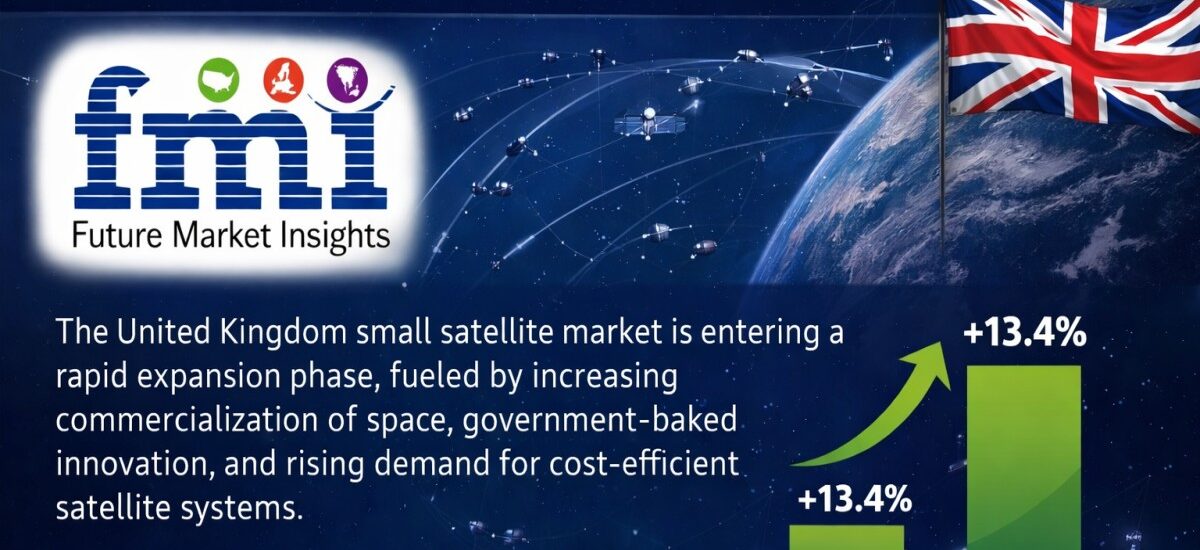
The United Kingdom small satellite market is entering a rapid expansion phase, fueled by increasing commercialization of space, government-backed innovation, and rising demand for cost-efficient satellite systems. According to the latest analysis, the market is valued at USD 604.7 million in 2026 and is projected to reach USD 2,120.5 million by 2036, expanding at a robust CAGR of 13.4%.
This growth reflects a structural transformation in the UK’s space ecosystem, where small satellites-once limited to niche applications-are now central to communications, Earth observation, navigation, and data-driven services across industries.
Get detailed market forecasts, competitive benchmarking, and pricing trends
https://www.futuremarketinsights.com/reports/sample/rep-gb-31324
Featured Snippet: Key Market Answer
Q: What is driving the growth of the small satellite market in the United Kingdom?
A: Growth is driven by increasing government investment in space capabilities, rising demand for low-cost satellite solutions, expansion of LEO-based constellations, and advancements in satellite miniaturization and modular platform technologies.
Quick Stats
• Market Size (2026): USD 604.7 million
• Forecast (2036): USD 2,120.5 million
• CAGR (2026-2036): 13.4%
• Leading Orbit Segment: Low Earth Orbit (LEO) – 79.6%
• Leading Satellite Type: Minisatellites – 25%
• Top Growth Region: England (CAGR 14.7%)
Market Overview: UK Space Ecosystem Driving Small Satellite Adoption
The United Kingdom’s small satellite market sits at the convergence of aerospace engineering, telecommunications, and advanced data analytics. The shift toward agile, cost-effective satellite systems is redefining how both commercial and government stakeholders approach space-based services.
Three structural forces are shaping this transformation:
• Expansion of commercial space ventures and satellite startups
• Increasing government investment in sovereign space capabilities
• Development of integrated space ecosystems, including manufacturing, testing, and analytics
Small satellites are increasingly preferred due to their shorter development cycles, lower launch costs, and scalable deployment models, making them ideal for modern space missions.
Key Growth Drivers
1. Government Space Strategy & Investment
The UK government’s focus on strengthening national space capabilities is accelerating funding, policy support, and infrastructure development. This reduces investment risks and encourages private sector participation.
2. Rising Commercial Applications
Demand is surging across:
• Broadband connectivity and IoT networks
• Earth observation and climate monitoring
• Maritime and environmental tracking
These applications are creating sustained demand for scalable satellite constellations.
3. Advancements in Miniaturization
Technological progress in modular satellite platforms, standardized buses, and miniaturized payloads is reducing costs while improving performance and deployment speed.
4. Expanding Research & Academic Adoption
Universities and research institutions are increasingly deploying CubeSats and nanosatellites for experimentation and training, further boosting demand.
Speak to Analyst
https://www.futuremarketinsights.com/customization-available/rep-gb-31324
Market Trends Shaping the Industry
• LEO Constellation Growth: High-frequency data and global coverage driving demand
• Modular Satellite Platforms: Standardization enabling faster deployment and scalability
• Data Monetization: Integration with AI, cloud, and analytics platforms
• Co-Design Partnerships: Collaboration between payload developers and manufacturers
• Emerging Applications: Precision agriculture, climate monitoring, autonomous systems
Segment Insights
Satellite Type Leadership: Minisatellites (25%)
Minisatellites dominate due to their:
• Balanced size and functionality
• Ability to handle complex missions
• Cost-efficiency compared to large satellites
Meanwhile:
• CubeSats are gaining traction for commercial and academic use
• Picosatellites & femtosatellites are expanding in niche applications
• Microsatellites serve mid-range operational needs
Orbit Type Dominance: Low Earth Orbit (LEO) (79.6%)
LEO leads due to:
• Lower launch costs
• Reduced latency
• Ideal suitability for communication and Earth observation
Other segments include:
• MEO: Used for navigation and broader coverage
• GEO: Limited adoption due to higher costs but relevant for broadcasting and weather monitoring
Regional Insights
Top Growth Regions (CAGR 2026-2036)
• England: 14.7% – Leading hub for aerospace and space innovation
• Scotland: 13.1% – Growing spaceports and research ecosystem
• Wales: 12.2% – Increasing adoption in telecom and environmental monitoring
• Northern Ireland: 10.7% – Emerging participation in space technologies
Regional Outlook
England dominates due to its advanced infrastructure and investment ecosystem, while Scotland is rapidly emerging as a commercial launch and satellite innovation hub. Wales and Northern Ireland are steadily expanding through academic collaboration and industrial adoption.
Competitive Landscape
The UK small satellite market is highly competitive, with both global aerospace leaders and emerging innovators competing across technology, scalability, and mission support.
Key Players
• Airbus S.A.S.
• CASIC
• OHB SE
• Lockheed Martin Corporation
• Boeing
Competitive Differentiation Factors
• Modular satellite architectures
• Payload integration capabilities
• Documented performance and reliability metrics
• End-to-end mission support (launch + ground systems)
• Regulatory compliance and quality assurance
Competition is increasingly shifting toward technical performance, scalability, and lifecycle support, rather than just pricing.
Key Challenges
• High upfront mission development costs
• Limited access to launch slots
• Complex regulatory approvals (frequency, orbit, debris mitigation)
• Technical challenges in payload integration and performance
Expert Insight
The United Kingdom small satellite market is transitioning from a supportive role in global missions to a strategic leader in agile space solutions. As demand for real-time data and connectivity intensifies, small satellites are becoming foundational to next-generation digital infrastructure.
Organizations that invest in modular platforms, LEO constellation capabilities, and integrated data services will capture significant competitive advantage in this rapidly evolving market.
FAQs
1. What is the future outlook for the UK small satellite market?
The market is expected to reach USD 2,120.5 million by 2036, growing at a CAGR of 13.4%, driven by commercial space expansion and government support.
2. Which segment dominates the market?
Low Earth Orbit (LEO) dominates with a 79.6% share, due to cost efficiency and suitability for communication and observation.
3. Why are small satellites gaining popularity?
They offer lower costs, faster deployment, scalability, and flexibility, making them ideal for modern space applications.
4. What are the main challenges in the market?
• High initial investment
• Launch scheduling constraints
• Regulatory complexities
• Technical integration challenges
5. Which region leads in the UK?
England leads the market, supported by strong aerospace infrastructure and innovation investment.
Full Report for Detailed Insights:
https://www.futuremarketinsights.com/reports/united-kingdom-small-satellite-market
Conclusion
The United Kingdom small satellite market is undergoing a profound transformation, driven by innovation, policy support, and expanding commercial use cases. As space becomes increasingly accessible, small satellites are redefining how industries leverage data, connectivity, and global monitoring capabilities.
With strong momentum across both public and private sectors, small satellites are set to become a cornerstone of the UK’s future space economy, enabling scalable, cost-effective, and high-impact solutions across industries.