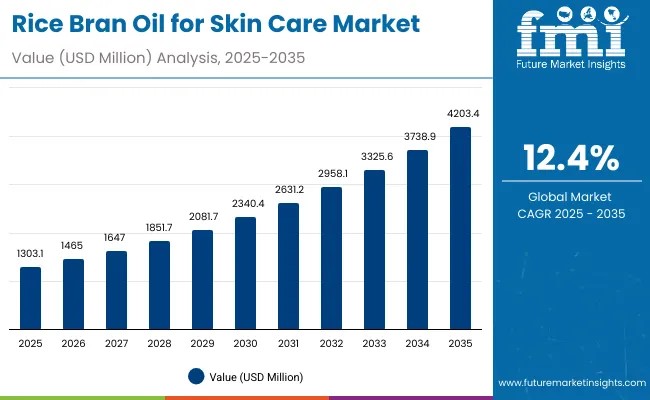
The global Rice Bran Oil for Skin Care Market is entering a high-growth phase, offering significant opportunities for both established cosmetic leaders and emerging manufacturers seeking to expand portfolios, adopt new technologies, and scale internationally. According to the latest market outlook, the industry is projected to grow from USD 1,303.1 million in 2025 to USD 4,203.4 million by 2035, registering a robust CAGR of 12.4% and achieving a 3.2X expansion in market size over the decade.
This strong trajectory highlights rice bran oil’s transformation from a niche botanical ingredient into a mainstream, high-value component of modern skincare, driven by clean beauty, anti-aging demand, and Asian beauty influence.
Gain access to detailed segment-wise analysis and forecast statistics – Download the Sample Report Today
Why the Rice Bran Oil for Skin Care Market Is Growing
- Rising Anti-Aging Demand: High levels of γ-oryzanol, tocopherols, and ferulic acid make rice bran oil a powerful natural antioxidant for skin repair and UV protection.
- Clean-Label and Natural Preference: Consumers increasingly favor botanical, vegan, and fragrance-free formulations over synthetic alternatives.
- E-commerce and D2C Expansion: Digital platforms allow both global brands and startups to reach eco-conscious consumers worldwide.
- Asian Beauty Influence: K-beauty and J-beauty routines have normalized rice bran oil as a trusted, multifunctional skincare ingredient.
Key Market Segments Driving Revenue
By Function
- Antioxidant/Repair (γ-oryzanol, tocopherols) – 49.9% share
- Moisturizing
- Brightening
- Soothing
By Product Type
- Facial oils
- Serums
- Creams & lotions
- Cleansers & balms
By Grade
- Cold-pressed / Virgin – 48.8% share
- Refined cosmetic grade
- Organic-certified
By Claim
- Natural / Organic – 50.2% share
- Clean-label
- Vegan
- Fragrance-free
By Distribution Channel
- E-commerce
- Asian beauty specialty stores
- Pharmacies
- Mass retail
By Region
- North America
- Europe
- Asia-Pacific
- Latin America
- Middle East & Africa
These segments underline the market’s versatility and its appeal across mass, premium, and dermocosmetic categories.
Regional Hotspots and Expansion Opportunities
- Asia-Pacific leads global growth, with India (21.6% CAGR) and China (19.2% CAGR) emerging as the fastest-growing markets.
- Japan continues to drive innovation through premium dermocosmetics and antioxidant-focused formulations.
- Europe, led by the UK and Germany, benefits from strong demand for organic-certified and COSMOS/NATRUE-compliant skincare.
- North America, particularly the United States, shows steady growth through indie brands, dermatologist-backed products, and clean beauty adoption via e-commerce.
Competitive Landscape: Innovation from Established and New Players
The Rice Bran Oil for Skin Care Market is moderately fragmented, creating room for both established giants and agile newcomers. DHC leads with an 8.1% global share, while brands such as Kose, Shiseido, Hada Labo, Innisfree, Rohto, Tatcha, Kiehl’s, and The Ordinary continue to expand rice bran oil usage across serums, facial oils, and moisturizers.
At the same time, emerging and niche manufacturers, including sustainability-focused and organic-certified brands like Haeckels, are gaining traction by leveraging:
- Cold-pressed and upcycled sourcing
- Vegan and clean-label positioning
- AI-driven personalization and subscription-based D2C models
Competitive advantage is shifting from single hero products to ecosystem-based strategies, combining technology, omnichannel distribution, and recurring consumer engagement.
Technology, Sustainability, and Future Outlook
Innovation remains central to long-term success. Brands are investing in AI-personalized skincare, premium extraction technologies, and sustainable sourcing of rice bran as an upcycled by-product. Regulatory trust, organic certifications, and dermatologist validation further strengthen consumer confidence.
By 2035, rice bran oil is expected to be firmly positioned as a core global skincare ingredient, not only in Asia but across Western markets as awareness grows.
Conclusion
With strong double-digit growth, expanding applications, and rising demand for natural, antioxidant-rich skincare, the Rice Bran Oil for Skin Care Market offers a compelling growth platform. For established brands, it presents an opportunity to deepen premium portfolios, while new manufacturers can scale rapidly through clean beauty innovation, digital-first strategies, and advanced formulation technologies.
Why FMI: https://www.futuremarketinsights.com/why-fmi
About Future Market Insights (FMI)
Future Market Insights, Inc. (FMI) is an ESOMAR-certified, ISO 9001:2015 market research and consulting organization, trusted by Fortune 500 clients and global enterprises. With operations in the U.S., UK, India, and Dubai, FMI provides data-backed insights and strategic intelligence across 30+ industries and 1200 markets worldwide.
Contact Us:
Future Market Insights Inc.
Christiana Corporate, 200 Continental Drive,
Suite 401, Newark, Delaware – 19713, USA
T: +1-347-918-3531
For Sales Enquiries: sales@futuremarketinsights.com
Website: https://www.futuremarketinsights.com
LinkedIn| Twitter| Blogs | YouTube