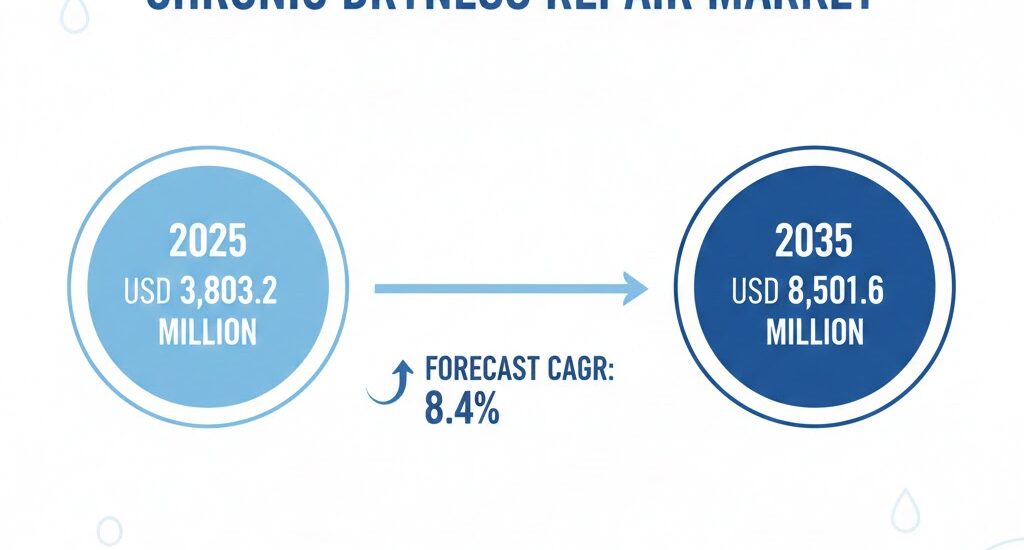
The global Chronic Dryness Repair Market is entering a decade of transformative growth, driven by rising diagnoses of eczema, psoriasis, and diabetic skin dryness. According to new industry evaluations, the market is projected to increase from USD 3,803.2 million in 2025 to USD 8,501.6 million in 2035, marking a robust 123.5% expansion at a steady CAGR of 8.4%. This surge reflects both strong consumer demand and rapid innovation from established brands and emerging manufacturers.
With digital-first players entering the field and global dermatology leaders strengthening their portfolios, the landscape is shifting toward medical-grade efficacy, ingredient transparency, and personalized skincare solutions.
Subscribe for Year-Round Insights → Stay ahead with quarterly and annual data updates – https://www.futuremarketinsights.com/reports/sample/rep-gb-26105
A Decade of Strong Expansion
The first phase of growth (2025–2030) will lift the market from USD 3.8 billion to USD 5.7 billion, contributing 40% of decade-long expansion. This period is marked by widespread adoption of creams, balms, and ointments across hospitals and pharmacies as diabetic skin complications and psoriasis-linked dryness become more prevalent.
The second phase (2030–2035) will add USD 2.8 billion, driven by:
- Rapid e-commerce adoption in Asia
- Rising preference for dermatologist-tested and medical-grade solutions
- Demand for high-efficacy actives like hyaluronic acid, urea, glycerin, and petrolatum
Innovations such as AI-based regimen selection, subscription refills, and clean-label formulations are helping both established and new manufacturers scale globally.
Why the Market Is Growing
- Rising Prevalence of Chronic Skin Disorders
Aging populations and increased diagnoses of eczema and diabetes-linked xerosis are pushing consumers toward clinical-grade moisturizers and repair products.
- Shift Toward Medical-Grade Formulations
Medical-grade products already account for 48.80% of global revenue in 2025, reflecting strong trust in dermatologist-tested solutions.
- E-commerce Acceleration
Digital platforms in China and India are enabling small and mid-tier brands to compete with long-established skincare manufacturers, reshaping global accessibility.
Key Segments of the Market
By Function
- Intense hydration
- Barrier reinforcement
- Long-lasting moisturization
- Crack prevention
By Product Type
- Creams
- Lotions
- Balms
- Ointments
By Channel
- E-commerce
- Pharmacies/drugstores
- Mass retail
- Clinics/hospitals
By Claim
- Fragrance-free
- Medical-grade
- Dermatologist-tested
- Clean-label
By End User
- Aging adults
- Diabetic patients
- Psoriasis/eczema sufferers
- General consumers
By Active Ingredient
- Hyaluronic acid
- Urea
- Shea butter
- Glycerin
- Petrolatum
By Region
- North America
- Latin America
- Europe
- East Asia
- South Asia & Pacific
- Middle East & Africa
Product Spotlight: Creams Lead with 49.90% Share
Creams dominate the Chronic Dryness Repair Market due to:
- Fast absorption and convenience
- Strong clinical evidence for long-lasting hydration
- Dermatologist preference for treating eczema, diabetic dryness, and psoriasis
Growing innovation in clean-label, fragrance-free, urea- and HA-enriched formulations is helping both global giants and up-and-coming brands expand presence.
Claim Spotlight: Medical-Grade Takes 48.80% Share
Medical-grade solutions win consumer trust based on:
- Clinical validation
- Higher concentrations of proven actives
- Endorsement by dermatologists and hospitals
This segment will remain a key battleground for innovation, especially in China, India, and the United States.
Channel Spotlight: Pharmacies & Drugstores at 47.70%
Pharmacies lead due to:
- High credibility
- Professional guidance
- Reliable availability of dermatologist-backed brands
Still, digital-first channels are rapidly rising and expected to capture larger shares by 2030.
Regional Insights
United States (CAGR: 8.5%)
- High eczema and diabetes-linked dryness
- Strong demand for urea- and petrolatum-rich formulas
- Subscription refill models gaining traction
United Kingdom (CAGR: 12.5%)
- NHS-backed emollient therapy guidance
- Seasonal dryness boosts cream and ointment usage
India (CAGR: 22.1%)
- Growing diabetic population
- Strong e-commerce adoption in tier-2/3 cities
- Value packs driving mass-market penetration
China (CAGR: 19.2%)
- Rapid digital health expansion
- Highest global adoption of medical-grade claims
- Surge in affordable yet effective local brands
Competitive Landscape
The market is moderately fragmented, led by:
- Eucerin (8.10% share in 2025)
- Aquaphor
- Neutrogena
- CeraVe
- Aveeno
- O’Keeffe’s
- Nivea
- La Roche-Posay
- Bioderma
- Vanicream
Meanwhile, new entrants specializing in clean-label, sensitive-skin, and AI-personalized routines are rapidly gaining visibility. The competitive edge is increasingly shifting from brand legacy to clinical credibility, digital engagement, and omnichannel distribution.
Conclusion
With rising chronic skin conditions and accelerating global digital adoption, the Chronic Dryness Repair Market is poised for sustained, innovation-driven expansion. Established leaders and new entrants alike have significant opportunities to scale by embracing medical-grade science, clean formulations, and consumer-personalized technologies.
Why FMI: https://www.futuremarketinsights.com/why-fmi
About Future Market Insights (FMI)
Future Market Insights, Inc. (FMI) is an ESOMAR-certified, ISO 9001:2015 market research and consulting organization, trusted by Fortune 500 clients and global enterprises. With operations in the U.S., UK, India, and Dubai, FMI provides data-backed insights and strategic intelligence across 30+ industries and 1200 markets worldwide.
Contact Us:
Future Market Insights Inc.
Christiana Corporate, 200 Continental Drive,
Suite 401, Newark, Delaware – 19713, USA
T: +1-347-918-3531
For Sales Enquiries: sales@futuremarketinsights.com
Website: https://www.futuremarketinsights.com
LinkedIn| Twitter| Blogs | YouTube