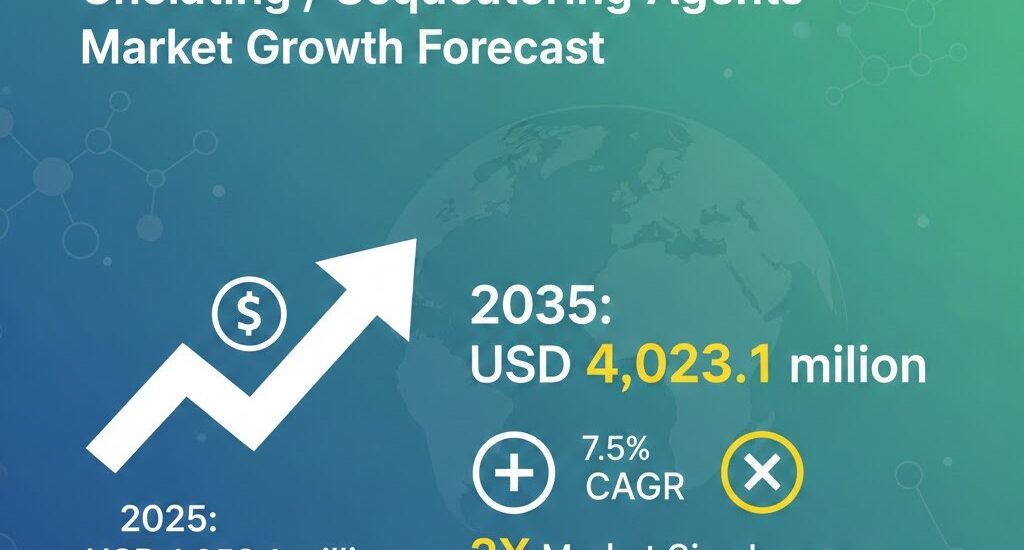
The global Chelating / Sequestering Agents Market is on track for a decade of accelerated growth, reaching USD 4,023.1 million by 2035, up from USD 1,952.1 million in 2025, marking a substantial 193% expansion. With a projected 7.5% CAGR, the industry is undergoing a pivotal transformation as manufacturers—both established and emerging—invest in greener technologies, biotechnology-driven innovations, and premium cosmetic formulation capabilities.
Subscribe for Year-Round Insights → Stay ahead with quarterly and annual data updates – https://www.futuremarketinsights.com/reports/sample/rep-gb-26344
Rising Demand Reshapes Market Dynamics
From 2025 to 2030, the market grows steadily by USD 850.3 million, driven by mainstream adoption in personal care and skincare manufacturing. Metal ion chelators hold a 48.1% share in 2025, supported by rising usage in anti-aging, sensitive-skin, and premium dermocosmetic lines. EDTA & derivatives remain dominant with a 44.2% share, though sustainable alternatives are rapidly emerging.
The second half of the decade—from 2030 to 2035—marks a sharper acceleration of USD 1,220.7 million, fueled by Asia-Pacific’s booming cosmetics sector. India and China lead with 14.1% and 12.5% CAGRs, respectively. Biotechnology-derived chelators and biodegradable alternatives gain extraordinary momentum in this period, reflecting evolving regulatory landscapes and consumer-driven sustainability expectations.
Why the Market Is Growing
- Transition to Eco-Friendly Chelators
Stringent European regulations and global sustainability commitments are catalyzing a shift from persistent compounds such as traditional EDTA to biodegradable agents like gluconates, citric acid & salts, and next-generation bio-based chelators. Brands seeking ECOCERT and COSMOS compliance are accelerating this transition. - Surge in Premium Cosmetics & Dermocosmetics
Chelating agents are essential for stabilizing high-performance skincare, sunscreens, and microbiome-focused formulations. As consumer spending increases in Asia and Europe, demand for chelator-enabled premium formulations is rising. - Biotechnology and Green Chemistry Innovation
Market leaders such as BASF, Clariant, Dow, and Evonik are investing in circular chemistry, fermentation-based chelators, and low-impact production processes. New entrants, especially sustainability-focused SMEs, are capturing niche opportunities in clean-label cosmetics.
Key Segments of the Chelating / Sequestering Agents Market
By Ingredient Type
- EDTA & Derivatives – 44.2% share; widely used in skincare & hair care
- Gluconates – gaining momentum as biodegradable alternatives
- Citric Acid & Salts – favored in clean-label formulations
- Biotechnology-Derived Chelators – fastest-growing, regulatory-compliant segment
By Delivery System
- Free Form (55.7% share) – preferred for ease of formulation
- Pre-dispersed solutions
- Powder concentrates
By Physical Form
- Solutions & concentrates
- Powders
- Granules
By Application
- Skin care products
- Hair care formulations
- Bath & shower products
- Color cosmetics
By End Use
- Personal care manufacturing
- Premium cosmetics
- Dermocosmetic brands
Market Opportunities & Challenges
Drivers
- Growing need for formulation stability in high-performance products
- Regulatory push toward biodegradable ingredients
- Expansion of personal care manufacturing hubs in India, China, Japan
Restraints
- High cost of transitioning from legacy EDTA-based formulations
- Regulatory restrictions on non-biodegradable agents
- Complex formulation compatibility for emerging biotech chelators
Key Trends
- Multifunctional clean-label formulations
- Integration of chelators into microbiome-friendly skincare
- Higher demand from premium and sensitive-skin product lines
Regional & Country-Level Insights
- United States (5.2% CAGR)
The U.S. market grows from USD 393.25 million (2025) to USD 720.41 million (2035), driven by clean-label reformulations and rising demand for biodegradable alternatives. Hair care and skincare remain dominant categories. - United Kingdom (8.1% CAGR)
A strong hub for premium and dermocosmetic innovation, the UK benefits from strict sustainability standards and active biotech-industry partnerships. - India (14.1% CAGR)
The fastest-growing global market, supported by expanding cosmetics manufacturing, rising disposable income, and a major shift toward eco-friendly ingredients. - China (12.5% CAGR)
Driven by major domestic cosmetic brands and stringent safety regulations, China is rapidly transitioning from EDTA to biodegradable and bio-based chelators. - Germany (6.1% CAGR)
A European leader in green chemistry and dermocosmetic innovation. Transition to eco-certified chelators is accelerating due to EU regulatory pressure.
Competitive Landscape
The global market remains moderately fragmented. BASF leads with an 8% share. Other major players—Nouryon, Clariant, Dow, Evonik, Ashland, Innospec, Solvay, Seppic, Jungbunzlauer—are focusing on biodegradable portfolios and advanced biotech solutions.
Emerging players with strong sustainability positioning are gaining traction, especially in Asia-Pacific and Europe.
Recent Industry Developments
- March 3, 2025 – BASF launches biodegradable, COSMOS-compliant chelators for premium skincare.
- July 22, 2025 – Clariant partners with a leading Asian cosmetics brand to create biotechnology-derived chelators for dermocosmetic stability.
Why FMI: https://www.futuremarketinsights.com/why-fmi
About Future Market Insights (FMI)
Future Market Insights, Inc. (FMI) is an ESOMAR-certified, ISO 9001:2015 market research and consulting organization, trusted by Fortune 500 clients and global enterprises. With operations in the U.S., UK, India, and Dubai, FMI provides data-backed insights and strategic intelligence across 30+ industries and 1200 markets worldwide.
Contact Us:
Future Market Insights Inc.
Christiana Corporate, 200 Continental Drive,
Suite 401, Newark, Delaware – 19713, USA
T: +1-347-918-3531
For Sales Enquiries: sales@futuremarketinsights.com
Website: https://www.futuremarketinsights.com
LinkedIn| Twitter| Blogs | YouTube