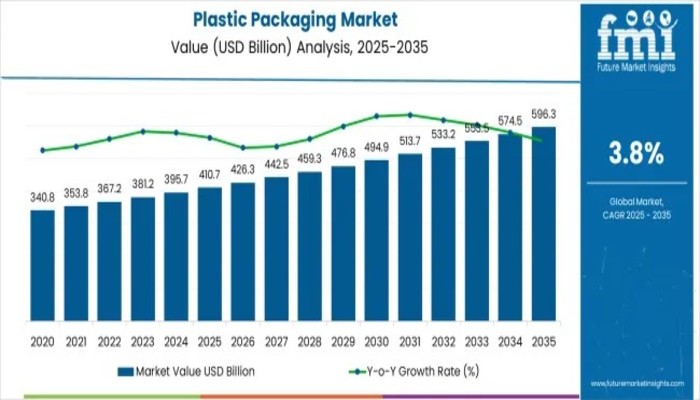
The global plastic packaging market stands at a critical intersection of growth, innovation, and sustainability. As industries worldwide move toward lighter, more durable, and highly functional packaging solutions, plastics continue to dominate due to their versatility and performance. The Plastic Packaging Market—valued at USD 410.7 billion in 2025—is projected to reach USD 596.3 billion by 2035, growing at a moderate CAGR of 3.8%.
Despite increasing environmental pressures, the sector remains resilient, driven by food, beverage, healthcare, e-commerce, and personal care demand. The period from 2025 to 2035 will mark a decade where the industry transitions from volume-driven growth to value-driven innovation.
Subscribe for Year-Round Insights → Stay ahead with quarterly and annual data updates – https://www.futuremarketinsights.com/reports/sample/rep-gb-22525
Meaning of the Plastic Packaging Market
The plastic packaging market encompasses all forms of rigid and flexible plastic-based packaging solutions used across industries to protect, store, transport, and present products. These include bottles, jars, trays, films, pouches, bags, drums, closures, wraps, and multilayer structures manufactured using technologies such as injection molding, blow molding, extrusion, and thermoforming. Beyond utility, modern plastic packaging is engineered to enhance shelf life, support branding, ensure safety, and optimize logistics.
Market Overview
The market’s growth curve between 2025 and 2035 reflects stability rather than volatility, with annual value additions tied closely to global consumption patterns. From 2025–2030, the market adds USD 85.6 billion, averaging USD 17 billion annually, supported predominantly by e-commerce expansion and food delivery ecosystems. The next five-year cycle (2030–2035) sees USD 100 billion in incremental value, driven by specialized barrier films, bio-based polymers, and recyclable mono-material structures.
A major structural shift is evident:
- Rigid plastics decline from 52% in 2025 to 48% in 2035, pressured by cost efficiencies and lightweighting trends.
- Flexible packaging grows by 7%, backed by demand for pouches, films, and multilayer laminates.
- Asia-Pacific contributes over 42% of incremental global growth, reflecting booming urban retail, rising packaged food consumption, and major manufacturing expansion.
Market Outlook (2025–2035)
The outlook for the plastic packaging industry remains strong, shaped by balancing sustainability goals with performance expectations. YoY growth stabilizes between 4.2% in 2025 and 3.2% by 2035, signaling market maturity. By 2030, technical innovation in recyclable structures, advanced coatings, and mono-material designs becomes the core differentiator for leading manufacturers.
Key outlook themes include:
- Greater adoption of bio-based and recyclable plastics
- Rapid shift toward lightweighting and downgauging
- Advanced barrier technologies for perishable goods
- Smart packaging integrations such as QR-enabled traceability
- Sustainability-linked procurement and closed-loop recycling systems
Growth Drivers of the Plastic Packaging Market
Several powerful drivers shape market expansion:
- Sustainability and Regulatory Push: Governments worldwide are tightening requirements around recyclability, labeling, traceability, and plastic waste management. Manufacturers are investing in recyclable PE and PET structures, biodegradable resins, and improved sorting technologies. Brands are increasingly opting for mono-material designs and refillable packaging systems.
- E-Commerce Boom: From 2022–2024 alone, e-commerce-related plastic packaging shipments rose by 18%, with polyfilm mailers and protective sleeves leading volume growth. Plastic packaging supports fulfillment speed, tamper resistance, durability, and lightweight logistics.
- Growth in Food, Beverage & FMCG Markets: Plastic packaging remains essential for preserving freshness, enhancing safety, and supporting portion-controlled consumption—especially in ready-to-eat and on-the-go formats.
- Innovation in Materials and Manufacturing: Advancements such as recycled-content resins, anti-counterfeit films, smart labels, and flexible formats have pushed the market toward high-value differentiation.
Demand Analysis
Demand trends show significant regional and sectoral variation:
- China leads with 5.1% CAGR, driven by multilayer pouches, laminated sachets, and upgraded molding lines.
- India and Southeast Asia continue to expand due to rising disposable incomes and fast-moving retail channels.
- Europe and North America show stable demand with strong focus on recyclable designs and circular economy models.
- Brazil and Latin America see moderate growth, supported by shrink films, personal care formats, and bio-based resin integration.
Globally, single-serve formats, protective e-commerce packaging, and smart labeling solutions continue to dominate unit volumes.
Key Market Trends
- Rise of Flexible Packaging: Lightweight, cost-effective, and versatile, flexible packaging gains prominence, especially in food, healthcare, and homecare segments.
- Shift to Mono-material Structures: This trend is driven by regulatory preferences for improved recyclability and reduced contamination.
- Integration of Digital Tracking Systems: RFID tags, QR codes, and serialized pouch systems enhance traceability, especially in China, Europe, and the UK.
- Material Substitution and Optimization: Manufacturers increasingly shift to PE, PP, and PET for recyclability and performance benefits.
- Technological Advancements: Automation, multi-cavity molding, and high-speed extrusion lines help reduce costs and increase precision.
Competitive Landscape
The plastic packaging market is highly competitive, featuring global giants and specialized solution providers:
- ALPLA, Amcor, Berry Global, and Mondi dominate with high-volume manufacturing and global supply chains.
- CCL Industries, ProAmpac, Constantia Flexibles excel in specialty films, labeling, and premium flexible formats.
- Graham Packaging, Huhtamaki, Sealed Air lead in protective and barrier packaging used for foodservice, pharma, and temperature-sensitive applications.
Key investments include mono-material lines, sustainable extrusion systems, advanced barrier films, and smart-label technologies. High capital requirements and complex integration systems raise entry barriers for newer players.
Why FMI: https://www.futuremarketinsights.com/why-fmi
About Future Market Insights (FMI)
Future Market Insights, Inc. (FMI) is an ESOMAR-certified, ISO 9001:2015 market research and consulting organization, trusted by Fortune 500 clients and global enterprises. With operations in the U.S., UK, India, and Dubai, FMI provides data-backed insights and strategic intelligence across 30+ industries and 1200 markets worldwide.
Contact Us:
Future Market Insights Inc.
Christiana Corporate, 200 Continental Drive,
Suite 401, Newark, Delaware – 19713, USA
T: +1-347-918-3531
For Sales Enquiries: sales@futuremarketinsights.com
Website: https://www.futuremarketinsights.com
LinkedIn| Twitter| Blogs | YouTube