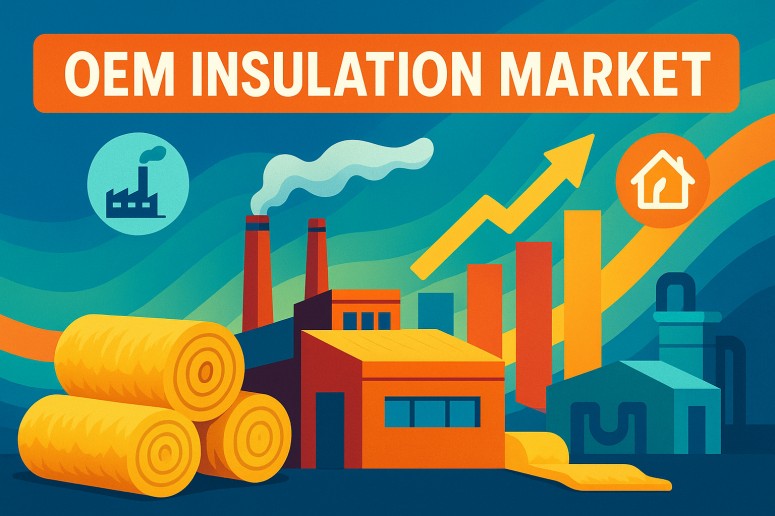
The global OEM insulation market is poised for strong expansion, climbing from USD 16.6 billion in 2025 to USD 25.3 billion by 2035, marking an absolute increase of USD 8.7 billion. Fueled by accelerating adoption of energy-efficient technologies, the market will grow at a steady CAGR of 4.3%, underscoring insulation’s central role in next-generation product design.
From high-performance HVAC systems and electric vehicles (EVs) to industrial refrigeration and consumer appliances, OEM insulation is fast becoming a cornerstone of manufacturing transformation—improving energy performance, reducing emissions, and elevating safety standards across global supply chains.
Efficiency, Electrification, and Performance Drive Demand
The market’s rapid ascent is tied to three converging factors shaping industrial evolution:
- Energy Efficiency Regulations – Global standards such as DOE, EcoDesign, and ENERGY STAR push manufacturers to adopt insulation materials that enhance thermal resistance by 20–30%, enabling compliance and product differentiation.
- Electrification and Vehicle Transformation – As EV production accelerates toward 25–30 million units annually by 2030, insulation becomes vital for battery thermal management, cabin noise reduction, and lightweighting initiatives that improve range and passenger comfort.
- Building Decarbonization – OEM insulation is increasingly integrated into prefabricated building modules and industrial components, enabling net-zero construction targets and boosting modular efficiency worldwide.
Together, these factors create unprecedented opportunities for insulation manufacturers and OEMs to deliver cost-effective, sustainable, and performance-driven solutions.
Glass Wool and Blanket Systems Lead Market Momentum
Among materials, glass wool maintains its position as the market leader, commanding approximately 22.0% of total share in 2025. Its widespread use across HVAC, appliance, and industrial applications stems from its thermal stability, acoustic absorption, and fire resistance, offering a balance of safety and cost-effectiveness that manufacturers demand.
By insulation type, blanket systems account for nearly 28.0% of total market share, underscoring their flexibility and compatibility with automated manufacturing lines. Automotive, HVAC, and appliance producers increasingly favor blanket insulation for complex geometries, reduced waste, and streamlined installation—critical advantages in mass production environments.
Automotive OEMs Set the Pace
The automotive industry dominates the OEM insulation market, capturing 26.0% of market share in 2025. As automakers transition toward electric mobility, the need for specialized insulation systems intensifies.
- Battery Thermal Management: Advanced fire-resistant barriers regulate battery temperatures and protect lithium-ion cells.
- Cabin Acoustics: Lightweight acoustic insulation ensures comfort in quieter EV powertrains.
- Underbody Protection: Heat shields safeguard components from exhaust temperatures and environmental exposure.
These insulation technologies not only improve safety but also enhance overall vehicle efficiency—key to achieving global sustainability and performance targets.
Regional Powerhouses Fuel Expansion
Asia Pacific Leads Global Growth
China and India stand at the forefront of OEM insulation market expansion.
- China—with a 5.9% CAGR—dominates through its vast HVAC and appliance manufacturing ecosystem, rising EV production, and efficiency standard upgrades.
- India, growing at 5.6% CAGR, is rapidly localizing appliance and automotive component production, supported by government incentive schemes and expanding industrial clusters.
North America and Europe: Technology and Standards
The United States (4.5% CAGR) continues to lead in advanced thermal management, vacuum insulation panels, and low-GWP foams, while Germany and the UK maintain industrial leadership in EV retooling, net-zero construction, and fire safety compliance.
Innovation Hubs in East Asia
South Korea and Japan drive material innovation, integrating aerogel composites and elastomeric foams into electronics, robotics, and high-end appliances—showcasing the shift toward compact, high-performance insulation systems.
Buy Now & Save: Premium Market Report at $5,000 | Discount Details Inside:- https://www.futuremarketinsights.com/reports/sample/rep-gb-2280
Strategic Collaboration Shapes the Future
The OEM insulation ecosystem thrives on collaboration across manufacturers, suppliers, and policymakers.
- OEMs are investing in integrated thermal systems that combine passive insulation with active cooling.
- Suppliers are localizing production in high-growth regions while advancing bio-based and recyclable materials to meet circular economy goals.
- Governments are enhancing efficiency standards, offering EV manufacturing incentives, and funding sustainable material innovation.
Together, these coordinated efforts are redefining the standards for performance, sustainability, and manufacturing efficiency worldwide.
Competitive Landscape: Innovation and Integration Define Leadership
The market features 25–35 key players, with Owens Corning, Saint-Gobain, and Rockwool Group leading through global manufacturing integration, advanced testing capabilities, and extensive OEM relationships.
Emerging challengers—Armacell, Kingspan Group, and Knauf Insulation—are expanding through specialized product lines and regional market strength, while conglomerates like BASF SE, 3M Company, and Johns Manville continue to refine niche technologies in elastomeric foams and polyurethane systems.
Competition increasingly centers on technical validation, fire safety certifications, and sustainability differentiation rather than price alone—reflecting the market’s evolution toward high-performance engineering partnerships.
A Strategic Market for the Next Industrial Era
As the OEM insulation market approaches USD 25.3 billion by 2035, it stands at the intersection of energy efficiency, electrification, and sustainability—three defining priorities for global manufacturing.
By enabling 20–40% efficiency gains, 10–25 decibel noise reductions, and enhanced fire safety compliance, OEM insulation is more than a material—it’s a strategic enabler of next-generation design, productivity, and environmental responsibility.
For manufacturers, suppliers, and investors alike, the coming decade represents not only a market opportunity but a mandate: to insulate the future of industry with smarter, safer, and more sustainable solutions.
Click Here to Purchase the Report:- https://www.futuremarketinsights.com/checkout/2280
About Future Market Insights (FMI)
Future Market Insights, Inc. (ESOMAR certified, recipient of the Stevie Award, and a member of the Greater New York Chamber of Commerce) offers profound insights into the driving factors that are boosting demand in the market. FMI stands as the leading global provider of market intelligence, advisory services, consulting, and events for the Packaging, Food and Beverage, Consumer Technology, Healthcare, Industrial, and Chemicals markets. With a vast team of over 400 analysts worldwide, FMI provides global, regional, and local expertise on diverse domains and industry trends across more than 110 countries.
Contact Us:
Future Market Insights Inc.
Christiana Corporate, 200 Continental Drive,
Suite 401, Newark, Delaware – 19713, USA
T: +1-347-918-3531
For Sales Enquiries: sales@futuremarketinsights.com
Website: https://www.futuremarketinsights.com
LinkedIn| Twitter| Blogs | YouTube