

The global spider silk fabric market is set for a transformative decade, growing from USD 74.1 million in 2025 to USD 158.5 million by 2035, at a compound annual growth rate (CAGR) of 7.9%, according to the latest market outlook. This steady rise reflects a shift from laboratory-scale production to commercial-scale applications, as biotechnology and textile industries converge to unlock the full potential of this remarkable material.
Once a scientific curiosity, lab-engineered spider silk has now entered the early stages of commercialization. Its exceptional combination of light weight, tensile strength, and elasticity makes it a prime candidate for next-generation textiles, defense gear, and medical materials. The coming decade will witness the transition of spider silk from prototype to product, marking a milestone for biofabrication and sustainable textile innovation.
Biotechnology Fuels a New Era of Fabric Engineering
The commercial appeal of spider silk lies in its superior mechanical performance and environmental sustainability. It is biodegradable, renewable, and offers strength comparable to Kevlar with a flexibility that synthetics like nylon cannot match. Yet the challenge remains in cost-effective and scalable production — a gap rapidly being addressed by synthetic biology and precision fermentation.
Key innovators such as Kraig Biocraft Laboratories, Bolt Threads, Spiber, and AMSilk are leading this charge by refining protein-engineering platforms capable of producing recombinant spider silk proteins at industrial scale. These firms are collaborating with global apparel giants and defense agencies to transform biotechnology breakthroughs into functional products.
For example, Spiber, headquartered in Japan, continues to expand its Brewed Protein™ platform in partnership with fashion brands like The North Face, producing bio-based fabrics that blend luxury aesthetics with performance durability. Meanwhile, Bolt Threads in the United States has advanced its proprietary Microsilk™ fiber, partnering with Stella McCartney and Adidas to pioneer sustainable fashion lines that highlight eco-conscious innovation.
Emerging players such as Biofabricate, Cambridge Bioworks, and Protein Evolution are entering the field with novel bio-reactor designs and scalable production workflows. These entrants are targeting niche markets in medical textiles and industrial applications, pushing the sector toward greater accessibility and diversity.
Synthetic Spider Silk Systems Dominate Market Share
Currently, synthetic spider silk systems command nearly 68% of total market share, driven by scalability and material consistency advantages. These engineered systems offer reliable production yields and uniform fiber quality, eliminating the constraints associated with natural spider silk harvesting. The balance between performance optimization and commercial viability has made synthetic spider silk the preferred solution for textile manufacturers pursuing high-performance fibers with sustainable sourcing credentials.
Natural spider silk, accounting for around 32% of the market, retains a strong presence in luxury and niche applications. Designers and high-end fashion brands continue to value its exclusivity and natural luster, ensuring its place in the premium textile segment even as synthetics dominate broader commercialization.
Regional Growth Patterns: Asia Pacific Leads the Charge
Regional market analysis shows Asia Pacific emerging as the epicenter of spider silk innovation. China, Japan, and South Korea are investing heavily in biotech-based textile manufacturing, integrating spider silk systems into national material innovation programs. China alone is projected to achieve a 10.7% CAGR, driven by government-backed biotechnology initiatives and expanding textile infrastructure. Japan’s focus on precision manufacturing and material consistency further supports the region’s dominance.
North America maintains steady growth, with biotech hubs in California, Massachusetts, and North Carolina leading pilot-to-commercial transitions. Collaboration between startups like Bolt Threads and defense institutions is unlocking new military-grade protective materials. Europe, particularly Germany and the United Kingdom, is also gaining traction, driven by stringent sustainability policies and the rising demand for biodegradable performance fabrics in the fashion and healthcare sectors.
In contrast, Latin America and the Middle East & Africa are growing at a slower pace, constrained by limited infrastructure and lower penetration of specialty textiles. However, expanding industrial bases and increased investment in biotech education are expected to gradually strengthen their position over time.
Purchase this Report for USD 5,000 Only | Get an Exclusive Discount Instantly! https://www.futuremarketinsights.com/checkout/27248
Everything You Need—within Your Budget. Request a Special Price Now! https://www.futuremarketinsights.com/reports/sample/rep-gb-27248
Applications Expand from Fashion to Aerospace
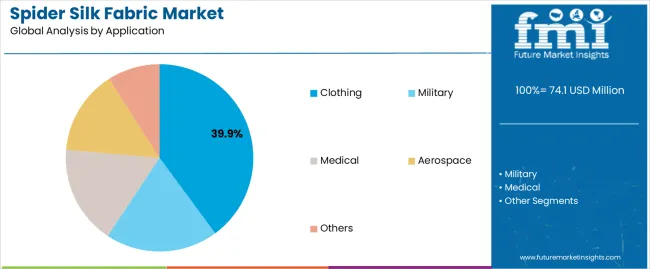
Clothing remains the largest application segment, accounting for nearly 40% of market demand, propelled by the performance apparel boom and sustainability-oriented fashion movements. The military and defense sector, contributing around 22% of revenues, continues to adopt spider silk-based materials for ballistic protection and lightweight gear. Medical applications—including surgical sutures, tissue scaffolds, and implantable meshes—represent one of the fastest-growing categories due to the material’s biocompatibility and non-toxic profile.
Beyond these, the aerospace sector is exploring spider silk for lightweight composites and protective coatings, offering both strength and elasticity essential for extreme environments. These specialized applications highlight the material’s growing footprint across industries traditionally dominated by synthetics and metals.
Market Challenges and the Road to Scalability
Despite its promise, the path to widespread commercialization is not without obstacles. The production of spider silk proteins through fermentation systems remains resource-intensive, relying on agricultural feedstocks such as soy or palm derivatives. Volatility in feedstock prices, coupled with high energy demands for fermentation and purification, adds cost pressure.
To overcome these challenges, manufacturers are investing in bio-reactor optimization, feedstock diversification, and process automation. These innovations aim to cut production costs while improving consistency — essential factors for scaling from boutique fashion to mainstream industrial adoption.
The integration of smart manufacturing systems, real-time material tracking, and quality-by-design frameworks is expected to further enhance production reliability. By aligning biotechnology with digital manufacturing, companies are preparing for the next phase of industrial-scale deployment.
About Future Market Insights (FMI)
Future Market Insights, Inc. (ESOMAR certified, recipient of the Stevie Award, and a member of the Greater New York Chamber of Commerce) offers profound insights into the driving factors that are boosting demand in the market. FMI stands as the leading global provider of market intelligence, advisory services, consulting, and events for the Packaging, Food and Beverage, Consumer Technology, Healthcare, Industrial, and Chemicals markets. With a vast team of over 400 analysts worldwide, FMI provides global, regional, and local expertise on diverse domains and industry trends across more than 110 countries.
Contact Us:
Future Market Insights Inc.
Christiana Corporate, 200 Continental Drive,
Suite 401, Newark, Delaware – 19713, USA
T: +1-347-918-3531
For Sales Enquiries: sales@futuremarketinsights.com
Website: https://www.futuremarketinsights.com
LinkedIn| Twitter| Blogs | YouTube




