

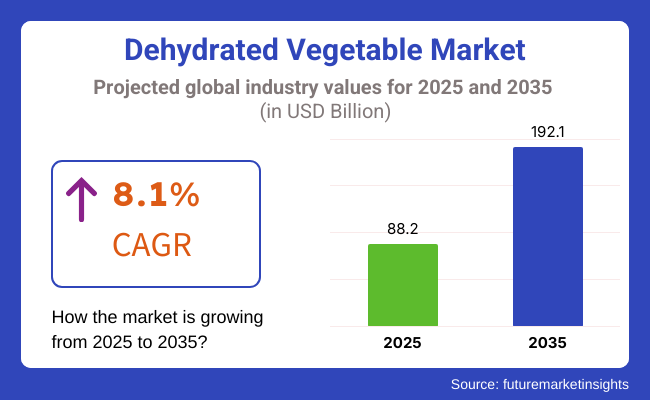
 The global dehydrated vegetable market is on a strong growth trajectory, expected to more than double from USD 88.2 billion in 2025 to USD 192.1 billion by 2035, registering a CAGR of 8.1%. This surge is fueled by increasing urbanization, the demand for convenient, shelf-stable food options, and growing health-consciousness worldwide. Innovations in drying technologies and the expansion of e-commerce channels are also transforming accessibility and appeal for consumers and food manufacturers alike.
Gain Valuable Market Knowledge: Request a Sample Report: https://www.futuremarketinsights.com/reports/sample/rep-gb-4161
Key Industry Highlights:
Strong Market Growth: The market is projected to grow at a CAGR of 8.1% from 2025 to 2035, fueled by rising demand for long-lasting, nutritious food ingredients.
Changing Lifestyles: Urbanization and busy consumer schedules are increasing reliance on ready-to-eat and easy-to-prepare foods, with dehydrated vegetables offering both convenience and nutritional retention.
Technological Innovation: Advancements such as freeze drying and vacuum drying are enhancing taste, appearance, and nutrient profiles, making dehydrated vegetables more attractive to health-conscious demographics.
E-commerce Expansion: Online platforms are playing a vital role in product distribution, offering subscription models, diverse packaging, and premium options for a growing base of digital shoppers.
Interest in Market Trends: Get Detailed Analysis and Insights with Our Comprehensive Report: https://www.futuremarketinsights.com/reports/dehydrated-vegetables-market
Collaboration Between Small Market Players to Strengthen Product Portfolio:
The global dehydrated vegetable market is seeing a wave of strategic partnerships, particularly among small to mid-sized players aiming to expand their reach and diversify product offerings. These collaborations often involve the co-development of clean-label, organic, and exotic vegetable blends that meet evolving consumer expectations. By pooling technological resources and distribution networks, smaller companies are positioning themselves competitively in a market increasingly driven by innovation, health trends, and transparency. Joint ventures with freeze-drying specialists and regional organic farms are becoming commonplace, especially in Europe and North America.
Market Concentration:
While the market features a robust mix of multinational and regional players, it remains moderately fragmented. Key global firms continue to lead in scale and R&D investment, particularly in North America and Asia, but are now being challenged by emerging brands that offer differentiated value propositions such as local sourcing, sustainability, and artisanal quality. Market concentration is highest in the U.S., where established brands dominate foodservice and retail channels. However, in Europe and Asia-Pacific, smaller firms with unique positioning are steadily gaining market share through targeted innovation and localized offerings.
Country-wise Insights:
United States (CAGR: 7.4%): The U.S. leads the global market with a strong preference for plant-based, convenient food ingredients. Dehydrated onions, carrots, and potatoes dominate applications in home meal kits and sauces. Organic and non-GMO variants are gaining popularity, supported by growing e-commerce and retail diversification.
United Kingdom (CAGR: 8.3%): The UK is set to register the fastest growth, driven by rising plant-based diets and urban convenience. Freeze-dried snacks, powdered blends, and meal kits are growing in popularity, especially among millennials seeking clean-label and traceable products.
Germany (CAGR: 7.1%): With a focus on sustainability and health, Germany is a leader in organic dehydrated vegetable consumption. Products are often used in vegan sauces and protein mixes, with retailers emphasizing eco-friendly packaging and certified organic sourcing.
France (CAGR: 6.8%): French consumers are blending traditional cooking with modern convenience, favoring dehydrated ingredients in gourmet blends and soups. Growth is propelled by demand for organic, easy-to-store vegetables, especially among aging and urban populations.
Japan (CAGR: 6.5%): In Japan, innovation and space-saving convenience are key. Dehydrated vegetables are commonly used in instant meals and elderly nutrition, with a strong emphasis on flavor and portion control. E-commerce and convenience stores dominate distribution.
Competition Outlook:
The competitive landscape is evolving rapidly, with companies racing to align with consumer demand for health, sustainability, and taste. Market leaders are investing in advanced drying technologies, robust supply chains, and eco-conscious packaging. Meanwhile, emerging players are capitalizing on niche segments—such as vegan, gluten-free, or superfood-enhanced vegetable powders—to carve out a loyal customer base.
Leading Dehydrated Vegetable Brands
- Fresno Cooperative Raisin Growers Inc.
- Olam International
- Dole Food Company
- Naturex S.A.
- Symrise AG
- Mercer Foods, LLC
- Chengde Shenli Food Co., Ltd.
- Vkc Nuts Private Limited
- Viva Bella Orchards Inc.
- Kiantama
- Sun-maid Growers of California
- Sunshine Raisin Corporation
- Traina Dried Vegetable Inc.
- Lion Raisins Inc.
- Others
 Explore Fruits and Vegetables Industry Analysis: https://www.futuremarketinsights.com/industry-analysis/fruits-and-vegetables
Key Segments of the Report
By Product Type:
This segment is further categorized into Carrot, Onions, Potatoes, Broccoli, Beans, Peas, Cabbage, Mushrooms and Tomatoes.
By Form:
This segment is further categorized into Minced & Chopped, Powder & Granules, Flakes, Slice & Cubes and Others.
By End Use:
This segment is further categorized into Food Manufacturers, Foodservice and Retail.
By Drying Method:
This segment is further categorized into Air Drying, Spray Drying, Freeze Drying, Drum Drying, and Vacuum Drying.
By Distribution Channel:
This segment is further categorized into Store-based retailing, Hypermarkets/ Supermarkets, Convenience Stores, Food and Drink Specialty Stores and Online retail.
By Region:
Industry analysis has been carried out in key countries of North America, Latin America, Eastern Europe, Western Europe, East Asia, South Asia & Pacific, Central Asia, Balkan and Baltic Countries, Russia & Belarus and the Middle East & Africa.




