


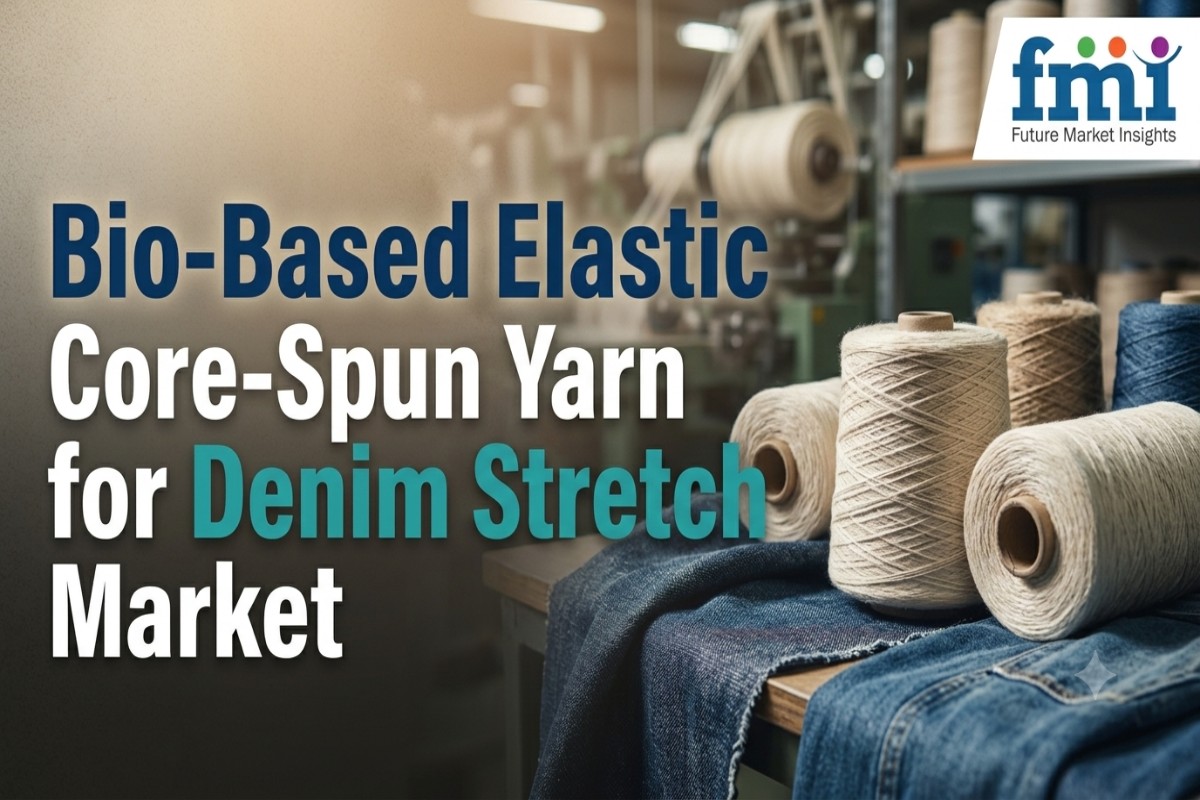
The global bio-based elastic core-spun yarn for denim stretch market is estimated to reach USD 191.0 million in 2026, compared with USD 165.0 million in 2025, according to Future Market Insights (FMI). The market is projected to reach USD 828.2 million by 2036, expanding at a compound annual growth rate (CAGR) of 15.8% between 2026 and 2036. This represents an incremental revenue opportunity of USD 637.2 million over the forecast period. Increasing interest in renewable elastic materials, lower-carbon denim production, and recyclable textile constructions is influencing material selection across denim manufacturing and sourcing operations.
Market Background: Renewable Elastic Materials Reshape Denim Production
Bio-based elastic core-spun yarn combines a stretchy, bio-based or partly bio-based elastic core with an outer sheath of staple fibers, allowing denim manufacturers to produce stretch fabrics while retaining traditional denim characteristics. Apparel brands are increasingly asking mills to explore renewable elastic materials as part of their lower-carbon sourcing targets.
Bio-based elastane is expected to account for 44.0% of the market in 2026, supported by its compatibility with existing mill equipment. Hybrid elastomer cores and PTT elastomer cores are projected to grow at CAGRs of 18.6% and 17.4%, respectively, through 2036. These rates exceed the overall market growth forecast.
However, processing compatibility remains an important challenge. New bio-based cores may respond differently to conventional thermal settings, requiring mills to recalibrate heat-setting conditions. Filament breakage, reduced production speeds, and inconsistent elasticity can increase operating costs. Manufacturers must therefore balance material innovation with production efficiency and fabric performance.
Segment and Regional Analysis: Cotton Sheaths and Direct Mill Supply Lead
FMI’s analysis identifies several important product and commercial segments:
- Core material: Bio-based elastane is projected to hold a 44.0% market share in 2026, although its share is expected to moderate to 42.1% by 2036.
- Sheath fiber: Cotton is expected to account for 52.0% of market revenue in 2026. Its abrasion resistance and ability to withstand stone washing, bleaching, and laser finishing support its position.
- Stretch level: Comfort stretch is projected to represent 41.0% of the market in 2026, reflecting demand for controlled elasticity and reduced processing risks.
- Yarn count: Fine-denier yarns are expected to hold a 37.0% share in 2026, supported by demand for lighter denim fabrics and improved drape.
- End use: Women’s denim is projected to account for 38.0% of market revenue in 2026, as brands review conventional spandex usage in stretch apparel.
- Distribution channel: Direct supply to denim mills is expected to hold a 56.0% share in 2026, while brand-nominated supply programs are projected to grow at a 17.3% CAGR.
Regionally, Turkey represents the largest country market, with a 12.0% share in 2026, followed by the United States at 9.0% and Italy at 7.0%.
Italy is projected to record the fastest country-level growth at 17.3% CAGR through 2036. India follows at 16.8%, Japan at 16.4%, and Turkey at 16.0%. China is expected to grow at 15.6%, while the United States and Brazil are forecast to record CAGRs of 14.9% and 14.5%, respectively.
Italy’s premium denim manufacturing base and Turkey’s established supply links with European fashion brands support their market positions. Meanwhile, India’s textile production network and Japan’s technical expertise in premium denim yarn manufacturing provide additional growth opportunities.
Get detailed market forecasts, competitive benchmarking, and industry insights: https://www.futuremarketinsights.com/reports/sample/rep-gb-32498
Executive Perspective: Performance and Compliance Will Shape Procurement
Nikhil Kaitwade, Principal Consultant at Future Market Insights, commented:
“Revenue will climb faster than tonnage in bio-based stretch yarn, because brands accept higher prices for plant-derived cores that lower the carbon footprint of jeans. The risk sits in Italy, where producer fees required by EU textile waste rules in force since October 2025 are to reflect recyclability, which could penalize elastic blends.”
This outlook highlights an important consideration for denim manufacturers and procurement executives. Material substitution must deliver measurable performance alongside renewable content. Suppliers need to demonstrate elongation, recovery, wash resistance, and consistent dye-lot quality before securing long-term brand programs. The ability to meet these requirements can influence supplier qualification and future sourcing agreements.
Future Outlook: Technical Qualification and Supply Readiness Matter
FMI expects the market to generate USD 637.2 million in additional revenue between 2026 and 2036. Opportunities include closed-loop material tracing contracts, low-heat polymer engineering, and hybrid bio-synthetic blending.
Manufacturers developing polymers that withstand conventional denim processing temperatures could reduce the need for extensive machine recalibration. Similarly, suppliers offering traceable biological feedstocks can support brands seeking verified material origins.
The research covers core material, stretch level, sheath fiber, yarn count, end use, and regional performance across North America, Latin America, Europe, East Asia, South Asia and Pacific, and the Middle East and Africa. FMI’s forecasting approach incorporates mill-level yarn off-take volumes for certified sustainable denim programs, supported by primary research and a proprietary forecasting model.
Competitive Landscape: Leading Companies Focus on Material Innovation
The competitive environment includes polymer developers and denim manufacturers working to improve bio-based yarn performance and production consistency. Key companies profiled in the report include:
- The LYCRA Company
- Hyosung TNC
- Asahi Kasei
- Candiani Denim
- Advance Denim
- Kaihara Denim
Competitive positioning depends on polymer development, processing stability, dye compatibility, and repeated laundering performance. Denim mills also need reliable access to qualified materials and consistent yarn recovery across production batches.
Explore More Related Studies Published by FMI Research:
https://www.openpr.com/news/4692946/humidity-responsive-polymers-market-to-reach-usd-1-2-billion
https://www.openpr.com/news/4692949/fipronil-pyrazole-market-to-reach-usd-495-1-million-by-2036-as
https://www.openpr.com/news/4692954/organosilicon-polymers-market-to-reach-usd-35-9-billion-by-2036
https://www.openpr.com/news/4692957/aromatic-polyesters-market-to-reach-usd-110-4-billion-by-2036
About Future Market Insights
Future Market Insights (FMI) is an ESOMAR-certified market research and consulting firm providing syndicated, customized, investment, and social media research across industries, including food and beverage, healthcare, chemicals, technology, and consumer markets. FMI delivers market intelligence, competitive analysis, and strategic insights to help organizations evaluate emerging opportunities and make informed business decisions. The company has offices in the United States, the United Kingdom, the UAE, and India.
For Press & Corporate Inquiries
Rahul Singh
AVP – Marketing and Growth Strategy
Future Market Insights, Inc.
For Sales: sales@futuremarketinsights.com
For Media: Rahul.singh@futuremarketinsights.com
Website: https://www.futuremarketinsights.com/