

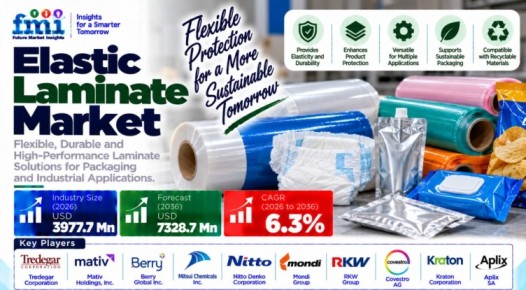
According to the latest market intelligence report published by Future Market Insights (FMI), the global elastic laminate market is projected to grow from USD 3,977.7 million in 2026 to USD 7,328.7 million by 2036, registering a compound annual growth rate (CAGR) of 6.3% during the forecast period. Expanding demand for disposable hygiene products, increasing emphasis on wearer comfort, and broader use of elastic materials in medical applications are expected to support market development.
Market Size & Growth Forecasts
- 2025 Baseline Value: Not specified in the published market summary.
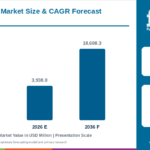
- 2026 Estimated Market Size: USD 3,977.7 million.
- 2036 Projected Value: USD 7,328.7 million.
- Growth Rate: 6.3% CAGR (2026–2036).
- Incremental Growth Opportunity: USD 3,351.0 million over the forecast period, equivalent to approximately 1.84 times the 2026 market value.
Elastic laminates combine elastic and supporting materials to deliver stretch, recovery, flexibility, and comfort. These properties make them important components in disposable diapers, adult incontinence products, feminine hygiene products, and selected medical and apparel applications.
>> Get Detailed Market Forecasts, Competitive Benchmarking, and Pricing Trends: https://www.futuremarketinsights.com/reports/sample/rep-gb-5722
Key Market Segments
By Material Type
- Polyethylene-based elastic laminates: Expected to account for 52.0% of material-type demand in 2026, supported by cost efficiency, stretch recovery, consistent bonding performance, and compatibility with high-speed hygiene-product manufacturing.
- Polypropylene-based laminates: Serve applications requiring specific combinations of flexibility, strength, and processing performance.
- Polyurethane-based and polyester-based laminates: Support specialized applications where elasticity, material strength, or other performance characteristics are important.
By Application
- Hygiene products: Projected to account for 67.0% of application demand in 2026, reflecting widespread use in baby diapers, adult incontinence products, and feminine care products.
- Medical applications: Provide additional opportunities through protective wear and patient-care products that require flexibility and comfortable fit.
- Apparel and industrial applications: Represent further areas of use for materials offering stretchability and durability.
Demand within hygiene applications is closely connected to manufacturers’ requirements for reliable fit, softness, breathability, and leakage control. Suppliers must also deliver consistent material quality and compatibility with established converting and lamination processes.
By Country / Region
- China: Expected to record a 7.2% CAGR through 2036, driven by large-scale hygiene-product manufacturing and growing adoption of disposable diapers and adult incontinence products.
- India: Projected to expand at a 7.0% CAGR, supported by rising hygiene awareness, increasing disposable diaper usage, and demand for affordable personal-care products.
- United States: Forecast to grow at a 6.8% CAGR, reflecting demand for premium hygiene products, adult incontinence solutions, and medical applications.
- Germany: Expected to register a 6.1% CAGR, supported by demand for consistent material performance in hygiene and healthcare products.
- Japan: Projected to record a 5.7% CAGR, with premium hygiene standards and elderly-care requirements contributing to demand.
The country outlook highlights the importance of hygiene-product manufacturing capacity, demographic needs, and material-performance requirements in shaping market growth.
Major Market Trends & Drivers
- Growing demand for disposable hygiene products: Baby diapers, adult incontinence products, and feminine care products remain important consumers of elastic laminates because fit, comfort, and leakage protection are central to product performance.
- Focus on comfort and breathability: Manufacturers are seeking softer, breathable materials with dependable elastic recovery to improve the experience of end users.
- Expansion of medical disposable applications: Protective wear and patient-care products offer additional opportunities for flexible materials that support fit and mobility.
- Cost and manufacturing efficiency: Polymer-price fluctuations and the technical demands of lamination create pressure to optimize material usage, bonding consistency, and high-volume production performance.
>> Access Detailed Market Insights: https://www.futuremarketinsights.com/reports/elastic-laminates-market
Competitive Landscape
Competition is shaped by polymer expertise, elastic-film technology, product consistency, and the ability to supply high-volume hygiene manufacturers. Companies are positioning their portfolios around stretch performance, softness, breathability, and compatibility with customers’ converting operations. The published report identifies the following key companies:
- Tredegar Corporation
- Mativ Holdings, Inc.
- Berry Global Inc.
- Mitsui Chemicals Inc.
- Nitto Denko Corporation
- Mondi Group
- RKW Group
- Covestro AG
- Kraton Corporation
- Aplix SA
Analyst Perspective / Insight
“The elastic laminate market is likely to move toward materials that combine stretch recovery with comfort and converting efficiency. Suppliers with stronger polyethylene laminate platforms and hygiene product integration support are expected to gain advantage as manufacturers prioritize fit, softness and production scale.”
MEDIA CONTACT
Contact Person: Media Relations Team
Designation: Corporate Communications
Email: sales@futuremarketinsights.com
Phone: +1-347-918-3531
Website: https://www.futuremarketinsights.com/
ABOUT FUTURE MARKET INSIGHTS
Future Market Insights, Inc. (FMI) is an ESOMAR-certified market research and consulting firm headquartered in Delaware, USA, with offices in the United Kingdom, the United Arab Emirates, and India. FMI delivers syndicated and custom research across food and beverage, healthcare, chemicals, technology, packaging, consumer goods, and industrial sectors. Its research helps organizations assess market opportunities, understand industry developments, and make informed strategic decisions.